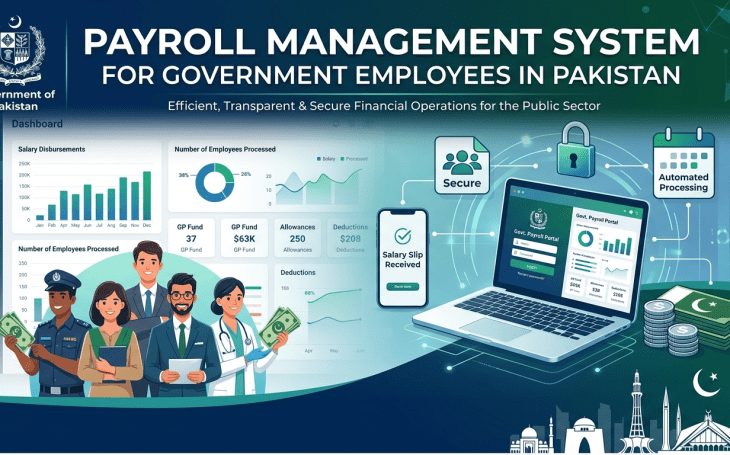
What is a Payroll Management System for Government Employees?

A payroll management system for government employees in Pakistan is a digital solution that automates salary processing, tax deductions, allowances, pensions, and compliance reporting in accordance with public-sector rules. It ensures accurate, transparent, and audit-ready payroll aligned with government regulations and FBR requirements.

Why Government Payroll in Pakistan Needs Automation

Government payroll is far more complex than private sector payroll.

It includes:

  • Basic pay scales (BPS)
  • Multiple allowances (housing, medical, travel)
  • Pension contributions
  • Tax deductions
  • Compliance reporting

Manual systems or outdated software create:

  • Salary delays
  • Calculation errors
  • Audit risks
  • Lack of transparency

A modern payroll management system eliminates these issues.

Key Challenges in Government Payroll Systems

1. Complex Salary Structures (BPS System)

Government employees follow structured pay scales. Managing increments, promotions, and revisions manually is difficult.

2. Multiple Allowances & Deductions

Payroll must include:

  • House rent allowance
  • Medical allowance
  • Conveyance allowance
  • Pension deductions

Errors in these calculations can lead to compliance issues.

3. Strict Compliance Requirements

Government organizations must follow:

  • Tax laws (FBR)
  • Audit regulations
  • Public finance rules

4. Large Workforce Management

Government departments often manage thousands of employees, making manual systems inefficient.

How a Payroll Management System Solves These Problems

✔ Automated Salary Calculations

Handles:

  • BPS structures
  • Allowances
  • Deductions
  • Annual increments

FBR Tax Integration

Automatically applies updated tax slabs and ensures compliance with the Federal Board of Revenue (FBR).

HR software that integrates with FBR Pakistan

 Pension & Retirement Management

Tracks:

  • Pension contributions
  • Retirement benefits
  • Service history

Audit-Ready Reporting

Generates:

  • Payroll summaries
  • Tax reports
  • Compliance documents

Centralized Employee Database

Stores all employee records securely in one system.

Employee database management software

Must-Have Features in Government Payroll Software

1. BPS (Basic Pay Scale) Automation

System should support:

  • Grade-based salaries
  • Step increments
  • Policy updates

2. Allowance Configuration

Flexible setup for:

  • Fixed allowances
  • Variable benefits
  • Department-specific rules

3. Multi-Department Management

Support for:

  • Ministries
  • Departments
  • Regional offices

4. Compliance Automation

Ensure alignment with:

  • FBR tax rules
  • Government audit standards
  • Labor regulations

5. Secure Access Control

Role-based permissions for:

  • HR
  • Finance
  • Auditors

Information Gain: 2026 Government Payroll Trends in Pakistan

Digital Transformation in Public Sector

Government institutions are shifting from manual systems to digital platforms for transparency and efficiency.

Increased Audit Scrutiny

Audit departments are demanding:

  • Real-time reports
  • Error-free records
  • Digital audit trails

Integration with National Systems

Future payroll systems may connect with:

  • Tax portals
  • Pension databases
  • National identity systems

Cloud vs On-Premise Payroll for Government

FeatureCloud PayrollOn-Premise System
Setup TimeFastSlow
MaintenanceLowHigh
AccessibilityRemoteLimited
Security UpdatesAutomaticManual
CostScalableHigh upfront

Cloud-based systems are becoming the preferred choice for modern government organizations.

Who Needs a Government Payroll System?

Federal Departments

  • Large workforce
  • Complex compliance

Provincial Governments

  • Region-specific policies
  • Multi-department structures

Public Sector Organizations

  • Regulatory compliance
  • Audit requirements

Autonomous Bodies

  • Hybrid payroll structures
  • Need flexible systems

HRMS for Government Organizations in Pakistan

Step-by-Step: How to Implement Payroll Software in the Government Sector

Step 1: Assess Current Payroll System

Identify:

  • Manual processes
  • Error-prone areas
  • Compliance gaps

Step 2: Choose Government-Focused Software

Ensure support for:

  • BPS system
  • Allowances
  • Pension management

Step 3: Digitize Employee Records

Convert:

  • Employee data
  • Salary history
  • Service records

Step 4: Configure Payroll Rules

Set up:

  • Salary structures
  • Allowances
  • Tax rules

Step 5: Train HR & Finance Teams

Ensure proper usage and adoption.

Step 6: Monitor & Optimize

Regularly review reports and improve processes.

Benefits of Payroll Automation for Government Employees

  • Accurate salary payments
  • Timely disbursement
  • Transparent payroll process
  • Reduced administrative workload
  • Improved audit readiness

Conversion Insight: Why Modern Payroll Systems Matter

Government organizations using outdated payroll systems face:

  • Delays
  • Errors
  • Compliance risks

Modern payroll systems provide:

  • Automation
  • Accuracy
  • Transparency

They transform payroll from a burden into a strategic advantage.

Conclusion: The Future of Government Payroll in Pakistan

Payroll management in the public sector is evolving.

With increasing compliance requirements and digital transformation, automation is no longer optional.

A payroll management system ensures:

  • Accuracy
  • Transparency
  • Compliance

Government organizations that adopt early will lead in efficiency and accountability.