


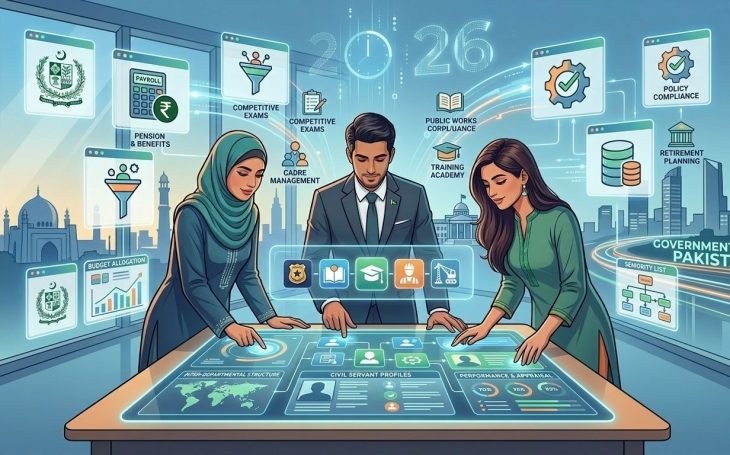
Government organizations in Pakistan manage thousands of employees across multiple departments, offices, and locations. Handling such a large workforce using manual systems or spreadsheets can be slow and inefficient.
Many public sector organizations still rely on paperwork for attendance, payroll processing, employee records, and leave approvals. These outdated processes create delays, reduce transparency, and increase administrative workload.
This is why many government departments in Pakistan are now exploring HRMS to modernize their human resource management.
A Human Resource Management System (HRMS) helps public institutions automate HR processes, improve data accuracy, and strengthen compliance with government policies.
In this guide, we will explain how HRMS works for government organizations, what features are most important, and how public institutions in Pakistan can benefit from digital HR transformation.

An HRMS (Human Resource Management System) is a digital platform that helps organizations manage their workforce efficiently.
For government departments, an HRMS centralizes employee information and automates key HR functions such as:
Instead of maintaining multiple paper files or disconnected systems, HRMS provides a single digital platform for managing all HR operations.
This improves transparency, reduces errors, and speeds up administrative processes.

Government institutions often manage very large workforces. Ministries, departments, universities, hospitals, and public sector companies may employ hundreds or even thousands of staff members.
Manual HR processes create several challenges.
Public sector HR departments must manage a wide range of employees, including:
Tracking all employee data manually becomes difficult as organizations grow.
Government payroll systems often involve complex salary structures that include:
Without automated systems, payroll preparation can take several days.
In many public organizations, employee data is stored in multiple locations or files.
This makes it difficult to access information quickly or generate accurate HR reports.
Manual processes can reduce visibility into attendance records, leave balances, and payroll calculations.
Digital HR systems improve transparency for both employees and administrators.
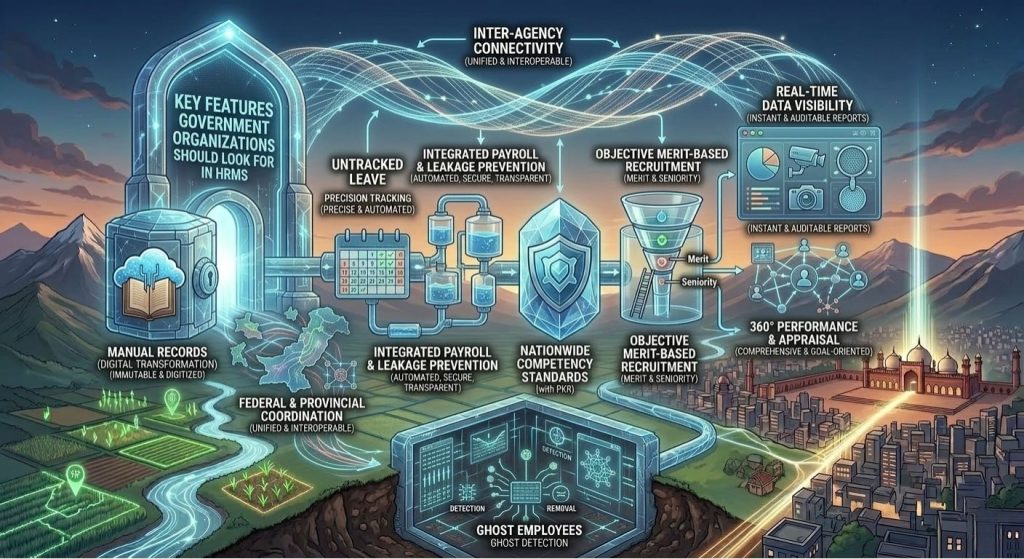
Not all HR systems are designed to support the needs of public sector organizations. When selecting an HRMS, government departments should focus on features that support large-scale workforce management.
An HRMS stores all employee information in a single secure system.
This includes:
Having a centralized database helps HR teams access employee records instantly.
Government institutions must maintain accurate attendance records.
HRMS systems allow organizations to track:
These systems can also integrate with biometric attendance devices used in many public offices.
Payroll automation is one of the most valuable features of HR software.
An HRMS can automatically calculate:
Automated payroll reduces human errors and ensures employees receive accurate salaries on time.
Managing employee leave requests manually can be time-consuming.
HRMS allows employees to:
This reduces paperwork and speeds up the approval process.
Government departments regularly hire staff for new projects and vacancies.
An HRMS helps streamline recruitment by allowing HR teams to:
This improves the efficiency of hiring processes.
Implementing HRMS provides several advantages for government institutions in Pakistan.
Automation reduces the time required to perform routine HR tasks such as attendance tracking and payroll processing.
HR teams can focus more on workforce planning and employee development.
Digital HR systems reduce the risk of human errors in payroll calculations and employee records.
Accurate data improves decision-making and reporting.
HRMS provides clear records of employee attendance, salary payments, and leave requests.
This improves accountability and trust within government organizations.
Government organizations must follow strict regulatory and administrative policies.
An HRMS helps maintain compliance by keeping accurate records and generating reports when needed.
Public sector institutions often need detailed HR reports for audits and management reviews.
HRMS systems can generate reports instantly, saving time and effort.
While HRMS offers many advantages, public-sector organizations may face challenges during implementation.
Employees accustomed to manual systems may initially resist new technology.
Proper training and awareness programs can help overcome this challenge.
Transferring employee data from paper records or spreadsheets to a digital system requires careful planning.
Organizations must ensure data accuracy during this process.
Government institutions may already use other software systems such as finance or ERP systems.
The HRMS should integrate smoothly with these platforms.
Many organizations are moving toward cloud-based HR systems for their flexibility and scalability.
Cloud HRMS allows government departments to:
This approach supports the broader goal of digital transformation in the public sector.

Selecting the right HRMS provider is critical for successful implementation.
Government organizations should consider the following factors:
The system must support Pakistani payroll rules and HR policies.
Government data must be protected with strong security measures and access controls.
The system should be able to handle thousands of employees without performance issues.
Reliable technical support ensures smooth implementation and long-term system performance.
Modern HR platforms like PayPeople help organizations automate HR operations through a centralized digital system.
PayPeople offers features designed to support organizations with large workforces, including:
With a cloud-based infrastructure and local HR compliance support, PayPeople helps organizations simplify HR operations and improve workforce management.
Governments worldwide are adopting digital technologies to improve administrative efficiency.
In Pakistan, HRMS adoption is expected to increase as public institutions modernize their operations.
Future HR systems will include:
Government organizations that adopt HR technology early will be better prepared for the evolving demands of modern public administration.
Managing large workforces manually is becoming increasingly difficult for government organizations in Pakistan.
HRMS solutions provide a centralized platform for managing employee data, payroll, attendance, and recruitment processes efficiently.
By implementing a modern HRMS, public sector organizations can improve transparency, reduce administrative workload, and support digital transformation initiatives.
As government institutions continue to modernize, HR technology will play a crucial role in improving operational efficiency and workforce management.