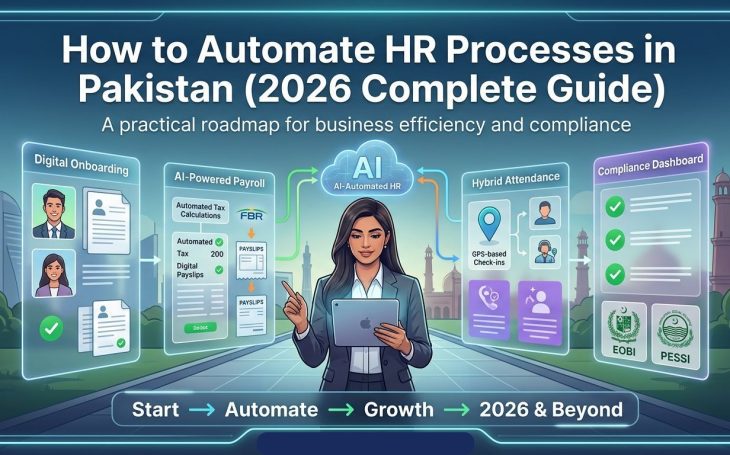
How to Automate HR Processes in Pakistan (2026 Complete Guide)
Why HR Automation is No Longer Optional
Businesses in Pakistan are evolving fast. As teams grow, manual HR processes become slow, error-prone, and expensive.
Tasks like payroll, attendance tracking, recruitment, and compliance require accuracy and speed. Relying on spreadsheets or disconnected systems creates inefficiencies that impact business performance.
This is where HR automation comes in.
Automating HR processes allows companies to reduce manual workload, improve compliance, and make faster decisions. Whether you run a startup, SME, or enterprise, automation is now a necessity—not a luxury.
What is HR Process Automation?
HR process automation refers to using software to handle repetitive HR tasks with minimal human intervention.
Instead of manually managing employee data, payroll, or leave records, businesses use HR software solutions to streamline operations.
Automation ensures accuracy, saves time, and improves employee experience.
Why Pakistani Businesses Need HR Automation
1. Compliance with Local Regulations
Managing compliance with tax laws, EOBI, and social security can be complex. Automation ensures calculations are accurate and reports are generated on time.
2. Time-Saving and Efficiency
Manual HR tasks consume hours every month. Automation reduces processing time from days to minutes.
3. Reduced Human Errors
Payroll mistakes, attendance miscalculations, and incorrect records can lead to serious issues. Automated systems minimize these risks.
4. Scalability
As your workforce grows, automation helps you manage hundreds or thousands of employees without increasing HR workload.
Which HR Processes Should You Automate First?
If you’re starting your automation journey, prioritize these areas:
1. Payroll Management
Payroll is one of the most critical HR functions. Automation helps:
Calculate salaries accurately
Deduct taxes automatically
Generate payslips instantly
Ensure compliance with Pakistani regulations
2. Attendance & Time Tracking
Automating attendance allows:
Real-time tracking
Integration with biometric devices
Accurate overtime calculation
Reduced time theft
3. Leave Management
An automated leave system enables:
Easy leave requests
Manager approvals
Leave balance tracking
Policy enforcement
4. Recruitment & Applicant Tracking
Automation improves hiring by:
Screening CVs faster
Managing candidate pipelines
Scheduling interviews
Reducing hiring time
5. Employee Database Management
A centralized system helps:
Store employee records securely
Access data instantly
Maintain accurate history
Improve reporting
Step-by-Step: How to Automate HR Processes in Pakistan
Step 1: Identify Pain Points
Start by analyzing your current HR challenges:
Are payroll errors common?
Is attendance tracking inaccurate?
Are HR tasks taking too long?
This helps you prioritize automation.
Step 2: Choose the Right HR Software
Look for features such as:
Cloud-based access
Local compliance support (FBR, EOBI)
Payroll automation
Attendance integration
Employee self-service
Step 3: Digitize Employee Data
Before automation, convert all manual records into digital format:
Employee profiles
Salary structures
Attendance records
Leave balances
This ensures a smooth transition.
Step 4: Automate Core Workflows
Start with key workflows:
Payroll processing
Leave approvals
Attendance tracking
Employee onboarding
Gradually expand to advanced automation.
Step 5: Train Your HR Team
Even the best software fails without proper usage. Train your HR team to:
Use dashboards
Generate reports
Handle compliance features
Step 6: Monitor & Optimize
Automation is not a one-time setup. Continuously:
Review reports
Identify inefficiencies
Optimize workflows
Key Features to Look for in HR Automation Software
1. Cloud-Based System
Access HR data anytime, anywhere.
2. Employee Self-Service Portal
Employees can:
Apply for leave
Download payslips
Update personal data
This reduces HR workload.
3. Integration Capabilities
The system should integrate with:
Biometric devices
Accounting software
ERP systems
4. Real-Time Reporting
Make data-driven decisions with:
Attendance reports
Payroll summaries
Performance insights
5. Compliance Automation
Ensure automatic handling of:
Tax deductions
EOBI contributions
Labor law requirements
Challenges in HR Automation (And How to Overcome Them)
1. Resistance to Change
Employees may resist new systems.
Solution: Provide training and highlight benefits.
2. Data Migration Issues
Moving from manual to digital can be complex.
Solution: Use structured data import tools.
3. Initial Cost Concerns
Automation requires investment.
Solution: Focus on ROI—automation reduces long-term costs.
4. Choosing the Wrong Software
Not all HR systems are built for Pakistan.
Solution: Select software with local compliance features.
Benefits of HR Automation for Pakistani Businesses
Faster payroll processing
Improved compliance accuracy
Reduced administrative workload
Better employee experience
Data-driven decision making
Scalable HR operations
Automation allows HR teams to focus on strategy instead of repetitive tasks.
Future of HR Automation in Pakistan
HR technology is evolving rapidly. Key trends include:
AI-powered recruitment
Predictive performance analytics
Voice-enabled HR assistants
Fully automated compliance systems
Businesses adopting automation early will gain a competitive advantage.
Conclusion: Start Automating Today
HR automation is no longer optional for businesses in Pakistan. It is essential for growth, compliance, and efficiency.
By automating key HR processes like payroll, attendance, and recruitment, companies can save time, reduce errors, and scale effortlessly.
The right HR software can transform your HR department into a strategic powerhouse.
HR automation is the use of software to streamline and manage HR tasks such as payroll, attendance, recruitment, and employee data management without manual intervention.
It helps businesses ensure compliance with local regulations, reduce manual errors, save time, and improve overall efficiency in HR operations.
Payroll, attendance tracking, leave management, and recruitment processes should be automated first for maximum impact.
While there is an initial cost, HR automation reduces long-term expenses by improving efficiency and minimizing errors.
Yes, HR automation helps small businesses manage employees efficiently, reduce workload, and scale operations without increasing HR staff.