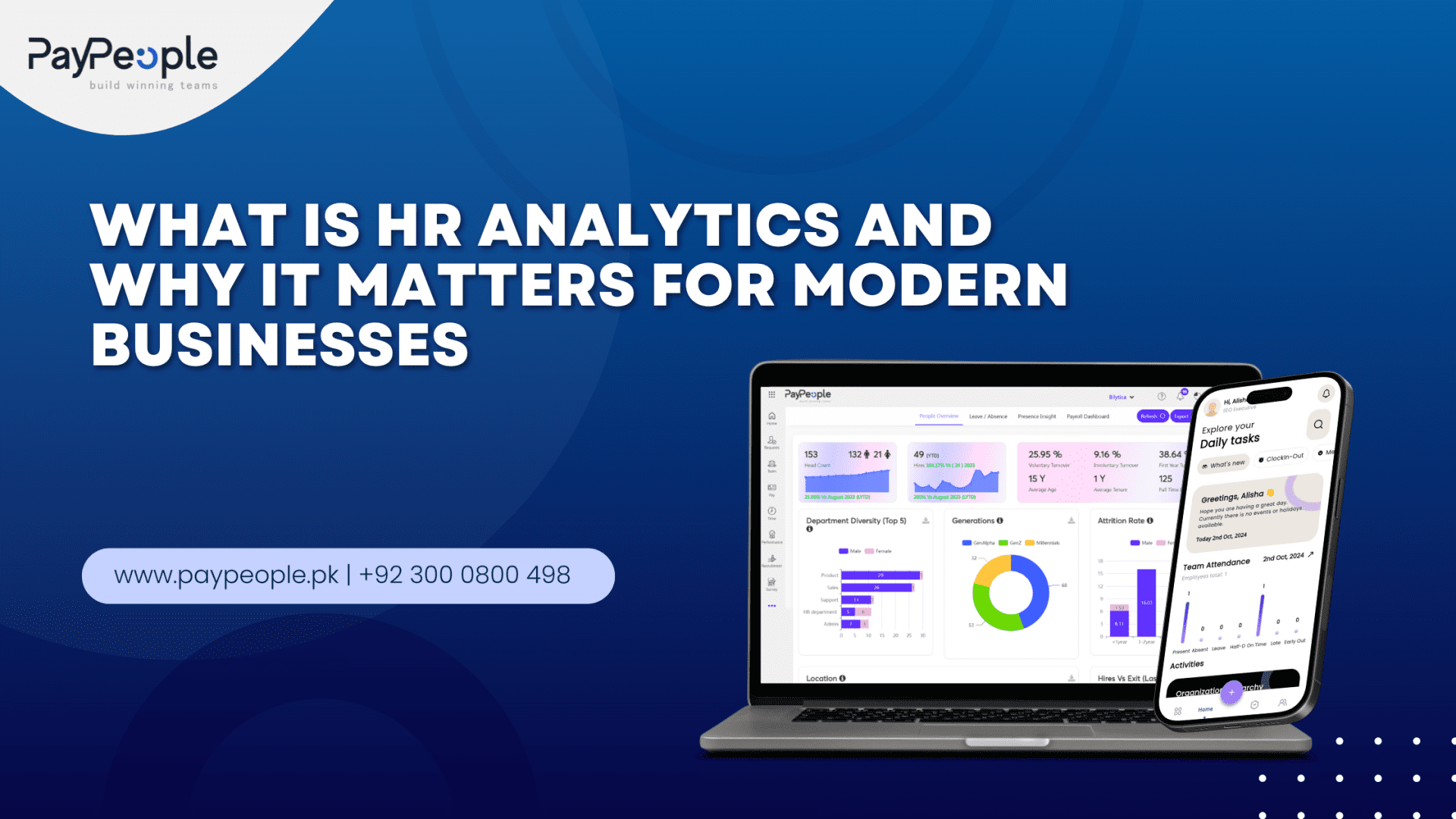

With the help of intelligent tools to drive decision-making in today’s era of data dominance, companies are turning more towards HR analytics as a transformational influence in transforming the way businesses deal with and involve their people. By merging data and strategic human resource management, HR analytics allows companies to drive operations to the best of their ability, improve employee experiences, and deliver quantifiable business outcomes.
This article offers a detailed view of what HR analytics is, the core elements of it, and why HR analytics has become crucial for contemporary businesses. You may either be a large company or an expanding business looking to invest in HR software; knowing the importance of HR analytics is vital to ensure sustainable growth and compete in the industry.
| Module | Tier | Price (PKR/employee/month) | Notes |
|---|---|---|---|
| Core HR & Analytics | Startup | Rs. 400 | Basic reporting & automated EOBI/SESSI calculations. |
| Advanced People Analytics | Professional | Rs. 600 | Includes predictive turnover & sentiment analysis tools. |
| Enterprise Insights | Enterprise | Custom Quote | API access for PowerBI/Tableau & multi-country support. |
HR analytics, or people analytics or workforce analytics, is the systematic collection, analysis, and interpretation of data about employees for making better human resource decisions. It moves beyond the level of simple reporting by providing predictive insights to guide workforce planning, talent acquisition, performance management, and employee engagement strategy.
In contrast to intuitive or hindsight-based HR practices, HR analytics delivers real-time actionable insights to inform strategic choices. It shifts human resources from being a cost center to a value-adding function with a focus on overall business objectives.
For one to appreciate the potential of HR analytics, it is important to have an understanding of its key elements:
HR analytics begins with the aggregation of data from various sources—such as payroll systems, attendance systems, performance management software, engagement surveys, and exit interviews. Combining the data offers a complete picture of the workforce and deposes data silos.
Descriptive analytics is concerned with what has occurred. For instance, examining turnover rates, training hours, or absences patterns helps us understand past trends and gives background for decisions in the future.
Predictive analytics employs statistical models and machine learning techniques to predict future results. It can be used to predict which employees are likely to leave, which candidates will perform well, or how team performance will change.
This aspect advises concrete actions based on predictions. For example, if the data indicate that there is a high risk of turnover in a certain department, the system can propose targeted contact efforts or leadership turnover.
Dashboards and visualization tools allow HR professionals to read data quickly and effectively. These tools facilitate better leadership communication through providing complex analytics in simple, easy-to-consume formats.
The business environment is changing at a fast rate, and organizations need to respond to keep up with the competition. Here’s why PayPeople HR analytics has become a strategic necessity for contemporary businesses:
Using HR analytics, businesses can connect their people capabilities with strategic plans in the long term. Identifying skill gaps, projecting future talent requirements, and workforce demographics can help businesses plan for hiring, training, and succession in advance.
Historical hiring trends rely on intuition. HR analytics brings in objectivity with the analysis of past hiring records, candidate performance indicators, and recruitment channel performance. This leads to improved recruitment decisions, lower time-to-fill, and improved quality of hire.
High turnover may be expensive and chaotic. Predictive HR analytics can spot the reasons for employee attrition. Whether compensation, management style, or limited growth opportunities, analytics allows companies to eliminate causes before they become problems.
Through the analysis of performance metrics, HR departments can guarantee equitable appraisals and recognize high achievers. Performance data may also reveal training requirements, and focused development initiatives could raise productivity as well as employee satisfaction.
HR analytics can track levels of engagement by way of sentiment analysis, surveys, as well as communication patterns. This data enables firms to design a more inclusive and engaging work environment, which leads to higher retention and performance.
With overtime costs, absenteeism, training ROI, and benefit utilization insights, companies can better spend HR budgets. It results in cost reduction without sacrificing employee experience or operational efficiency.
HR analytics is also important to ensure compliance with the law and company policies. Through monitoring of employee documentation, diversity statistics, and incident reports, organizations can pre-emptively respond to possible legal risks and keep regulatory compliance at its best.
Companies in various industries are already benefiting from HR analytics. Some of the real-world applications are:
These practical illustrations emphasize how data-driven HR practices can bring quantitative benefits to business performance.
For new-to-HR-analytics companies, the process of implementation might appear complicated. Yet, if approached in the proper way and using the PayPeople, it can be a smooth process. The following are some important steps to follow:
In choosing an HR software package with analytics, companies should make the following features their top priority:
These features not only increase analytical capabilities, but also ensure the system can accommodate long-term organizational growth.
Companies who spend on HR analytics now are in a better position to keep pace with these future developments and stay competitive in their sector.
In an increasingly complex and competitive business landscape, HR analytics is a powerful tool for turning human resources into a strategic force to be reckoned with. With data-driven decisions, contemporary companies can unlock workforce potential, enhance employee experience, and deliver operational excellence.
For businesses that want sustainable growth, spending on HR analytics software is no longer a choice—it is a strategic imperative. The power to transform workforce data into strategic insight makes it possible for organizations to drive challenges away, capture opportunities, and deliver measurable business results.
You can explore our other blogs like:
HR Analytics software in Pakistan, like PayPeople, typically ranges from Rs. 400 to Rs. 800 per employee per month. This subscription model allows SMEs to access advanced predictive tools and automated FBR/EOBI compliance reporting without a massive upfront investment in hardware or custom development.
A standard implementation of PayPeople’s HR Analytics takes between 2 to 4 weeks. This includes importing historical data from Excel, configuring local tax slabs for Pakistan, and training your HR team on how to use the automated dashboards for real-time decision making.
Security is a priority. PayPeople ensures all workforce data is hosted on secure cloud servers with high-grade encryption. We provide local support and ensure data backup protocols meet the stringent requirements of Pakistani financial and enterprise sectors, keeping your sensitive employee information protected yet accessible.
Modern HR Analytics tools integrate seamlessly with biometric machines (ZKTeco, Hikvision) and accounting software like QuickBooks or Xero. This allows for a unified data flow where attendance directly informs payroll processing and performance metrics without manual data re-entry.
Yes, PayPeople offers a fully functional 14-day free trial. This allow Pakistani HR managers to upload sample data, run parallel payroll reports, and explore the analytics dashboards to see how data-driven insights can solve specific workforce challenges before committing to a plan.
We provide a dedicated Service Level Agreement (SLA) that includes local WhatsApp support, email ticketing, and phone consultations. Our team in Pakistan understands local labor laws, ensuring you get expert help with both technical issues and compliance-related data queries.