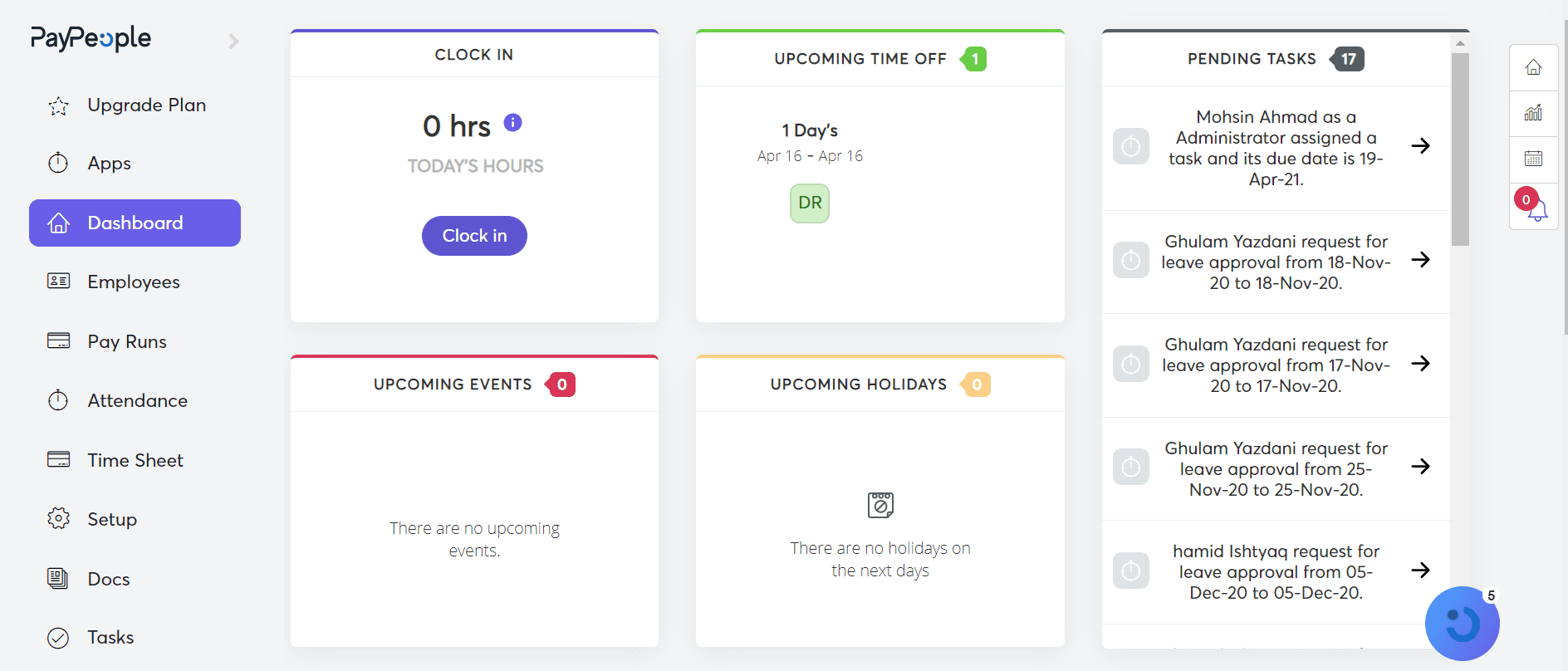

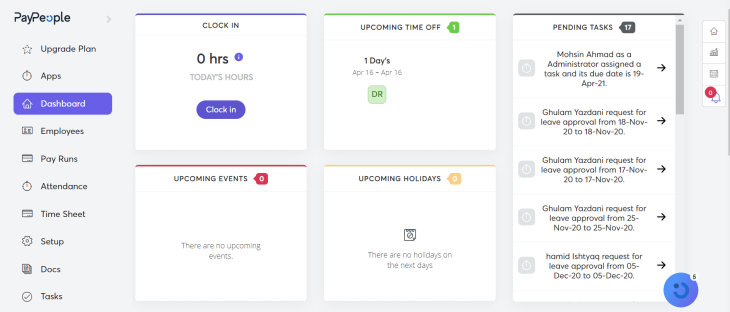
Paypeople #1 Payroll Software in Pakistan, Managing payroll manually is time-consuming and prone to errors. As businesses in Pakistan grow, payroll complexity increases due to tax regulations, attendance tracking, overtime calculations, and compliance requirements.
A modern payroll software in Pakistan helps organizations streamline salary processing, improve transparency, and enhance overall productivity.
Below are the five key factors that make payroll software essential for business success.
Paypeople #1 Payroll Software in Pakistan
Module Tier Price (PKR/employee/month) Notes Core Payroll Startup Rs. 400 FBR Tax, EOBI, and Bank-File Exports Payroll + Attendance Growth Rs. 600 Includes Biometric & Shift Management Full HRMS Suite Enterprise Rs. 850 Includes Performance, Recruitment, and Assets

Since the perspective of business exercises has gotten dynamic, incorporation of HR has gotten more stable. There are key encounters of HR which impacts a business and supports in unavoidable turn of events;
Payroll software automates salary calculations, tax deductions, bonuses, and overtime payments. Instead of spending hours on spreadsheets, HR teams can process payroll within minutes. This reduces manual errors and ensures timely salary disbursement.
Automation allows businesses to focus on strategic growth instead of administrative tasks.
Transparency plays a critical role in maintaining employee satisfaction.
A centralized payroll system provides:
Detailed salary breakdowns
Tax deduction records
Attendance-linked payroll calculations
Access to payslips through self-service portals
When employees clearly understand their salary structure, trust in the organization improves.
Payroll software is not just about salary processing. It integrates with performance management systems to link compensation with employee performance.
Businesses can:
Track bonuses based on KPIs
Align salary increments with performance reviews
Reward high-performing employees
This creates motivation and drives productivity across teams.
Payroll systems help management analyze labor costs and workforce expenses.
With accurate payroll reports, businesses can:
Plan budgets effectively
Forecast workforce expenses
Set realistic financial targets
Monitor departmental payroll costs
When financial data is measurable, better decisions can be made.
As the saying goes:
“What gets measured gets managed.”
Payroll software ensures compliance with local labor laws and tax regulations in Pakistan.
It helps businesses:
Maintain tax compliance
Generate government-compliant reports
Keep secure employee records
Integrate with attendance and HR systems
This reduces legal risks and ensures smooth business operations.
We also deal with Payroll Software in Pakistan in Pakistan
we are planning to open a branch office of Payroll Software in Pakistan in in Pakistan
Payroll Software in Pakistan in low cost in Pakistan
Cloud-based HR System in Pakistan helps with following your destinations in a specialist way. Why it is basic to follow? Permit us to appreciate the need with somewhat model; For example you have a portrayed goal of ‘weight decrease’, think about how conceivable it is that you don’t use a checking machine to follow, you will end up showing up at no spot. We have all heard the saying, “What finishes assessed gets.” HR programming helps you with that.
Proposed read: How to get higher ROI by characterizing targets? Target Setting Process with HRMS Software
Key Management: HR improves the association’s primary worry with its data on what HR means for various leveled accomplishment. Pioneers with dominance in Attendance Software in Pakistan imperative organization participate in corporate powerful that underlies current staffing evaluations and projections for future workforce needs reliant upon business premium.
End: Human Resource has now become the establishment of any business due to dynamic work culture. Inaccessible and on the spot filling in as become a regular practice which needs capable oversight. Extreme smaller than expected organization will not ever work for since quite a while past run at this point HR’s commitment will undoubtedly bring positive changes. On the most noteworthy purpose of everything, Face Recognition Software in Pakistan plans are driving the market to.
Attendance System In Pakistan
Attendance System In Pakistan
Why Use Attendance System In Pakistan
Attendance Management System In Pakistan
Attendance Management Software In Pakistan
Benefits of Attendance Management Software In Pakistan
SMEs in Pakistan That Affect Business adopt Payroll Software in Pakistan from PayPeople for three repeatable reasons: native EOBI / SESSI / PESSI and FBR-tax-slab handling, per-employee-per-month PKR billing that scales with headcount, and a Pakistan-based support team that answers in working hours. Most teams move off Excel or a legacy desktop HRMS once the monthly payroll run takes more than two working days, or once a multi-branch payroll consolidation becomes a source of reconciliation errors.
The most-used modules in Pakistan That Affect Business are payroll, biometric attendance and leave — these three together cover 80% of the day-to-day HR workload for a 50–250-employee SME. Recruitment, performance and expense modules are typically rolled out in a second phase 60–90 days after go-live, once managers are comfortable with self-service and approval workflows. PayPeople bills per-employee-per-month in PKR, starting around Rs. 400 for core HR + payroll, with volume discounts above 100 employees and custom enterprise pricing for multi-branch setups.
Compliance is the deal-decider. EOBI and SESSI/PESSI contribution rates are maintained centrally and pushed to every customer’s payroll run, so you don’t manually patch tax tables when the federal budget changes. FBR income-tax slabs for salaried employees update the same way. The full monthly return — EOBI form, SESSI/PESSI form, FBR salary withholding statement — is generated from one screen, signed off and archived in the audit trail. Multi-branch payroll consolidates into a single GL-coded export ready for the accounting team.
Getting started in Pakistan That Affect Business: book a 30-minute demo at paypeople.pk/book-a-demo, the team hands you a 7-day sandbox with sample employees and a pre-configured tax slab, and you run one parallel-payroll month against your existing process before cutover. Total go-live for a typical Pakistani SME is 2–4 weeks; multi-branch enterprise rollouts take 6–8 weeks. WhatsApp +92 300 0800498 or email sales@paypeople.pk to start.
Modern payroll software in Pakistan like PayPeople automatically calculates the employer and employee portions of EOBI based on the latest notified wage floors. It generates accurate contribution reports, ensuring your business stays compliant with the Employees’ Old-Age Benefits Institution without manual spreadsheet errors.
The software includes a pre-configured tax engine that applies the current FBR income tax slabs for the 2024-2025/2026 fiscal years. When the government announces new tax brackets in the federal budget, the cloud system updates them globally so your salary processing remains legally compliant.
Yes, PayPeople generates standard bulk-payment files compatible with major Pakistani banks like HBL, MCB, and Meezan Bank. This allows you to process monthly salary disbursements via IBFT or bulk transfer in minutes rather than hours.
PayPeople offers a dedicated Employee Self-Service (ESS) portal and a mobile app. Employees can view their salary breakdowns and download PDF payslips directly. You can also automate payslip delivery via WhatsApp or email for maximum convenience.
Absolutely. The system is designed for multi-branch organizations in Pakistan. It allows you to define different cost centers for Karachi, Lahore, or Faisalabad while consolidating the entire group’s payroll and tax liabilities into a single FBR-ready report.
The software handles the entire full and final settlement process, including gratuity accruals, provident fund payouts, unutilized leave encashment, and notice period adjustments, ensuring a smooth exit for employees while maintaining historical data.