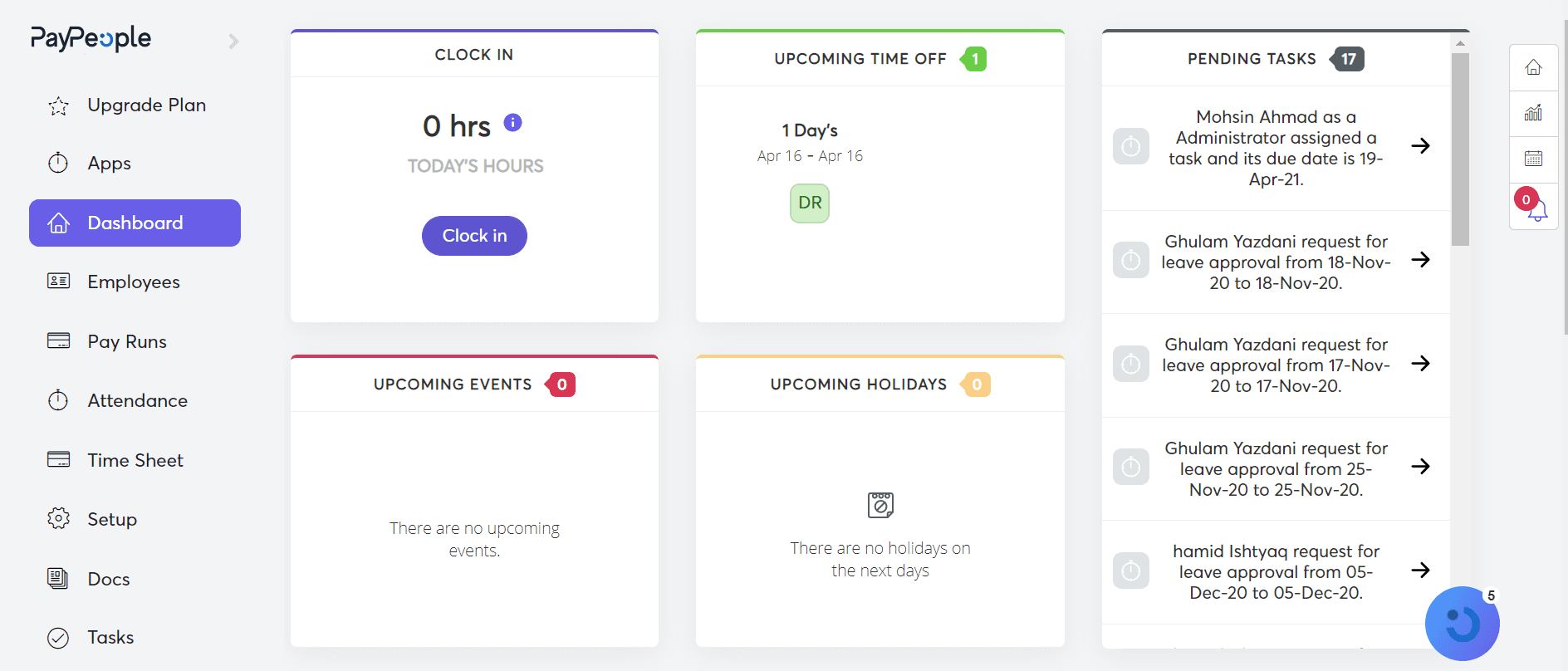

Payroll software in Pakistan provides the essential foundation for business productivity by automating complex salary processing and ensuring 100% compliance with local labor laws. Moving away from manual Excel spreadsheets allows Pakistani SMEs and enterprises to handle FBR tax slabs, EOBI contributions, and SESSI filings with surgical precision, reducing administrative overhead by up to 70%.
Execution of payroll software in Pakistan streamlines the entire employee lifecycle, from monthly salary processing to final settlements. By automating wage calculations, businesses eliminate human error in tax deductions and EOBI contributions. This reliability builds employee trust, as workers receive accurate, automated payslips via WhatsApp or email on time, every month.
When HR teams spend less time on manual data entry, they can focus on strategic talent management and organizational growth.
Yes, professional payroll software in Pakistan is designed to handle the specific statutory requirements of EOBI, SESSI, and PESSI automatically. The system tracks the latest contribution rates and caps set by the government, ensuring that both employer and employee portions are calculated correctly.
This automation prevents costly penalties associated with incorrect filings and ensures that your business remains in good standing with provincial and federal labor departments across Karachi, Lahore, and Islamabad.
Managing FBR income tax slabs manually is a significant risk for Pakistani businesses due to frequent fiscal policy updates. Payroll software in Pakistan automatically applies the most recent tax brackets for the current financial year. It calculates monthly tax projections, handles tax-free thresholds, and manages adjustments for bonuses or commissions.
At the end of the year, the system generates Annexure-C reports ready for filing, making the entire tax compliance process seamless for the finance department.
One of the most productive features of modern payroll systems is the ability to generate bank-ready files for bulk transfers. Instead of manual entry in corporate banking portals, the software exports a formatted file (CSV or Excel) compatible with major Pakistani banks like HBL, Meezan, MCB, and Bank Alfalah.
This allows for one-click salary disbursement through IBFT or bulk payment systems, ensuring that hundreds of employees are paid simultaneously while maintaining a digital audit trail.
Transitioning from Excel to a cloud-based payroll system involves a structured implementation process. First, a thorough audit of current employee data and salary structures is conducted. This data is then securely imported into the software, where specific rules for allowances, deductions, and tax exemptions are configured.
Most Pakistani companies run a ‘parallel payroll’ for one month—calculating salaries in both Excel and the new software—to verify accuracy before going live and retiring the old spreadsheets.
Pricing for payroll software in Pakistan is typically structured on a monthly per-employee basis, making it affordable for both startups and large corporations. This SaaS model ensures you only pay for the active head-count in your organization.
| Module | Tier | Price (PKR/employee/month) | Notes |
|---|---|---|---|
| Core Payroll | Basic | Rs. 300 – 450 | FBR tax, EOBI, and bank-file exports. |
| Compliance Plus | Standard | Rs. 450 – 600 | Includes SESSI, PESSI, and WhatsApp payslips. |
| Full Service | Enterprise | Rs. 600+ | Gratuity, Provident Fund, and Multi-branch support. |
Execution of payroll software in Pakistan is no longer a luxury but a necessity for competitive businesses aiming for high productivity and compliance. By consolidating salary processing, tax filing, and bank disbursements into one platform, you protect your business from legal risks and operational bottlenecks. Book a demo today to see how PayPeople can transform your monthly payroll cycle.
SMEs in Pakistan For Business Productivity adopt Payroll Software in Pakistan from PayPeople for three repeatable reasons: native EOBI / SESSI / PESSI and FBR-tax-slab handling, per-employee-per-month PKR billing that scales with headcount, and a Pakistan-based support team that answers in working hours. Most teams move off Excel or a legacy desktop HRMS once the monthly payroll run takes more than two working days, or once a multi-branch payroll consolidation becomes a source of reconciliation errors.
The most-used modules in Pakistan For Business Productivity are payroll, biometric attendance and leave — these three together cover 80% of the day-to-day HR workload for a 50–250-employee SME. Recruitment, performance and expense modules are typically rolled out in a second phase 60–90 days after go-live, once managers are comfortable with self-service and approval workflows. PayPeople bills per-employee-per-month in PKR, starting around Rs. 400 for core HR + payroll, with volume discounts above 100 employees and custom enterprise pricing for multi-branch setups.
Compliance is the deal-decider. EOBI and SESSI/PESSI contribution rates are maintained centrally and pushed to every customer’s payroll run, so you don’t manually patch tax tables when the federal budget changes. FBR income-tax slabs for salaried employees update the same way. The full monthly return — EOBI form, SESSI/PESSI form, FBR salary withholding statement — is generated from one screen, signed off and archived in the audit trail. Multi-branch payroll consolidates into a single GL-coded export ready for the accounting team.
Getting started in Pakistan For Business Productivity: book a 30-minute demo at paypeople.pk/book-a-demo, the team hands you a 7-day sandbox with sample employees and a pre-configured tax slab, and you run one parallel-payroll month against your existing process before cutover. Total go-live for a typical Pakistani SME is 2–4 weeks; multi-branch enterprise rollouts take 6–8 weeks. WhatsApp +92 300 0800498 or email sales@paypeople.pk to start.
Payroll software in Pakistan automates EOBI, SESSI, and PESSI by applying the latest provincial rates to employee gross salaries. It calculates both the employer and employee contributions, generating consolidated reports that match the government’s portal requirements, ensuring your business stays compliant in Karachi, Lahore, and beyond.
The software is pre-configured with the current FBR income tax slabs for salaried individuals. It automatically deducts the correct tax amount each month based on the projected annual income, handling various tax-exempt allowances and producing the necessary documentation for annual tax filing in Pakistan.
Yes, PayPeople generates bank-compatible files for bulk transfers (IBFT). You can export these files for all major Pakistani banks, allowing you to process the entire company’s salary in a single upload to your corporate banking portal, significantly reducing manual errors.
PayPeople delivers automated payslips directly to employees via WhatsApp and email. This ensures instant delivery, reduces paper waste, and allows employees to access their historical salary data and tax certificates directly from their smartphones, improving overall workplace transparency.
The software includes dedicated modules for Gratuity and Provident Fund management. It calculates monthly accruals based on company policy, tracks employee contributions, and provides accurate final settlement (Full & Final) calculations when an employee leaves the organization.
PayPeople is a multi-branch payroll system that allows you to manage different locations under one central dashboard. You can set location-specific compliance rules while maintaining a unified payroll run for the entire group, which is ideal for businesses with offices in different cities.