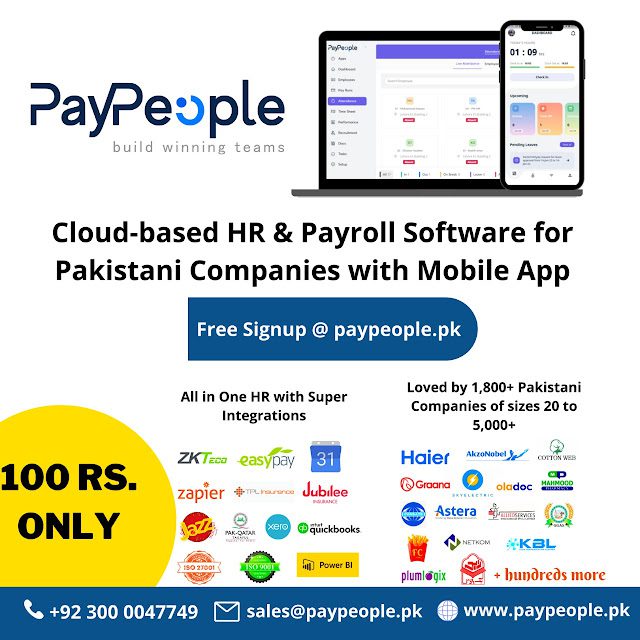

HRMS in Pakistan helps businesses transition from administrative chaos to systematic people management by centralizing employee records, workflows, and self-service tools into one secure cloud platform. In a market like Pakistan—where managing EOBI documentation and provincial compliance is critical—having a localized HR system ensures your HR department moves from manual entry to strategic decision-making.
Modern HRMS in Pakistan acts as the digital backbone for growing SMEs and large enterprises alike. By consolidating employee master data, organizations eliminate the risk of lost physical files and fragmented spreadsheets. Every teammate’s history—from their initial offer letter to their last appraisal—is stored in a single, version-controlled document vault.
This clarity allows HR managers in cities like Lahore and Karachi to focus on talent development rather than hunting for missing paper records.
An employee self-service (ESS) portal reduces HR administrative overhead by up to 40% by putting power back into the hands of the workforce. Employees can log in to view their own attendance logs, download payslips, and update personal details without emailing the HR department.
For Pakistani businesses with remote sites or multiple branches, ESS ensures everyone feels connected to the core organization through a mobile-friendly interface.
Automated approval workflows for leave, expenses, and claims replace the slow “paper-trail” culture common in many local offices. When an employee applies for a leave, the HRMS automatically routes the request to their reporting manager based on the pre-configured org chart.
Once approved, the system updates the leave balance in real-time. This level of transparency prevents disputes and ensures that your workforce planning is always based on accurate, live data.
Data security is a primary concern when implementing HR software in Karachi or Islamabad. A cloud-based HRMS offers role-based access control, ensuring that sensitive information like salary details and CNIC copies are only visible to authorized personnel.
With encrypted cloud hosting, Pakistani companies get enterprise-grade security that far exceeds the safety of keeping physical files in a cabinet or unencrypted Excel sheets on a local PC.
A flexible HRMS allows you to build a dynamic org chart that reflects your company’s unique structure, whether you follow a flat hierarchy or a complex matrix. You can define reporting lines, department heads, and functional leaders with a few clicks.
As your company grows in Peshawar or Sialkot, the system scales with you, making it easy to reassign teams and visualize your entire workforce structure instantly.
The true power of an HRMS in Pakistan lies in its ability to feed clean data into other systems. By integrating your core HR data with attendance and payroll modules, you ensure that salary processing is based on verified employee status and approved leaves.
This “single source of truth” eliminates manual data transfers between departments, significantly reducing the margin for human error during the monthly salary cycle.
| Module | Self-Service | Workflow Builder | Price (PKR/employee/month) |
|---|---|---|---|
| Core HR & Directory | Yes | Basic | Rs. 200 |
| Standard HRMS Bundle | Yes | Advanced | Rs. 400 |
| Enterprise Suite | Yes | Unlimited | Rs. 600 |
Selecting the right HRMS in Pakistan is an investment in your company’s scalability and employee experience. By focusing on core modules like self-service, document management, and automated workflows, you can build a high-performance culture throughout Pakistan. Book a demo today to see how PayPeople can transform your HR operations.
SMEs in Pakistan Which Features Will Shape Payroll adopt HRMS in Pakistan from PayPeople for three repeatable reasons: native EOBI / SESSI / PESSI and FBR-tax-slab handling, per-employee-per-month PKR billing that scales with headcount, and a Pakistan-based support team that answers in working hours. Most teams move off Excel or a legacy desktop HRMS once the monthly payroll run takes more than two working days, or once a multi-branch payroll consolidation becomes a source of reconciliation errors.
The most-used modules in Pakistan Which Features Will Shape Payroll are payroll, biometric attendance and leave — these three together cover 80% of the day-to-day HR workload for a 50–250-employee SME. Recruitment, performance and expense modules are typically rolled out in a second phase 60–90 days after go-live, once managers are comfortable with self-service and approval workflows. PayPeople bills per-employee-per-month in PKR, starting around Rs. 400 for core HR + payroll, with volume discounts above 100 employees and custom enterprise pricing for multi-branch setups.
Compliance is the deal-decider. EOBI and SESSI/PESSI contribution rates are maintained centrally and pushed to every customer’s payroll run, so you don’t manually patch tax tables when the federal budget changes. FBR income-tax slabs for salaried employees update the same way. The full monthly return — EOBI form, SESSI/PESSI form, FBR salary withholding statement — is generated from one screen, signed off and archived in the audit trail. Multi-branch payroll consolidates into a single GL-coded export ready for the accounting team.
Getting started in Pakistan Which Features Will Shape Payroll: book a 30-minute demo at paypeople.pk/book-a-demo, the team hands you a 7-day sandbox with sample employees and a pre-configured tax slab, and you run one parallel-payroll month against your existing process before cutover. Total go-live for a typical Pakistani SME is 2–4 weeks; multi-branch enterprise rollouts take 6–8 weeks. WhatsApp +92 300 0800498 or email sales@paypeople.pk to start.
An HRMS in Pakistan acts as a centralized digital vault for all employee information, including CNIC copies, educational documents, and contract history. This ensures that HR managers in cities like Lahore and Karachi can access any record instantly, maintaining a clear audit trail for compliance and internal reviews.
Yes, PayPeople offers a robust mobile-friendly employee self-service portal. Employees across Pakistan can apply for leaves, view their attendance, and update their personal profiles directly from their smartphones, which significantly reduces the daily administrative burden on the HR department.
The core HRMS manages the employee lifecycle from onboarding to offboarding. It integrates seamlessly with our payroll module by providing verified data on employee status, department changes, and approved leaves, ensuring that the payroll software calculates salaries based on the most accurate human resource data.
Security is a top priority for HRMS in Pakistan. Our platform uses role-based access control (RBAC), meaning only authorized managers can view sensitive salary or personal data. All information is encrypted and hosted on secure cloud servers, offering higher protection than traditional physical filing systems.
Absolutely. A key feature of our HRMS in Pakistan is the dynamic org chart builder. You can easily define reporting lines, set up multi-level approval hierarchies for different departments, and visualize your entire company structure to ensure better workforce planning and accountability.
Most Pakistani SMEs can complete the core HRMS rollout in 7 to 14 days. This involves importing employee master data, setting up the org chart, and configuring initial approval workflows. PayPeople provides local support to ensure your team is trained and ready to use the system quickly.