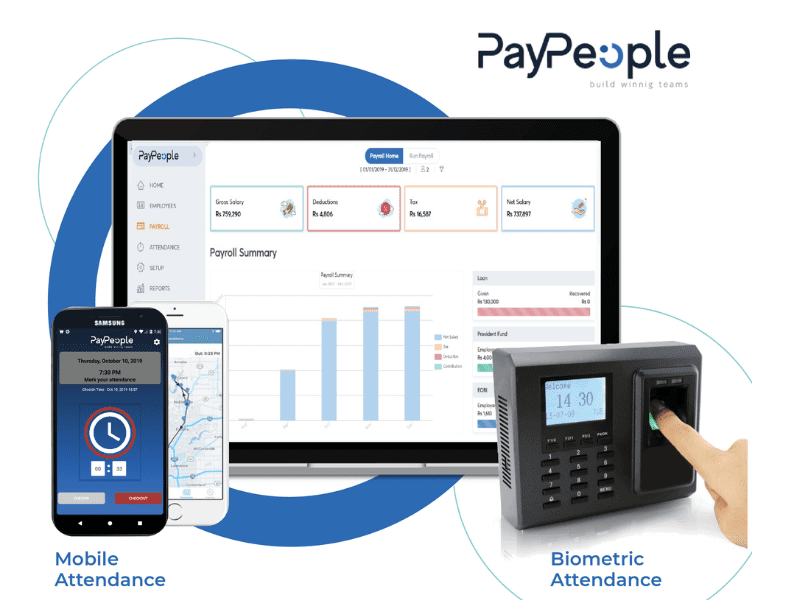

HRMS in Islamabad provides modern enterprises with the essential digital infrastructure to manage their most valuable asset—people—while maintaining complete data sovereignty and organizational visibility. In a rapidly evolving capital market, HR managers are shifting away from manual spreadsheets to core human resource systems that offer a single source of truth for employee master data, document management, and organizational hierarchies.
HR managers in the federal capital are increasingly focusing on data-driven decision-making to optimize workforce costs and employee engagement. Effective HRMS in Islamabad allows for real-time tracking of turnover rates, employee lifetime value, and departmental budget utilization.
By leveraging people management software, organizations can identify high-potential employees in Islamabad’s competitive talent pool and address attrition before it impacts the bottom line.
A centralized document vault serves as a secure, role-based repository for all employee-related information, including contracts, educational degrees, and previous work experience. HRMS in Islamabad ensures that physical files are replaced by digital records that are easily searchable and protected by enterprise-grade encryption.
This module is vital for compliance audits and ensuring that sensitive employee information remains accessible only to authorized personnel.
Employee Self-Service (ESS) portals empower the workforce by allowing them to view their profiles, request leaves, and download letters without manual HR intervention. Implementing HRMS in Islamabad reduces the administrative burden on HR teams by up to 40%, as employees can update their contact information or check leave balances directly via mobile or desktop.
This transparency fosters trust and significantly improves the employee experience across the organization.
Approval workflows in a modern HRIS automate the journey of leaves, expense reimbursements, and benefit claims from the requester to the final approver. For businesses using HRMS in Islamabad , these multi-level hierarchies ensure that every request follows the designated chain of command, with automated email and push notifications.
This prevents bottlenecks and ensures that claims are processed within the established SLA (Service Level Agreement).
Visualizing the reporting structure through an automated org chart helps in understanding the span of control and identifying gaps in leadership. HRMS in Islamabad dynamically updates the organizational hierarchy whenever a promotion or department transfer occurs. This ensures that the reporting line remains accurate for both operational workflows and strategic workforce planning during expansion phases.
Data security is a top priority for Islamabad-based enterprises, particularly those in the IT, NGO, and government sectors. HRMS in Islamabad utilizes role-based access control (RBAC), ensuring that only specific users can view salary-sensitive or confidential employee records.
With audit trails and data encryption at rest and in transit, cloud-based systems provide superior protection compared to traditional on-on-premise servers or paper files.
| Module | Self-Service | Workflow Builder | Price (PKR/employee/month) |
|---|---|---|---|
| Core HR & Master Data | Full Access | Static | Rs. 250 – 400 |
| Leave & Attendance | Request/View | Custom Multi-Level | Rs. 150 – 300 |
| Expense & Claims | Claim Submission | Advanced Routing | Rs. 100 – 200 |
| Full HRMS Suite | Unified Portal | Unlimited Flows | Rs. 400 – 650 |
Adopting a comprehensive HRMS in Islamabad is no longer just a trend but a necessity for organizations looking to scale efficiently. By automating core HR functions, Islamabad businesses can focus on talent development and strategic growth. Book a demo today to see how PayPeople can transform your human resource system.
SMEs in HRMS in Islamabad from PayPeople for three repeatable reasons: native EOBI / SESSI / PESSI and FBR-tax-slab handling, per-employee-per-month PKR billing that scales with headcount, and a Pakistan-based support team that answers in working hours. Most teams move off Excel or a legacy desktop HRMS once the monthly payroll run takes more than two working days, or once a multi-branch payroll consolidation becomes a source of reconciliation errors.
The most-used modules in , biometric attendance and leave — these three together cover 80% of the day-to-day HR workload for a 50–250-employee SME. Recruitment, performance and expense modules are typically rolled out in a second phase 60–90 days after go-live, once managers are comfortable with self-service and approval workflows. PayPeople bills per-employee-per-month in PKR, starting around Rs. 400 for core HR + payroll, with volume discounts above 100 employees and custom enterprise pricing for multi-branch setups.
Compliance is the deal-decider. EOBI and SESSI/PESSI contribution rates are maintained centrally and pushed to every customer’s payroll run, so you don’t manually patch tax tables when the federal budget changes. FBR income-tax slabs for salaried employees update the same way. The full monthly return — EOBI form, SESSI/PESSI form, FBR salary withholding statement — is generated from one screen, signed off and archived in the audit trail. Multi-branch payroll consolidates into a single GL-coded export ready for the accounting team.
Getting started in at paypeople.pk/book-a-demo, the team hands you a 7-day sandbox with sample employees and a pre-configured tax slab, and you run one parallel-payroll month against your existing process before cutover. Total go-live for a typical Pakistani SME is 2–4 weeks; multi-branch enterprise rollouts take 6–8 weeks. WhatsApp +92 300 0800498 or email sales@paypeople.pk to start.
HRMS in Islamabad centralizes all employee master data, including contracts and education documents, into a secure cloud vault. This allows HR teams in the capital to eliminate physical filing systems and manage their organizational hierarchy and reporting lines with real-time accuracy and role-based security.
The self-service portal in HRMS in Islamabad allows employees to request leaves, submit expense claims, and view their own documents without HR assistance. This transparency improves employee satisfaction and reduces the administrative workload for Islamabad-based HR managers by nearly 40%.
Implementation for HR software in Islamabad typically takes 2 to 4 weeks for SMEs. This includes setting up the org chart, migrating employee records from legacy spreadsheets to the HRIS vault, and training managers on the approval workflow modules.
Yes, HRMS in Islamabad from PayPeople provides a unified platform where core HR data connects directly with leave management and expense modules. This ensures that every approval workflow and organizational change is reflected across the entire human resource system instantly.
Security is paramount for Islamabad’s IT and NGO sectors. HRMS in Islamabad utilizes 256-bit encryption and role-based access control (RBAC). This ensures that sensitive records in the employee document vault are only accessible to authorized personnel, with full audit trail compliance.
Pricing for HRMS in Islamabad is transparent and starts at Rs. 400 per employee per month. This cloud-based model allows Islamabad firms to scale their people management software costs as their headcount grows, avoiding expensive upfront server and licensing fees.