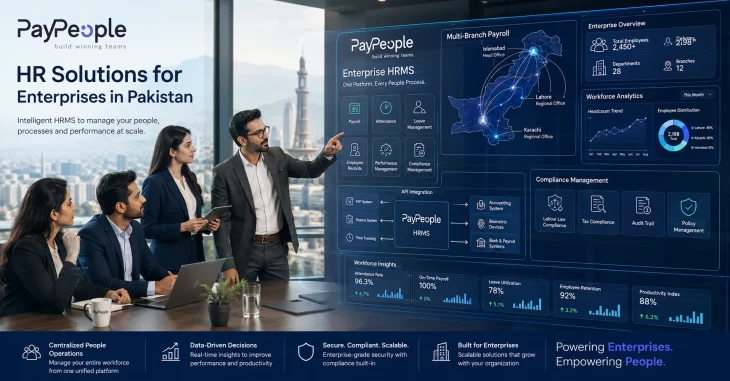
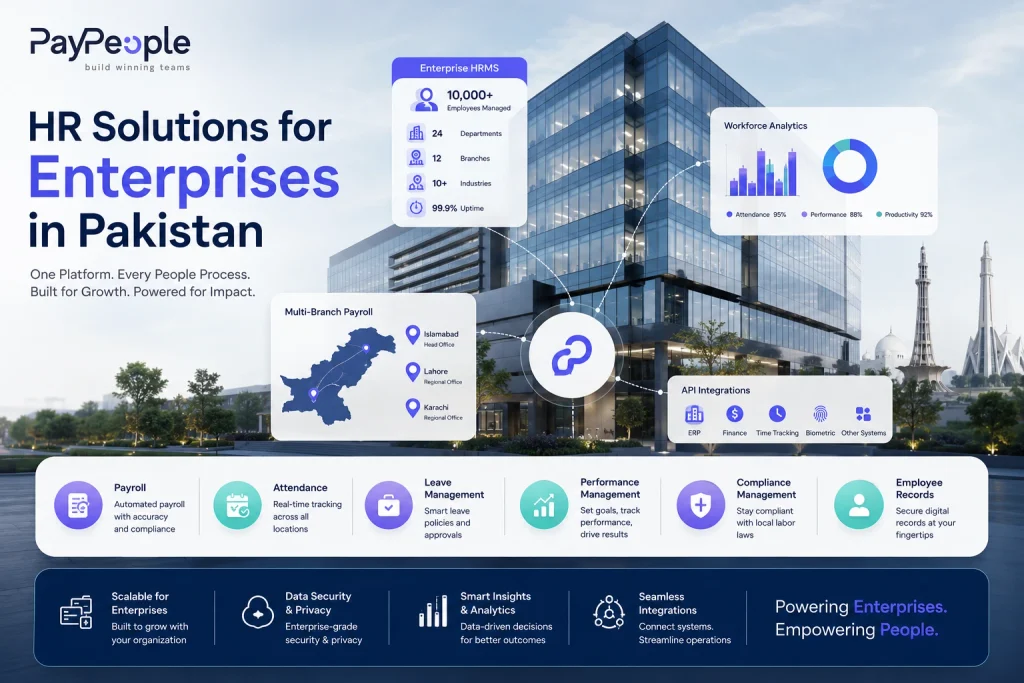
Quick answer: Enterprise HR solutions in Pakistan need to handle what SME-focused HRMS platforms typically don’t: multi-branch or multi-entity payroll consolidation, custom reporting for leadership and board-level reporting, API access to connect with existing ERP/finance systems, and dedicated implementation support for rollouts spanning hundreds or thousands of employees across multiple cities.
Where “Enterprise” HR Needs Genuinely Diverge from SME HR
Most HR software marketed in Pakistan is built around the 50-250 employee range — a single head office, maybe one or two branches, straightforward payroll. Once a company crosses into true enterprise scale (roughly 500+ employees, multiple branches or business units, often multiple cities), the requirements change in kind, not just in degree:
Multi-branch payroll consolidation stops being optional. A company with five branches across three cities running payroll manually has five separate attendance registers and no reliable way to produce one consolidated report for the CFO — this is a structural problem, not a volume problem.
Custom reporting becomes a leadership requirement, not a nice-to-have. Board and executive reporting typically needs workforce analytics (headcount, cost-per-hire, attrition by department) that generic out-of-the-box reports don’t cover.
API access matters because enterprises already run ERP, accounting, or finance systems — HR data needs to flow into the general ledger without manual re-entry, not exist as an isolated system.
Implementation support needs to be structured, not self-serve. A 500-person, multi-branch rollout is a project with data migration, role configuration, and phased training — not a signup form.
Core Challenges at Enterprise Scale
Compliance risk multiplies with scale. When the government announces a mini-budget or adjusts income tax slabs, an HR manager relying on Excel across multiple branches faces hours of manually rechecking formulas per location to ensure the company doesn’t under- or over-deduct tax. Automated payroll applies federal regulation updates instantly across every branch. For the full compliance framework this needs to sit on top of, see our HR Compliance in Pakistan guide.
Audit-readiness across locations. If a labour inspector or FBR notice arrives, a disorganized multi-branch company can’t afford to search through physical folders across cities. A centralized system keeps every location audit-ready simultaneously.
EOBI/PESSI-SESSI tracking across provinces. A company with staff in Lahore and Karachi is registered under PESSI for one group and SESSI for another — enterprise HR software needs to handle both simultaneously without treating provincial social security as a single blended number.
Enterprise Compliance Checklist
A centralized system should keep every branch audit-ready by maintaining:
Signed contracts — digital proof of agreed salary and terms, for every employee, every branch
Getting Started: From Manual Chaos to Enterprise HRMS
Internal audit first. Identify exactly which “time-thief” — manual payroll, scattered attendance records, inconsistent leave tracking — disrupts operations most before evaluating vendors.
Select a partner that understands local, multi-province compliance — not a generic international platform requiring months of custom configuration to handle EOBI or provincial social security correctly.
Involve staff early. A multi-branch rollout succeeds or fails on adoption; early involvement reduces resistance.
Plan implementation realistically. See our 2026 implementation guide for what a rollout timeline actually looks like at scale — vendors promising same-day go-live for a 500-person company are usually oversimplifying.
Understand enterprise pricing. Per-employee pricing typically includes volume discounts above 100 employees, with custom enterprise pricing for multi-branch setups..
If your enterprise is specifically in the IT/technology sector, our HR software for IT companies guide covers additional considerations — remote/hybrid workforce management and incentive-heavy payroll structures — that apply on top of general enterprise requirements.