


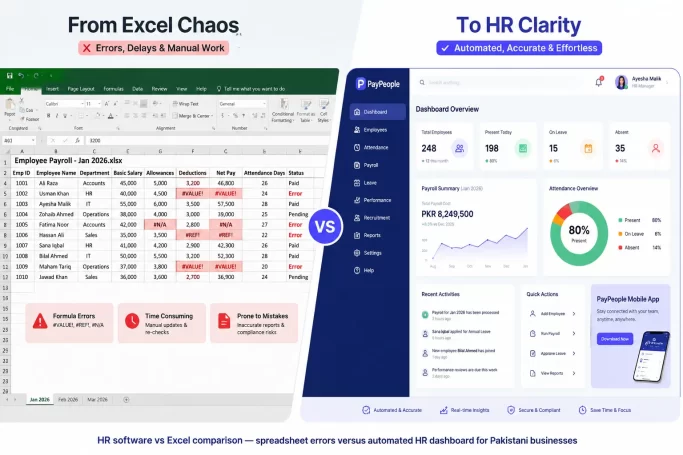
Definition: HR software is a cloud-based platform that centralises employee records, automates payroll, tracks attendance, manages leave, and handles statutory compliance (EOBI, PESSI/SESSI, FBR tax withholding) from a single dashboard — replacing the collection of Excel files most Pakistani businesses start with.
At a Glance: Excel works for teams under 15–20 people with simple salaries. Once you cross that threshold, open a second office, or need EOBI/FBR compliance tracking, spreadsheet errors cost more than HR software. For a 60-person company, software typically pays for itself within one quarter on admin time savings alone.
Most Pakistani companies start HR on Excel. Somebody builds a sheet for employee names, another tab for attendance, a third for salaries. It works at 10 people. By the time headcount crosses 40, that same spreadsheet is quietly costing the company money — one wrong formula breaks payroll, EOBI contributions get miscalculated because nobody updated the minimum wage cell, and the CEO cannot get a headcount without opening three files.
This is not a question of whether to move off Excel. It is a question of when. Below is a straight HR software vs Excel comparison for Pakistan — with actual PKR numbers, FBR 2026–27 slab data, and EOBI/PESSI specifics — so you can make that call with real information instead of vendor promises.
Excel costs nothing extra — it ships with the Microsoft 365 licence every office already pays for. Every HR assistant in Lahore, Karachi, or Islamabad knows the interface. Training: zero. Setup: one afternoon. For a startup with 8 employees, a single attendance-and-salary sheet covers everything.
The problems show up not because Excel is bad, but because the business outgrows what any spreadsheet can safely handle. That tipping point arrives earlier than most founders expect.
EOBI runs on a 5+1 formula: employer pays 5% of the minimum wage, employee pays 1%. In Punjab, Sindh, and KP for FY 2026–27, the minimum wage is Rs. 40,000 — so the employer owes Rs. 2,000 per registered employee monthly, and the employee deduction is Rs. 400. Balochistan and ICT sit at Rs. 37,000. PESSI and SESSI add roughly 6% from the employer against the insurable wage ceiling.
In Excel, someone has to update that base figure every time the government revises it. Miss the update and every subsequent month’s contribution goes to EOBI wrong. HR software with Pakistan compliance built in handles these updates automatically.
The FBR FY 2026–27 budget restructured salaried income tax: the old 23% bracket dropped to 20%, the 30% bracket dropped to 25%, and the single 35% band starting at Rs. 4.1 million was split into 29% (Rs. 4.1–5.6M), 32% (Rs. 5.6–7M), and 35% above Rs. 7M. The 9% surcharge on incomes above Rs. 10M was abolished for salaried individuals.
Each of these changes requires manual formula updates across multiple Excel cells. Forget one bracket boundary and higher-paid employees get wrong deductions for months — creating problems at FBR filing time.
Excel records who last saved the file. That is the entire history. It cannot tell you who changed a salary from Rs. 85,000 to Rs. 95,000, or when someone deleted an attendance row by accident. During a Labour Department audit, you need to prove what was calculated and when. A 14-month-old spreadsheet with manual edits cannot provide that.
“Attendance_Final_v3_UPDATED_Asim.xlsx” — if that filename sounds familiar, you know this problem. Multiple editors, local copies, conflicting data. When the CEO asks for a department-wise cost breakdown, someone builds it from scratch every time. Cloud HR software generates these reports in seconds because the data is already structured and lives in one place.
| Function | Excel | HR Software (e.g. PayPeople) |
| Payroll | Manual formulas; error-prone at scale | Automated; EOBI + PESSI/SESSI + FBR slabs built in |
| Tax Withholding | Update formulas manually after each budget | Tax tables update centrally after Finance Act |
| Attendance | Manual entry or biometric paste | Biometric / GPS / app — feeds payroll directly |
| Leave Management | Shared sheet, manual balances | Self-service portal; auto-deduct, policy-enforced |
| Employee Records | Scattered across tabs and folders | Single database, searchable, access-controlled |
| Compliance | HR remembers to update rates | Auto-updates on government notifications |
| Reporting | Build from scratch each time | Pre-built dashboards; Excel/PDF export |
| Audit Trail | Last-saved-by only | Full log: who, what, when |
| Data Security | File-level password | Role-based access, encrypted, cloud backup |
| Monthly Cost | Rs. 0 (in Office licence) | From Rs. 400/employee/month (PayPeople) |
Not every company needs HR software today. Excel is honestly fine if all three conditions hold:
Under 15–20 employees. Data volume stays manageable for one person.
Simple payroll. Flat monthly salaries, no overtime, no multi-province PESSI/SESSI split.
One person owns the sheet. Version chaos starts the moment a second editor touches the file.
The moment any condition changes — employee 20, a second office, or your HR person goes on leave and nobody can run payroll — start evaluating software.
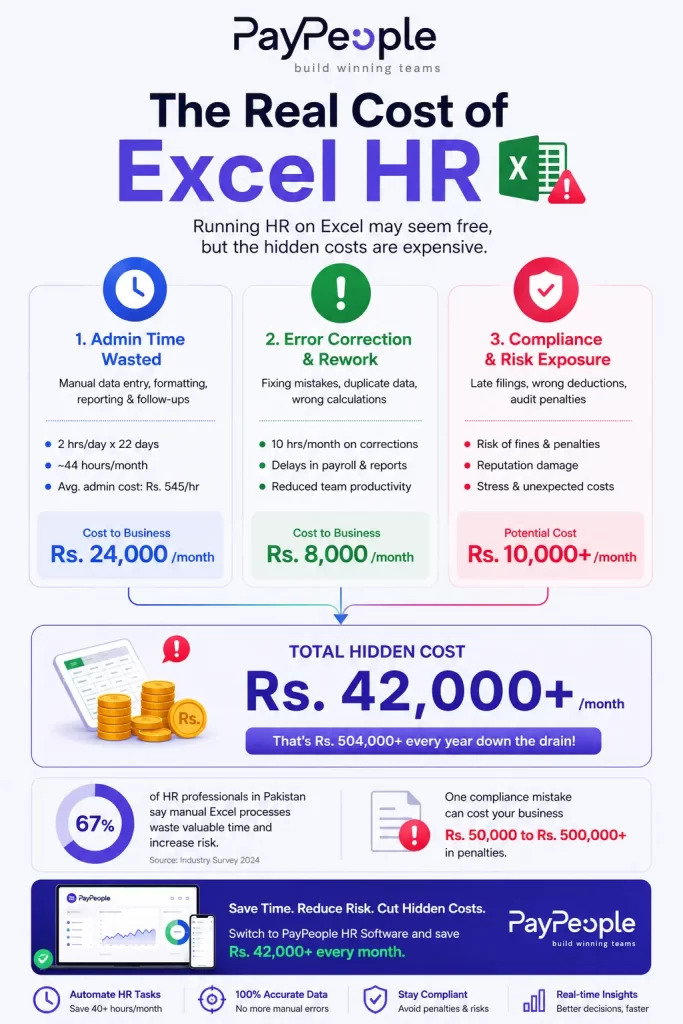
Scenario: 60-person company, Lahore.
Excel hidden costs: HR executive at Rs. 60,000–80,000/month spending 40% of their time on spreadsheet maintenance = Rs. 24,000–32,000/month in admin labour alone. Add payroll error corrections (3–4 hours per incident, twice a quarter), and missed EOBI filing risk (Rs. 120,000 in contributions per missed month for 60 employees, plus late penalties).
HR software cost: PayPeople at Rs. 400/employee/month × 60 = Rs. 24,000/month (Rs. 288,000/year). The software pays for itself within the first quarter on admin time savings — before error reduction and compliance risk enter the equation. Brands like Maria.B and Nando’s Pakistan made this switch.
Pakistan compliance built in. EOBI, PESSI/SESSI, and FBR slabs should be pre-configuredfeeds directly into payroll, not something you build yourself.
PKR billing. Paying in USD for HR software when payroll runs in rupees adds currency risk.
Employee self-service. A portal where staff check leave balances and download payslips cuts HR inbox volume in half.
Go-live under 4 weeks. A 50–200 person Pakistani SME should not need a 6-month deployment.
Support in PKT. When payroll breaks at 11 PM on the 28th, you need a team that answers in your time zone.
Step 1 — Audit. Open every HR file; list what each holds (master data, attendance, leave balances, EOBI numbers).
Step 2 — Clean. Remove ex-employees, duplicate rows, and unused columns before moving anything.
Step 3 — Map fields. Match your column headers to the platform’s CSV import template.
Step 4 — Run parallel. Process one month’s payroll in both systems. Compare outputs line by line.
Step 5 — Cut over. Once numbers match, stop updating the spreadsheets. Archive them for reference.
If your HR team spends more time fixing spreadsheets than managing people, the spreadsheet has outgrown its usefulness. PayPeople gives Pakistani businesses payroll automation with EOBI, PESSI/SESSI, and FBR compliance built in — starting at Rs. 400/employee/month, billed in PKR, with Lahore-based support. Book a free demo and run your next payroll without a VLOOKUP.