HR Software for Compliance in Pakistan: What to Test Before You Buy
What “Compliance” Actually Means Here
Four different authorities are checking four different things, on four different schedules, and none of them talk to each other.
FBR wants to know tax was deducted and deposited correctly, every month. EOBI wants its old-age benefit contribution registered and paid, every month. Whichever provincial social security institution applies — PESSI, SESSI, or the KP/Balochistan equivalents — wants its own contribution, on its own schedule. And the provincial labour department can show up for an inspection at any time and ask for employment records going back years.
Good HR software doesn’t simplify these rules. It just makes sure all four get applied correctly, every single pay cycle, without anyone having to re-derive them from memory.
The 2026 Rate Table
Rates and ceilings change periodically. Always confirm the current EOBI wage ceiling and provincial social security percentage directly with EOBI (eobi.org.pk) or the relevant provincial institution before running payroll off this table.
Obligation
Authority
Standard Rate
Calculated On
Frequency
EOBI
EOBI (Federal)
5% employer / 1% employee
EOBI wage ceiling
Monthly, by the 15th
Social Security — Punjab
PESSI
Province-set, periodically revised
Wages up to provincial ceiling
Monthly
Social Security — Sindh
SESSI
Province-set, periodically revised
Wages up to provincial ceiling
Monthly
Social Security — KP
KP ESSI
Province-set, periodically revised
Wages up to provincial ceiling
Monthly
Social Security — Balochistan
Balochistan ESSI
Province-set, periodically revised
Wages up to provincial ceiling
Monthly
Income Tax
FBR
Progressive slabs, reset every Finance Act (1 July)
Projected annual salary
Monthly deduction; Form 149 filed monthly
Workers Welfare Fund
FBR / Provincial Revenue Authority
~2% of accounting profit
Company profit
Annual
Gratuity
Standing Orders Ordinance
One month’s last salary per year served, from year 5
Years of continuous service
At separation
Why the EOBI ceiling trips people up: the 5% employer share is meant to apply to a fixed government wage ceiling, not whatever an individual earns. A spreadsheet without that rule hard-coded will keep applying 5% to full salary, overpaying on every employee above the ceiling — and EOBI audits check for exactly this. ( See how cloud payroll software with native EOBI/PESSI handling applies these rates automatically instead of requiring manual updates each Finance Act.
Why “social security” isn’t one number: a company paying staff in Lahore and Karachi is registered under PESSI for one group and SESSI for the other, with separate filings for each. Treating it as a single blended percentage is the second most common error after the EOBI one.
How a Compliant System Actually Runs Payroll
Set up statutory IDs once. EOBI registration code, plus each province’s social security number, entered at setup so every future run references the right authority automatically.
Keep FBR slabs current at the source. New slabs should apply the moment they take effect on July 1 — not after someone notices the mistake in August.
Calculate everything in one pass. Gross-to-net, EOBI on the correct base, the right provincial rate, and tax withholding — together, not as five separate manual steps. This is what PayPeople’s payroll compliance module is built to do natively.
Generate the actual forms. EOBI contribution form, the provincial social security schedule, and FBR’s Form 149 — out of the same payroll run, not re-typed into three different portals.
Attach proof to the employee record. Paid challans and tax certificates filed against each employee so a three-year lookback is a search, not an archaeology project.
What an Inspector Actually Asks For
Labour audits and FBR reviews are predictable. They want: monthly payroll registers, proof of EOBI and social security deposits, FBR withholding statements and salary certificates (Form 16), signed employment contracts, leave records, and gratuity calculations for anyone who’s left.
Most companies that fail an audit aren’t non-compliant in principle — they just can’t produce the proof fast enough. A single late or wrong filing, plus the accountant time to fix backdated records, usually costs more than a year of decent payroll software. That’s the actual ROI argument, not a sales pitch.
Beyond Payroll: The Rest of the Compliance Picture
Leave tracking by type, not as one bucket. Annual, casual, sick, and maternity leave each have separate legal minimums. Lump them together and unused leave becomes a disputed cash claim the moment someone resigns. Leave management software that tracks leave types separately closes this gap automatically.”
Written contracts on file. The 1968 Industrial and Commercial Employment Ordinance requires terms in writing — a stored, signed contract closes a gap that costs companies in labour court.
Gratuity tracked continuously, not calculated at exit. It’s one month’s last-drawn salary per year served, from year five. That liability grows quietly; software should show it running, not surprise anyone at resignation.
Overtime tied to actual attendance data. Paying overtime below the legal rate is one of the most common sources of labour-court awards, and it’s almost always a manual-calculation error.
An audit trail on every change. Who edited a salary, when, and why — this is the first thing an auditor checks for, and the easiest thing to have ready if the system logs it automatically.
Six Things to Test Before Buying
Skip the demo script and check these directly:
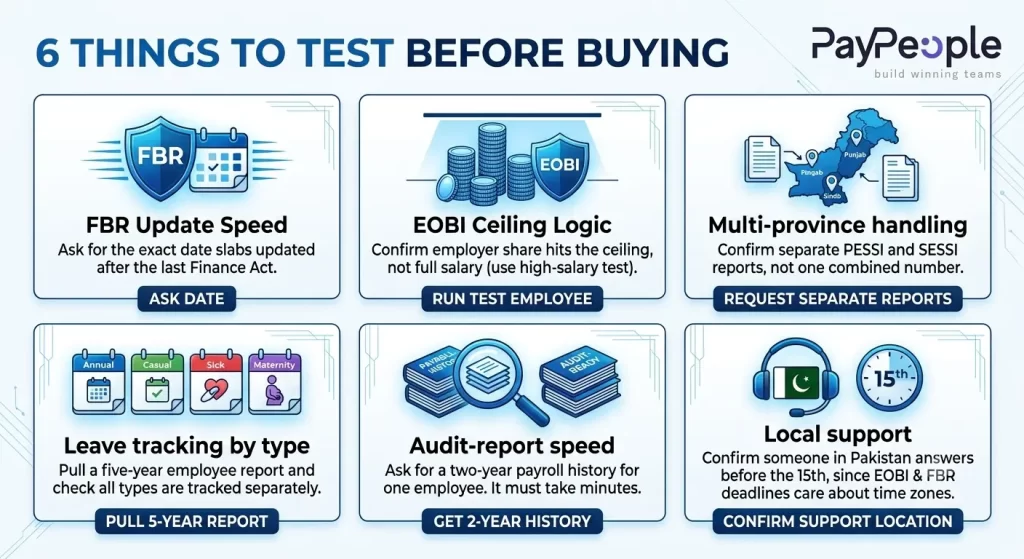
FBR update speed — ask for the exact date they updated slabs after the last Finance Act.
EOBI ceiling logic — run a high-salary test employee and confirm the employer share hits the ceiling, not full salary.
Multi-province handling — confirm separate PESSI and SESSI reports, not one combined number.
Leave tracking by type — pull a five-year employee’s leave report and check annual, casual, sick, and maternity are tracked separately.
Audit-report speed — ask for a two-year payroll history on one employee. If it takes more than a couple of minutes, it isn’t audit-ready.
Local support — confirm someone in Pakistan answers before the 15th of the month, since EOBI and FBR deadlines don’t care what time zone a vendor’s support team is in.
The Bottom Line
None of this changes what Pakistani law requires. It changes whether that requirement actually gets met every month without depending on one person’s spreadsheet habits. The failure pattern is always the same: EOBI on the wrong base, provincial social security treated as one number instead of several, tax slabs left stale past July 1, and records too scattered to produce on short notice. Software built specifically around Pakistan’s compliance rules — not retrofitted from a generic international platform — closes each of these gaps directly.
PayPeople runs this compliance logic natively: EOBI, SESSI/PESSI, and FBR handling built in, with audit-ready reporting and a Pakistan-based support team. Book a free demo or message WhatsApp +92 300 0800498 and run it against your own payroll.
Frequently Asked Questions
How is EOBI calculated in HR software for Pakistani companies?
5% from the employer, 1% from the employee, applied to the EOBI wage ceiling — not the employee's actual salary. A properly built system hard-codes that ceiling so the contribution stays correct no matter how high a salary goes, and updates automatically when EOBI revises the figure.
Can the same system handle both PESSI and SESSI?
It needs to. Punjab runs PESSI, Sindh runs SESSI, and KP and Balochistan have their own institutions again. A system that only outputs one blended "social security" number isn't built for a multi-province workforce — it needs location-based rules per employee and separate filings per province.
What happens if FBR slabs aren't updated by July 1?
Every payroll run after that date inherits the error, because the new Finance Act takes effect July 1 but the budget itself often passes in June. The gap compounds across the tax year until someone catches it, and the correction can draw more scrutiny than the original mistake.
Is HR software legally required in Pakistan?
No. No law mandates the software itself — what's mandatory is accurate tax deduction, EOBI registration, and proper records. A company can technically do this by hand. In practice, that stops being reliable somewhere around 20–30 employees, where software shifts from convenience to risk management.
What does a labour inspection actually require?
Payroll registers, proof of EOBI and social security payments, FBR withholding statements, signed contracts, and leave records. Inspections are rarely lost on whether a company followed the rules — they're lost on whether it can prove it quickly.
Does the software calculate gratuity automatically?
It should. One month's last-drawn salary per completed year of service from year five, under the relevant Standing Orders provisions. The useful version of this tracks the liability continuously instead of only computing it the day someone resigns.
Is the Workers Welfare Fund the same thing as EOBI or income tax?
No — separate obligation, roughly 2% of accounting profit, filed annually rather than monthly. It gets missed precisely because it isn't part of the monthly payroll rhythm the way EOBI and tax withholding are.