


<!– SEO METADATA Focus keyphrase: HR and payroll software in Pakistan Secondary: HR and payroll software price in Pakistan, payroll software Pakistan, Excel to payroll software migration Slug: hr-and-payroll-software-in-pakistan Full URL: https://paypeople.pk/blog/hr-and-payroll-software-in-pakistan/ Meta title: HR and Payroll Software in Pakistan: Costs and Setup (2026) [59 chars] Meta desc: HR and payroll software in Pakistan starts near Rs. 200 per employee. What it costs, what it automates, and how to move off Excel without losing a month. [153 chars] OG title: What HR and Payroll Software Actually Costs in Pakistan OG desc: Pricing from Rs. 200 per employee, FBR and EOBI automation, and a five-step migration off Excel payroll. Image alt: HR team in Pakistan reviewing the monthly salary sheet before payroll is finalised –>
Basic HR and payroll software in Pakistan starts at around Rs. 200 per employee per month. At that level the system handles FBR salary tax slabs, EOBI and provincial social security deductions, and generates payslips instead of you typing them. The real return is not the price tag. It is that your monthly salary cycle stops depending on one person’s spreadsheet and one person’s memory.
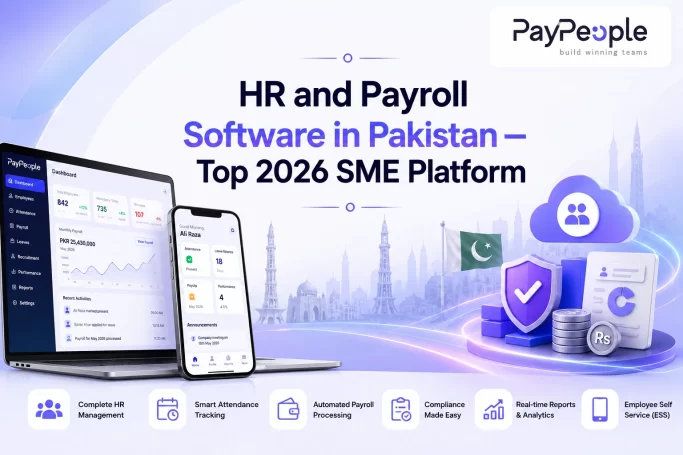
Streamline your company workflows with Pakistan’s leading HR and payroll software by PayPeople, Lahore.
Ask an HR manager in Lahore or Karachi what the last week of the month looks like and you tend to hear the same story. Attendance sheets come in late from the branch. Someone edited a formula in the salary file and nobody can say exactly when or why. A mid-year joiner’s tax has to be worked out by hand because the slab moved in the budget. Salaries go out, mostly right, and the corrections roll into the following month.
That is not a competence problem. It is a tooling problem. Excel was never designed to track statutory deductions that shift every fiscal year, across four provinces, for a headcount that keeps changing. It works fine at a dozen employees. Around thirty it starts costing you real hours, and at two hundred it starts costing you money in corrections and penalties.
Cloud payroll software is simply the point where a company decides those calculations should live in a system rather than in a file. Below is what that actually changes, what it costs locally, and how to move across without losing a month.

Running the same month twice, once in Excel and once in the new system, is the cheapest insurance you can buy during a payroll migration.
The three terms get used interchangeably in vendor marketing, which makes shortlisting harder than it needs to be. The distinction is simple.
| Payroll software | HR software | |
|---|---|---|
| Core job | Calculating and paying salaries | Managing people and records |
| Typically covers | Gross to net, FBR tax, EOBI and provincial contributions, payslips, bank files | Employee database, attendance, leave, recruitment, performance |
| Owned by | Finance or accounts | HR |
| Bought when | The monthly deadline becomes a risk | Headcount records stop being findable |
An HRMS is both of the above on one platform, with a single employee record feeding each side. If you want the fuller breakdown, including how HRMS differs from HRIS and HCM, that is covered in our guide to what an HRMS is.
Most Pakistani companies buy payroll first, because the salary deadline forces the decision every month, and add HR modules later when someone notices attendance is being typed into two systems. Either order works. What does not work is running them as two disconnected tools, because attendance is the input payroll depends on.
Most companies do not have one employee record. They have three or four: an HR file with the CNIC and joining letter, an attendance register, a salary sheet, and whatever the accounts department maintains separately. Every one of them is edited by a different person, and they drift apart quietly.
A single repository fixes the drift. Personal details, employment history, salary structure, leave balance and appraisal notes sit in one place, with access rules deciding who can see salary data and who cannot. That last part matters more than people expect. Salary information circulating as an unprotected Excel attachment is one of the most common data exposures in Pakistani offices.
Payroll is only simple when the company is small and uniform. Add overtime rates, a second branch on a different provincial contribution rule, a few contract staff, some mid-month joiners and a leaver who is owed final settlement, and the calculation becomes genuinely difficult to do by hand.
The software runs the whole sequence: gross pay, allowances, tax deduction, statutory contributions, loan or advance recovery, net pay, payslip. The deduction logic stays consistent from one month to the next, which is what auditors care about. Instead of explaining a spreadsheet, you show system logs and a calculation breakdown per employee.
Three things change on their own schedule in Pakistan: FBR‘s salaried tax slabs, which reset every 1 July when the Finance Act takes effect, EOBI contributions, which apply to a wage ceiling rather than actual salary, and provincial social security, where PESSI in Punjab and SESSI in Sindh are separate institutions with separate filings. A company paying staff in both Lahore and Karachi is running two social security systems, not one.
If those rules live inside spreadsheet formulas, every change is a manual project. If they live in the software, they are a settings update. The full breakdown of rates, deadlines and what an inspector actually asks for is covered in our HR software compliance guide for Pakistan.
Worth saying plainly: no software makes you compliant on its own. It removes arithmetic errors and keeps records that stand up to inspection. Classification of staff, contract terms and honest reporting are still management decisions.
The routine work is the expensive part. Marking attendance, approving leave, printing payslips, answering the same question from twelve people about the same deduction. Automating time and attendance does not eliminate the HR function. It frees the HR function to do hiring, training and retention properly.
Self service portals carry a lot of this. Staff check their own payslips, apply for leave, download tax certificates and update contact details without anyone opening a file for them. In practice, the most common HR queries in Pakistani offices are payslip copies and leave balances, and both disappear from the inbox once employees can see them in a mobile app.
Once payroll and attendance data sits in one system, questions that used to take a week become quick queries. What did overtime cost us last quarter, by branch? Which department has the highest turnover in the first six months? What is our real cost per employee after allowances and contributions?
That is where the value sits: not in dashboards for their own sake, but in being able to answer a board question with the number instead of an estimate.
The saving comes from three places. Fewer hours spent on manual processing. Fewer corrections, which are the hidden cost nobody tracks because they are absorbed into the next cycle. And fewer penalties from late or incorrect statutory filings.
For a company of a hundred people, the software cost is usually smaller than the salary of the additional person you would otherwise hire to keep the spreadsheets alive.
Growth is where manual payroll fails hardest. Fifty employees to five hundred is not a five hundred percent increase in effort with a spreadsheet, it is worse, because the exception cases multiply faster than the headcount. A cloud system handles the growth as configuration: new cost centres, new branch rules, new approval chains.
Remote access matters too, particularly for companies with field staff or offices in more than one city. Payroll approval from a phone in Islamabad for a branch in Karachi is now unremarkable, and HR software built for Pakistani businesses should handle multi-city structures without a separate deployment for each office.
Payroll data eventually needs to reach accounting, and HR data often needs to reach the ERP. Where the software supports integration with accounting and ERP tools, the journal entry for salary expense posts directly instead of being retyped, and headcount changes flow through without a monthly reconciliation meeting.
People judge an employer partly on whether salary arrives on time and correct. That sounds obvious, and it is still the most common complaint in exit interviews. Accurate, punctual payroll with a clear breakdown removes a persistent source of friction, and a visible leave balance removes another.
AI and machine learning are moving into HR systems, mostly in screening, attendance anomaly detection and cost forecasting. Treat these as useful additions rather than the reason to buy. The core value is still the boring part: correct salary, correct deduction, on the same day every month.
| Module | Tier | Price (PKR per employee per month) | What it covers |
|---|---|---|---|
| Core payroll | Basic | Rs. 200 | FBR tax, EOBI, automatic payslips |
| Premium HRMS | Standard | Rs. 450 | Adds multi-branch support and bank integration |
| Enterprise | Custom | Contact sales | Custom API hooks and ERP synchronisation |
Pricing usually depends on headcount tiers and contract length, so treat these as starting points and check the current pricing before budgeting.
Pro tip: Do not skip the parallel month, even under time pressure. It is the only step that proves your tax deductions, EOBI contributions and net pay all match before you retire the manual logs.
HR and payroll software is not a transformation project. It is a decision to stop running a critical monthly process on a file that one person understands. The gains are practical: consistent statutory deductions, records that survive an audit, an HR team spending time on people rather than arithmetic, and a payroll cycle that does not get harder every time you hire.
If your company is past the point where one spreadsheet can hold everything, the question is no longer whether to move. It is how cleanly you can do it, and the answer to that is mostly about running one careful parallel month before you switch.
PayPeople handles EOBI, SESSI/PESSI and FBR logic natively, with local support and PKR billing. Book a free demo and run it against your own payroll before you commit to anything.
Written by the PayPeople HR and Payroll Team. PayPeople is Pakistan-built and Pakistan-supported cloud HR, payroll and attendance software for SMEs and enterprises, with native handling of EOBI and SESSI/PESSI contributions and FBR salary tax slabs, PKR billing, and local data residency. Office: 384-E, Ali Center Plaza, 1st Floor, Johar Town, Lahore.