

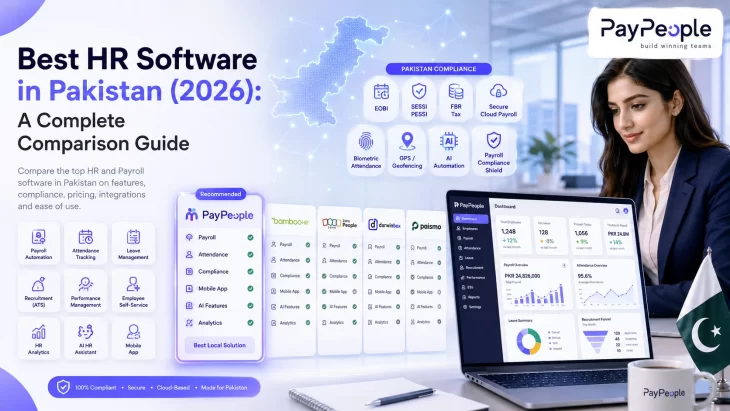
Quick Answer: There is no single “best” HR software in Pakistan for every company. For businesses that need automated EOBI/SESSI/tax compliance, biometric and field attendance, and local support, cloud HRMS platforms built for the Pakistani market — such as PayPeople — typically fit better than international generalist tools. For companies that operate across multiple countries or need deep customization, international platforms like BambooHR or Zoho People may be more suitable, provided you budget for USD-based pricing and manual compliance workarounds.
Definition — What is HRMS? An HRMS (Human Resource Management System) is software that centralizes employee records, payroll, attendance, leave, recruitment, and performance data into one platform, replacing spreadsheets and manual registers.
At a Glance:
There is no universal winner. “Best” depends on three variables: company size, payroll complexity, and industry-specific attendance needs. A 15-person startup and a 2,000-employee manufacturer have almost nothing in common in terms of HR software requirements, so any article that names one static “#1” for every reader is oversimplifying the decision.
This guide instead defines the evaluation criteria, compares platforms against them, and gives you a framework to reach your own answer.
Global HR platforms are built around US, UK, or EU labour frameworks. Pakistani payroll has its own statutory requirements that a generic system often can’t automate out of the box.
EOBI (Employees’ Old-Age Benefits Institution): A mandatory social security contribution for eligible employees, funded by both employer and employee contributions, administered federally.
SESSI / PESSI (Sindh/Punjab Employees’ Social Security Institution): Provincial social security schemes providing medical and injury benefits, with contribution rates that vary by province.
FBR income tax slabs: Pakistan’s Federal Board of Revenue publishes annual tax slabs that payroll systems must apply to correctly withhold income tax at source.
A payroll system that doesn’t natively calculate these will force your finance team into manual spreadsheet workarounds every pay cycle — which defeats the purpose of buying software in the first place. This is the single most important filter to apply before you evaluate any other feature.
Many Pakistani workplaces are not single-location, single-shift, desk-based offices. Common scenarios include:
For these environments, attendance software needs biometric device integration, GPS or geofenced mobile check-ins, and shift/roster management — not just a simple clock-in button. When comparing platforms, check specifically whether biometric integration is native or requires a third-party bridge.
The table below compares platforms commonly shortlisted by Pakistani businesses, based on publicly available product information as of 2026.
| Platform | Built For | Local Payroll Compliance (EOBI/SESSI/FBR) | Biometric/Field Attendance | Pricing Model | Best Fit |
| PayPeople | Pakistan-based businesses | Native | Biometric, GPS, geofencing | Quote-based (local PKR billing) | SMEs to enterprises needing full local compliance + AI HR agents |
| BambooHR | Global SMEs | Not native; manual workarounds needed | Limited | USD subscription | Multinational teams prioritizing UX over local compliance |
| Zoho People | Global, customizable | Not native | Add-on/manual | USD subscription, flexible tiers | Companies already using the Zoho ecosystem |
| Darwinbox | Enterprises across South Asia | Partial regional support | Yes, enterprise-grade | Enterprise quote-based | Large enterprises with dedicated implementation budget |
| Kredily | Startups, small teams | Basic/manual | Basic | Free/freemium tiers | Very small teams needing lightweight attendance + payroll |
| Paismo | Global/remote teams, EOR-focused | Not native (EOR/global payroll focus) | Biometric add-on | Per-employee USD pricing | Companies hiring internationally or using Employer of Record services |
| FlowHCM | Core HR + recruitment | Not specified/limited | Limited detail available | Not publicly listed | Companies wanting basic HCM without heavy payroll depth |
| Odoo HR | ERP-integrated businesses | Not native; requires localization module | Add-on | Per-app subscription | Companies already running Odoo ERP |
Note: Pricing and feature depth change frequently. Always confirm current details directly with each vendor before deciding.
Use this sequence rather than comparing feature lists line by line:
Pakistan-built platforms (e.g., PayPeople)
International platforms (e.g., BambooHR, Zoho People)
PayPeople is a cloud-based HR and payroll platform built for the Pakistani market, covering payroll, attendance (biometric and GPS-based), leave management, recruitment, performance management, an employee self-service mobile app, and AI-assisted HR modules for recruitment, payroll, compliance, performance, learning, and engagement analytics. It is developed by Bilytica, a technology company with a broader enterprise software portfolio, which supports the platform’s implementation and analytics capabilities. According to information published on PayPeople’s own site, the company has received recognition including the HBL P@SHA ICT Awards 2024 (Technology category) and holds ISO 27001 certification for information security — details worth independently verifying with the vendor during your evaluation, as with any vendor claim.
For companies whose primary requirement is accurate EOBI/SESSI/FBR-compliant payroll combined with field and biometric attendance tracking, this profile fits the decision framework above. For companies whose primary need is multi-country payroll or deep ERP customization, it’s worth comparing against enterprise-focused or ERP-native alternatives as well.
HR software selection doesn’t end at signing a contract — implementation, data migration, and employee onboarding to the new system are where many projects lose momentum. If you’re evaluating vendors, ask each one for a realistic implementation timeline, not just a feature list.
There isn't a single best option for every company. The right choice depends on your payroll complexity, attendance needs, and budget. Companies needing native EOBI/SESSI/FBR compliance typically do better with Pakistan-built platforms; multinational teams may prefer international tools.
Only platforms built with Pakistani payroll compliance in mind calculate these natively. Many international HR tools require manual calculation or a workaround, so this should be one of the first things you verify.
Pricing varies by vendor, employee count, and modules selected. Local platforms often quote in PKR, while international tools typically bill in USD per employee per month, which adds currency exposure. Always request a current quote directly from the vendor.
Reputable cloud HR platforms use encryption, role-based access control, and secure backups. Look for recognized certifications such as ISO 27001 as one indicator of security maturity, and ask vendors directly about their data protection practices.
Many platforms support biometric device integration, but the depth varies — some are native, others require third-party bridges. Confirm compatibility with your specific hardware before purchasing
Payroll software focuses specifically on salary calculation, tax deduction, and payslips. HRMS is broader, covering payroll plus recruitment, attendance, leave, performance, and employee records in one system.
It depends on team size and growth plans. Very small teams may start with basic payroll and attendance tools, but growing companies typically benefit from a unified HRMS to avoid switching systems later.
Choose based on your compliance and support needs. If EOBI/SESSI/FBR compliance and PKR billing matter most, a Pakistan-based vendor is usually a stronger fit. If you manage multi-country teams, an international platform may serve you better.
