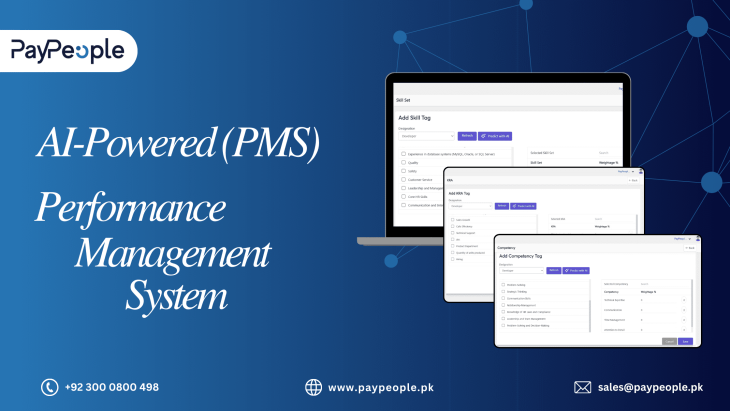
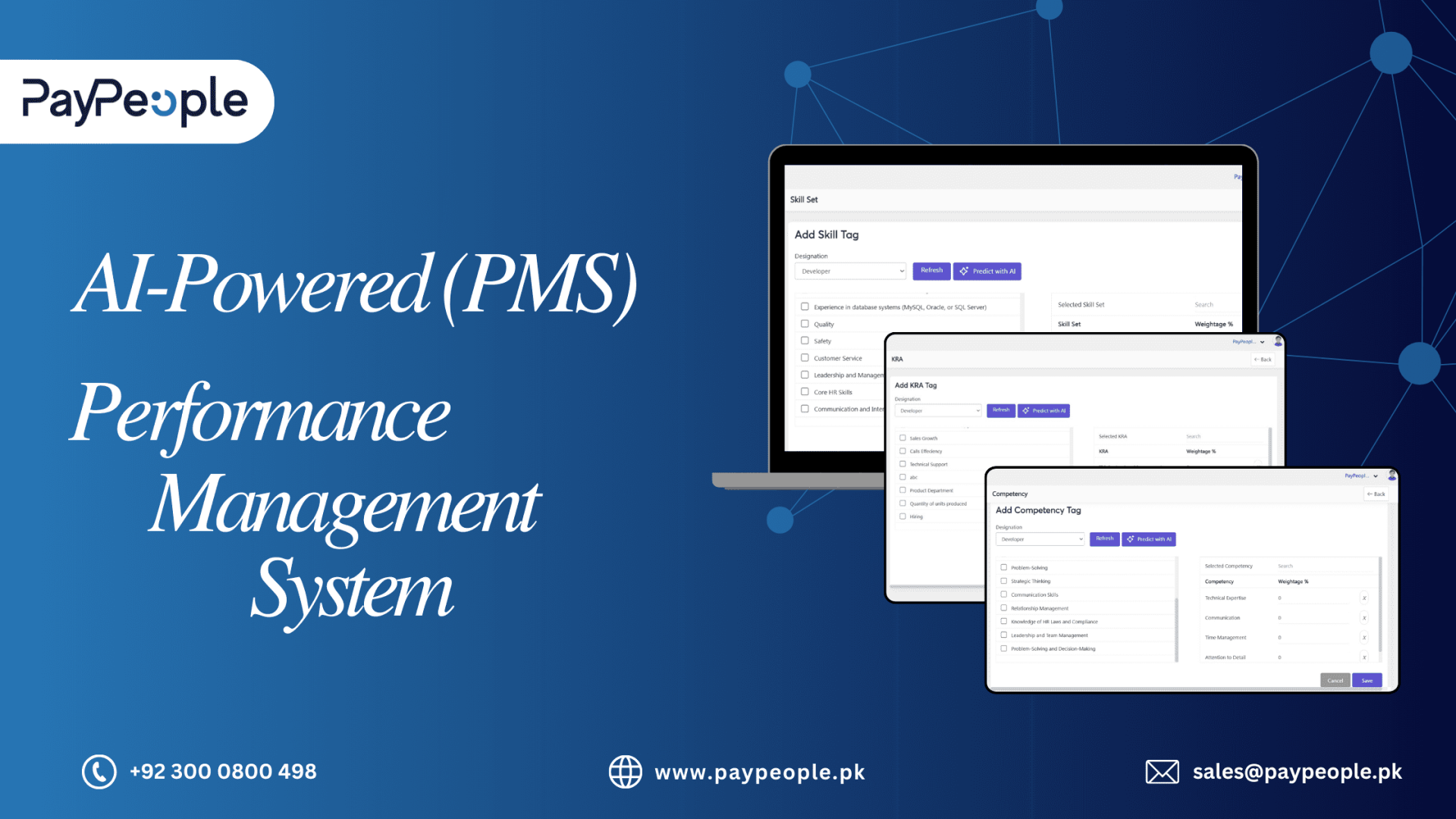
AI-Powered Performance Management: Top 2026 HR System
Improve employee output using PayPeople’s advanced ai-powered performance management platform designed for Lahore businesses.
With the fast-paced, constantly changing nature of the modern business world, organizations are under ongoing pressure to maximize performance, increase employee engagement, and stay flexible in response to changing market requirements. Perhaps one of the most powerful tools available to help businesses achieve these goals is AI-based performance management software. By incorporating artificial intelligence into legacy performance management infrastructure, companies can unlock a new generation of data-driven insights, operational effectiveness, and strategic talent cultivation.
What is AI-Driven Performance Management and how does it work?
Cycle
Method
Weight
Outcome
Quarterly Review
OKR & KPI Tracking
40%
Ongoing Coaching & PIP
Semi-Annual Check-in
360-Degree Feedback
20%
Skill Gap Analysis
Annual Appraisal
Manager & Self Rating
40%
Increment & Promotion
Performance management is the process of measuring employee performance, establishing goals, tracking progress, and giving feedback to ensure organizational goals are accomplished. In the past, the process was dominated by manual reviews, subjective judgments, and infrequent check-ins. But AI has redefined performance management as a more intelligent, real-time, and dynamic process.AI-based performance management software uses machine learning, natural language processing, and predictive analytics to free up staff from tedious tasks, recognize patterns in performance, and provide insightful analytics. These smart features not only eliminate administrative burdens but also enhance the equity, precision, and effectiveness of performance appraisals.
What should you know about major features of ai-based performance management systems?
Automated Goal Setting and Alignment
AI enables automatic alignment of personal employee goals to overall organizational goals. By pattern analysis and role-based analysis, AI systems suggest realistic and pertinent goals for each employee so their contributions directly impact business outcomes.Continuous Feedback and Real-Time Evaluations
Contrary to conventional yearly reviews, AI-driven systems allow constant tracking of performance. Employees and managers can share instant feedback, while AI tracks engagement levels, productivity rates, and behavioral patterns and offers continuous performance evaluations.Predictive Performance Analytics
AI processes past performance records and employee activities and forecasts future performance. Predictive information assists HR professionals and team managers in sensing prospective high performers, risky employees, or productivity constraints prior to affecting outcomes.AI-Powered Competency Mapping
With AI, organizations are able to map the competencies needed for each job role using industry standards, job descriptions, and internal data. The system would also be able to detect skill gaps and suggest upskilling or reskilling opportunities specific to each employee’s profile.Bias Reduction in Performance Reviews
One of the age-old problems of performance management is human bias. AI eliminates, to some extent, subjective bias, as it offers ratings based on facts and not on personal judgments. This ensures fairness and transparency while giving promotions, appraisals, and developmental feedback.Automated KRA and KPI Tracking
AI keeps the Key Result Areas (KRAs) and Key Performance Indicators (KPIs) up to date by capturing data from different systems, including CRM, project management software, or time-tracking applications. This will make performance appraisals based on real outcomes and metrics.Employee Engagement Insights
AI can gauge sentiment using surveys, communication channels, and feedback loops to gauge employee morale and engagement. Moreover, They are important in helping avoid attrition and promoting employee well-being.
What should you know about business advantages of ai-based performance management?
Improved Productivity
Performance systems based on AI automate routine administrative work, allowing managers more time for coaching and strategic planning. Employees enjoy clarity around expectations, timely feedback, and individualized growth plans—all of which lead to greater productivity.Data-Driven Decision Making
With AI, promotion, pay, and workforce planning decisions are made using real-time performance data and metrics instead of guesswork. Accuracy and fairness in HR processes are enhanced.Cost Efficiency
Performance tracking and assessment automation lowers labor and time costs in manual reviews, paperwork, and scheduling. As time passes, organizations can realize a quantifiable return on investment in the use of AI within HR processes.Better Employee Retention
AI solutions can automatically flag disengaged staff and recommend interventions, including training, mentoring, or role changes, in a timely manner. Turnover is minimized, and organizational stability is maximized.Strategic Workforce Development
AI allows HR departments to detect skill shortages within the workforce and craft tailored learning and development initiatives. Additionally, the company is well-stocked with the talent it will need to drive growth and innovation in the future.
What should you know about real-world applications across industries?
AI-based performance management software is not industry-specific. Organizations in different sectors—information technology, health care, finance, manufacturing, and education—are utilizing AI to enhance employee performance and business results.For instance, in the tech industry, enterprises apply AI applications to monitor software development cycles and measure developers’ productivity based on the output of projects as opposed to time spent. In the medical sector, performance management software assists in monitoring patient care outcomes to assess nurses and healthcare professionals. In manufacturing, AI systems measure performance based on the efficiency of production lines, quality control records, and compliance with safety protocols.
What should you know about ?
Integration with Other HR Functions
Another benefit of AI-based performance management systems is that they can easily integrate with other HR processes, including payroll, recruitment, learning management, and employee self-service portals. This integrated framework enables a comprehensive experience of every worker’s journey, from the initial onboarding to the performance phase to career development.
For example, organizations can map performance metrics to compensation systems, allowing them to reward and recognize high performers in a timely manner. Similarly, when they integrate performance management with learning management systems (LMS), they ensure that training recommendations directly address identified skill gaps and influence performance reviews effectively.
Making Certain a Successful Implementation
Though beneficial, the use of AI-driven performance management software necessitates planning. Companies need to make sure they choose a platform that suits their organization’s culture, objectives, and size.The following are the most important factors to consider:
Ease of Use: The software should be user-friendly for managers as well as employees.
Security of Data: Since performance information is sensitive, the platform should be compliant with data privacy laws and have stringent security measures.
Customization: All companies have specific KPIs and workflows. Customization of dashboards, reports, and workflows is crucial.
Training and Support: Adoption will require training HR staff and managers on utilizing the software.
Future Trends in AI-Powered Performance Management
The future of performance management will continue to change with new AI capabilities. Some expected trends are:
Natural Language Processing (NLP) to analyze qualitative feedback and employee dialogue
AI Coaches and Chatbots that support employees in becoming better at their job or enhancing skills
Augmented Decision-Making that blends the output of AI with human intuition for critical decisions
Hyper-Personalization of learning and development routes tailored to an individual’s behavior and career goals
As these technologies continue to develop, systems for managing performance will increasingly be proactive, personalized, and strategic.
Conclusion
With speed, complexity, and digitalization characterizing the age, companies can no longer depend on conventional performance review practices. Artificial intelligence-driven performance management software is a forward-looking answer that enables organizations to realize the full potential of employees. By adopting automation, predictive insights, and continuous feedback, companies can fuel productivity, boost employee engagement, and make better decisions based on real-time data.For decision-makers and HR leaders, embracing AI-powered performance management is more than a technology improvement—it is a strategic step toward the creation of a strong, high-performing, and agile organization.
As competition rises in every industry, businesses that invest in smart HR solutions now position themselves to succeed in the future workforce.
How to Launch an AI-Powered Appraisal Cycle in PayPeople
Define Goals and OKRs — Set up organizational and individual Key Result Areas (KRAs) within the PayPeople dashboard for the 2026 cycle.
Configure Review Questions — Select from pre-built templates or create custom 360-degree feedback questions tailored to your specific industry in Pakistan.
Self and Manager Evaluation — Employees complete self-assessments via the mobile app, followed by manager reviews based on real-time KPI data.
Conduct Calibration Meetings — Use AI-generated reports to compare ratings across departments to ensure consistency and eliminate subjective bias.
Finalize and Sync to Payroll — Publish final ratings and automatically update the compensation module for performance-based salary increments.
Frequently Asked Questions
What is AI-Powered Performance Management?
AI-Powered Performance Management uses machine learning to analyze employee data, automate OKR tracking, and remove subjective bias. In Pakistan, this helps HR departments move from manual Excel-based reviews to real-time, data-driven appraisals that improve fairness and productivity.
How does goal cascading work in AI-powered systems?
PayPeople enables a transparent OKR cascading system where CXO-level objectives are broken down into departmental goals. Employees in cities like Lahore and Karachi can see exactly how their daily KPIs contribute to the company’s overall success in Pakistan.
How can we avoid rating inflation in our appraisals?
PayPeople’s AI-Powered Performance Management includes a calibration tool that visualizes rating distributions. This helps Pakistani HR leaders identify ‘easy graders’ and ensures that ratings are bell-curved fairly across different departments and branches.
Does the software link performance ratings to increments?
Yes, PayPeople is built for the Pakistani market. The performance ratings an employee receives can be mapped to a budget, allowing for automatic calculation of salary increments while staying compliant with the latest FBR tax slabs for 2026.
What are the benefits of 360-degree feedback?
A 360-degree review gathers feedback from peers, subordinates, and managers. This provides a multi-dimensional view of an employee’s professional behavior, which is essential for leadership development in large Pakistani organizations.
Can AI performance software integrate with attendance data?
Our system integrates directly with biometric attendance devices across Pakistan. This allows managers to view a complete picture of performance, including punctuality and hours worked, alongside qualitative KPI achievements.