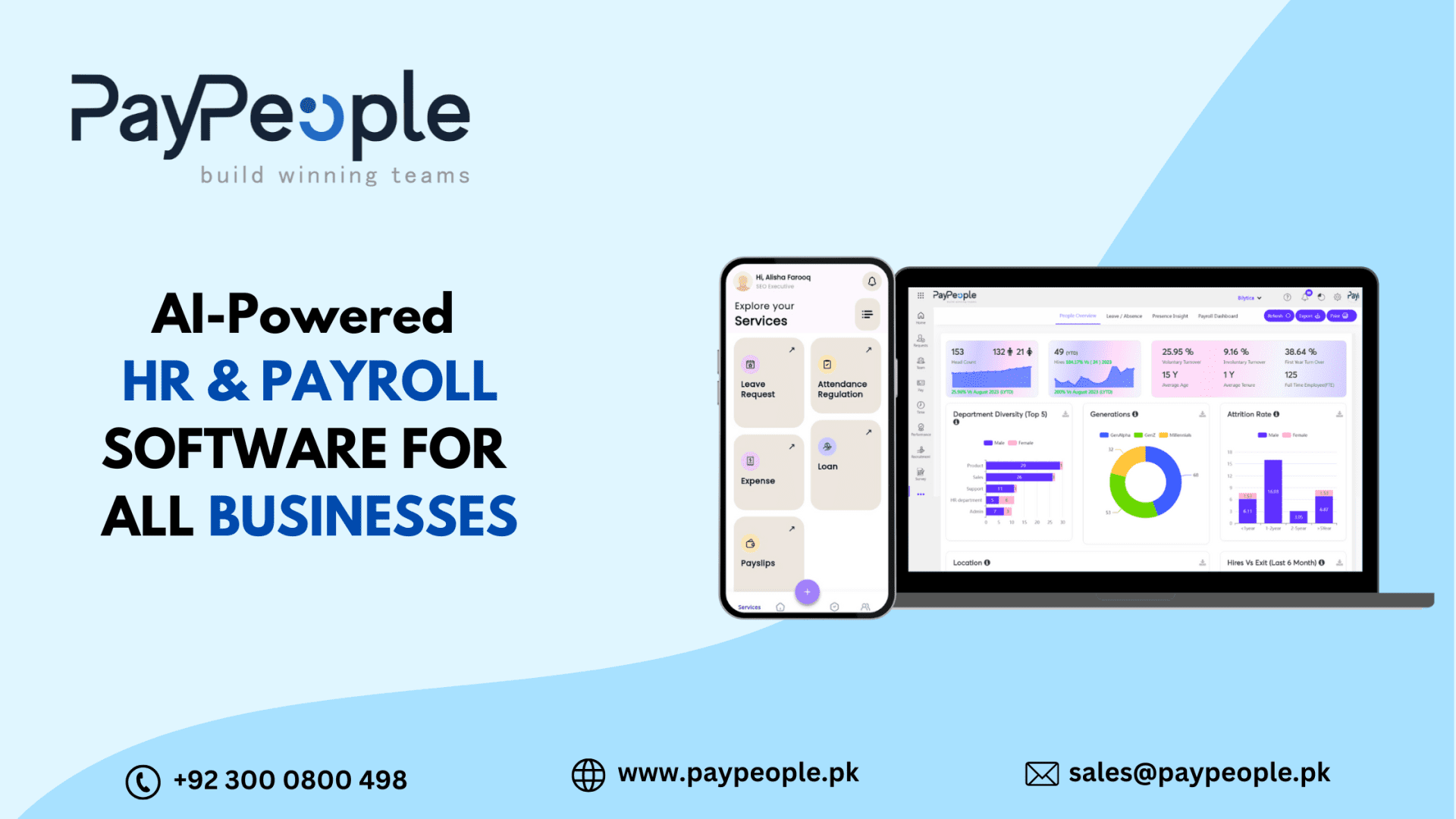

In today’s dynamic business environment, staying competitive means embracing technology that streamlines processes, enhances productivity, and facilitates strategic growth. Among the most significant innovations reshaping workplaces is AI-powered HR and Payroll software—an intelligent solution that automates routine tasks, enhances employee experiences, and provides actionable insights for decision-makers.
Modern enterprises, regardless of their size or industry, are transitioning away from manual HR processes to adopt end-to-end digital platforms that integrate payroll, employee tracking, performance management, recruitment, and more—all within a single, unified suite. Businesses that implement AI-powered HR and payroll systems are not just streamlining their operations; they are building a workforce strategy that aligns with the future of work.
| Module | Tier | Price (PKR/employee/month) | Notes |
|---|---|---|---|
| Core Payroll | Essential | Rs. 400 | EOBI, FBR Tax, and Bank File Export |
| Full HRMS | Growth | Rs. 650 | Includes Leaves & Attendance Tracking |
| AI-Powered Enterprise | Premium | Rs. 900 | Predictive Analytics & AI Recruitment |
Traditionally, the HR department has been seen as an administrative function, focused on managing employee records, processing payroll, and ensuring compliance. But that perception is rapidly changing. HR leaders are now expected to deliver strategic value: improving talent acquisition, boosting workforce productivity, reducing turnover, and guiding organizational culture.
To meet these expectations, HR and payroll professionals require digital tools that are intelligent, agile, and scalable. This is where AI-powered software comes into play. It automates labor-intensive tasks while delivering data-driven insights that empower organizations to make faster, smarter decisions.
AI-powered HR and Payroll software refers to an integrated digital platform that uses artificial intelligence and machine learning technologies to streamline workforce management processes. From onboarding new hires and managing employee attendance to generating payslips and ensuring tax compliance, AI automates repetitive tasks and minimizes human error.
But it goes beyond automation. These platforms leverage predictive analytics, natural language processing (NLP), AI chatbots, and machine learning algorithms to support everything from smarter hiring to personalized learning and development.
Here are the standout capabilities of AI-driven HR and payroll systems that can revolutionize how your business manages its people:
Payroll Software is one of the most time-consuming HR functions. AI eliminates manual data entry, calculates salaries, tax deductions, benefits, and generates payslips with exceptional accuracy. The result? Faster payroll cycles, fewer errors, and higher employee trust.
Through geofencing and biometric integrations, AI-powered Employee Tracking Software enables businesses to monitor attendance, shift patterns, and remote work activity in real time. This enhances workforce visibility and promotes accountability, crucial for enterprises with hybrid or distributed teams.
AI-powered recruitment tools can scan thousands of resumes within seconds, match candidates to job roles based on predefined skills and requirements, and even conduct preliminary assessments. This leads to faster hiring, better candidate fit, and reduced cost per hire.
AI doesn’t just report what’s happening—it predicts what will happen next. With historical data and behavioral analysis, predictive algorithms help businesses forecast attrition, skill shortages, and workforce demands. This allows for proactive planning and smarter HR investments.
A modern workforce expects autonomy. With AI-enabled self-service portals, employees can view payslips, apply for leave, update personal information, and access policy documents—without HR intervention. This not only saves HR time but also improves the employee experience.
AI-powered performance management systems track KPIs, feedback, and goals in real-time. By analyzing employee behavior and results, it offers personalized coaching suggestions, flags performance risks, and identifies high-potential employees for leadership development.
With ever-evolving labor laws and tax regulations, compliance is a major concern for businesses. AI helps stay compliant by automatically updating statutory components, generating audit trails, and ensuring error-free reports, minimizing legal and financial risks.
Investing in AI-powered HR and payroll solutions delivers more than just operational efficiency. It enables businesses to:
Reduce Administrative Overhead: Automate repetitive tasks like payroll, timesheets, and attendance management.
Enhance Data Accuracy: Minimize manual errors with automated calculations and AI validation checks.
Improve Decision-Making: Get access to real-time dashboards and predictive analytics for faster, evidence-based strategies.
Boost Employee Engagement: Enable self-service, mobile access, and intelligent HR communication for a more empowered workforce.
Scale with Ease: Whether expanding teams or entering new regions, cloud-based systems scale without disrupting workflows.
In a world driven by speed, data, and personalization, companies cannot afford to rely on outdated systems. Businesses that delay digital transformation risk falling behind competitors who are already leveraging AI for superior HR operations.
Moreover, as remote and hybrid work models become the norm, enterprises need agile systems that provide 360-degree visibility into employee performance, engagement, and compliance—anytime, anywhere. AI-powered HR software supports these needs by making workforce management seamless and strategic.
If your organization falls into any of the following categories, AI HR technology is not just useful—it is essential:
Growing SMEs are seeking to automate basic HR and payroll tasks to focus on scaling the business.
Large enterprises need centralized platforms to manage a dispersed workforce.
Industries with shift-based operations, such as retail, manufacturing, logistics, or healthcare, where attendance tracking and overtime calculations to be complex.
Companies are experiencing high turnover and require smarter talent acquisition and retention tools.
Businesses in highly regulated environments need compliance automation and audit readiness.
At PayPeople, we understand the challenges faced by modern HR teams and business owners. That’s why we have developed a complete HR and payroll suite powered by AI, tailored for businesses in Pakistan and beyond.
Our intelligent platform includes:
AI-Powered Payroll Engine with automated calculations, tax deductions, and compliance.
Employee Tracking Software with real-time attendance, shift monitoring, and location data.
Smart Recruitment System that automatically matches candidates to job descriptions using AI screening.
Performance Management Module with skill-based AI recommendations and KRA tracking.
Self-Service Portals that empower your workforce and reduce HR workload.
AI Buddy and LMS to personalize employee learning journeys and provide real-time support.
PayPeople is not just software—it’s your digital HR partner, designed to future-proof your workforce and give you a competitive advantage in the ever-evolving business world.
Artificial Intelligence is no longer a futuristic concept—it is a present-day business imperative. Companies that adopt AI-powered HR and Payroll software are not just automating processes; they are creating a smarter, more adaptive, and more engaged workforce.
Whether you are a growing startup or a multi-location enterprise, investing in AI-driven HR solutions will unlock new levels of efficiency, accuracy, and strategic clarity. As the workplace continues to evolve, now is the time to embrace intelligent systems that help you stay ahead competitively, operationally, and culturally.
You can explore our other blogs, like

AI-powered HR and payroll software in Pakistan automates the deduction of EOBI, SESSI, and PESSI by applying the latest government-mandated rates. The system automatically calculates employer and employee shares, generates payment challans, and ensures your business remains 100% compliant with provincial labor laws without manual data entry.
Our AI engine is updated in real-time following FBR budget announcements. AI-powered HR and payroll software automatically adjusts monthly tax withholding based on the latest income tax slabs for salaried individuals, ensuring correct deductions for basic salary, house rent, and utilities without recalculating Excel formulas every year.
Yes, AI-powered HR and payroll software generates bank-ready CSV and Excel files compatible with all major Pakistani banks, including HBL, Meezan, and Bank Alfalah. This allows for bulk IBFT transfers, meaning you can process hundreds of salaries in a single click rather than entering manual transactions.
Absolutely. AI-powered HR and payroll software is designed for multi-location businesses. You can manage employees in Karachi, Lahore, and Islamabad from a single cloud dashboard, with regional access controls for branch managers while centralizing the final salary processing at headquarters.
Yes, AI-powered HR and payroll software automates the entire offboarding process. It calculates notice period pay, encashment of pending leaves, and gratuity or provident fund balances based on the employee’s years of service and the company’s specific policy, ensuring a fair and fast final settlement.
One of the biggest benefits of AI-powered HR and payroll software is instant delivery. Once payroll is locked, the system automatically sends professional PDF payslips to every employee via WhatsApp and Email, reducing administrative costs and improving employee transparency across the board.