
In today’s rapidly evolving business landscape, staying competitive and agile is critical. Companies are increasingly turning to innovative technologies to streamline operations and enhance employee performance. One such technological advancement is the AI-powered Performance Management System (AI PMS). This intelligent system uses artificial intelligence to optimize the way organizations monitor, assess, and improve employee performance, providing both employers and employees with more efficient, data-driven insights.
| Cycle | Method | Weight | Outcome |
|---|---|---|---|
| Quarterly | OKR Check-ins | 30% | Skill Alignment |
| Mid-Year | Progress Review | 20% | Course Correction |
| Annual | 360-Degree Feedback | 50% | Increment & Promotion |
Performance management is a structured process through which firms keep track and evaluate employees’ performance, detect areas for enhancement, and define goals for long-term growth. Previously, performance management depended a great deal on human effort, sporadic reviews, and subjective evaluations. Although this method fulfilled its aim, it tended to result in biases, inefficiencies, and unreliable feedback.
With the infusion of AI, performance management is transforming. AI PMS solutions leverage data analytics, machine learning algorithms, and predictive models to deliver more precise, real-time feedback on the performance of employees. Through the use of technology, organizations are able to transition from a reactive, subjective process to a proactive, objective, and ongoing performance management system.
PayPeople’s AI-driven PMS depends on large data sets to produce actionable information regarding employee performance. Through the aggregation of data across multiple touchpoints—e.g., employee interactions, project performance, and feedback—AI can develop a complete view of individual performance and assist in improved decision-making. These systems can look for patterns over time, which makes them more capable of detecting strengths, weaknesses, and areas of improvement.
In contrast to conventional performance management systems that usually offer feedback during quarterly or annual reviews, AI PMS offers continuous, real-time feedback. This enables employees to get timely advice and recommendations, which can improve their performance and motivation. Continuous feedback promotes a culture of ongoing improvement and enables employees to align their goals with the organization’s goals.
AI PMS software can generate individualized development plans for employees according to their performance records. Such plans may include training suggestions, mentorship programs, and career development recommendations customized to the needs of each individual. PayPeople AI tracks progress and updates these plans as needed, ensuring that employees remain on course for professional development.
AI systems can identify future performance trends by examining past data. Through recognizing patterns and correlations, AI systems can assist managers in anticipating possible issues and opportunities. For example, AI can notify managers of under-performing staff or indicate high-potential talent within the company. This is possible through predictive analytics, enabling better–informed decisions such as providing extra training, new projects, or assistance to employees that are underperforming.
AI PMS systems can also help ensure greater employee engagement and retention levels. With personalized feedback, the opportunity to grow, and career development tracks, such systems make employees feel important and nurtured. Employees want to remain with organizations that take care of their growth, and AI-driven PMS systems are instrumental in creating a scenario where employees can flourish.
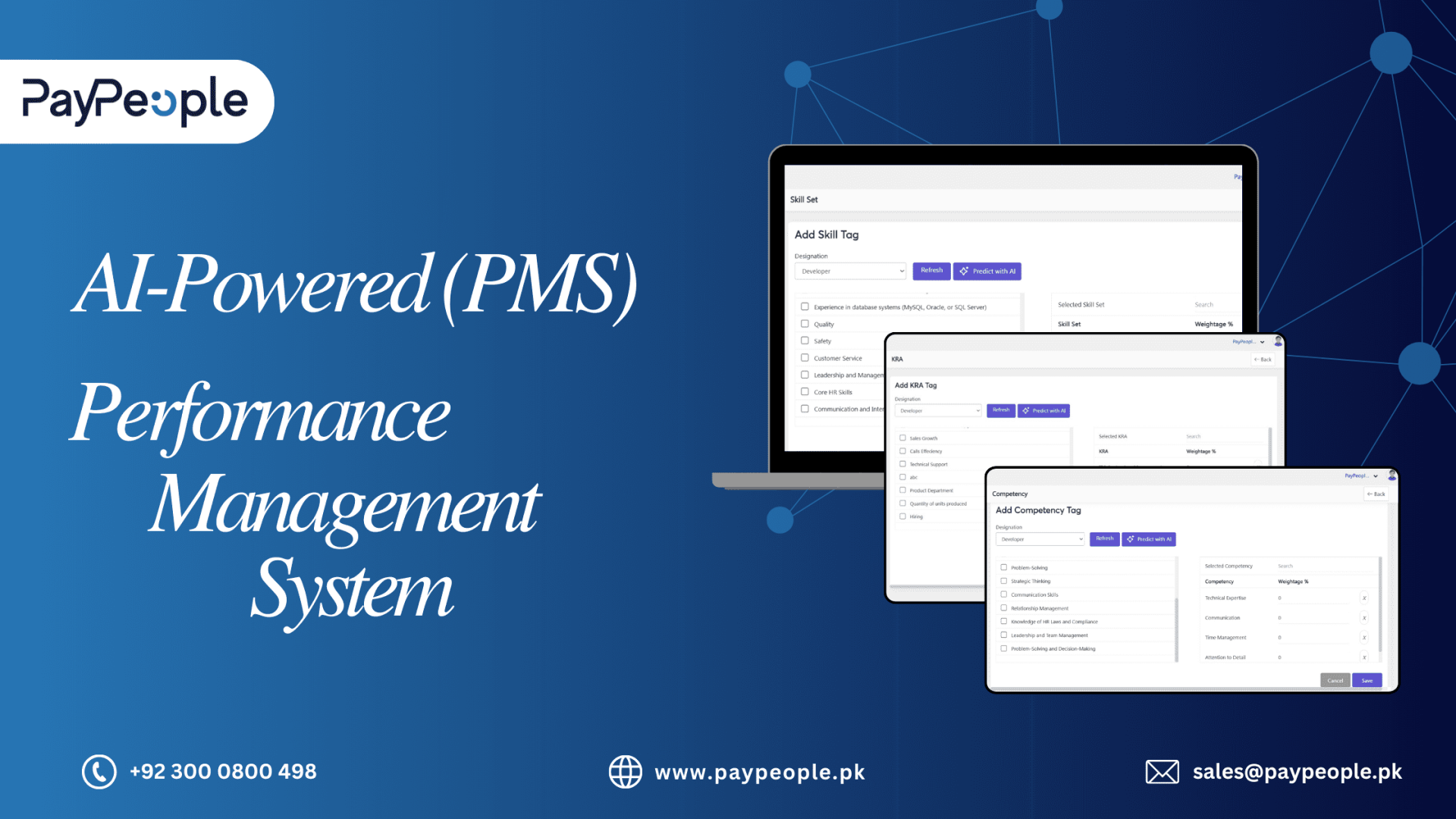
PayPeople’s AI performs the tagging of KRAs automatically by examining job descriptions and performance. This is done to maintain consistency, save time, and ensure that individual goals remain in sync with larger business goals.
Increased Efficiency
With most aspects of performance management automated by AI PMS, the burden on HR personnel and managers in terms of paperwork is minimized. Functions like receiving feedback, appointing review, and creating reports are simplified and thus enable the HR professionals to devote more time to strategic interventions. This operational efficiency results in a more efficient performance management system.
Enhanced Accuracy
AI PMS systems deliver more precise employee performance insights since they are based on objective facts and not on subjective appraisals. This precision guarantees that employees are judged in a fair manner and that the performance data is credible for decision-making activities like promotions, salary increments, and training requirements.
Improved Employee Experience
With the capability to provide personalized feedback and development plans, AI PMS systems improve the employee experience. Employees enjoy the timely and constructive feedback and the opportunity to continuously improve. A system that enables their growth and success eventually leads to greater job satisfaction and loyalty.
Strategic Decision-Making
AI PMS gives managers and HR professionals beneficial insights that aid data-driven decision-making. With the capability to receive real-time performance data, leaders can make more informed decisions regarding resource allocation, talent management, and organizational growth. These strategic choices can have a direct influence on overall business performance and achievement.
Though AI-based performance management systems have many benefits, there are a few challenges to their adoption:
Data Privacy and Security
AI PMS systems rely heavily on employee data, which raises concerns about data privacy and security. Organizations must ensure that they comply with data protection regulations and implement strong security measures to safeguard sensitive employee information.
Initial Investment and Integration
Implementing an AI-powered system requires a significant upfront investment in terms of both financial resources and time. Organizations must also ensure that the AI PMS integrates seamlessly with existing HR systems and processes. This may require additional training for HR staff and employees.
Dependence on Technology
Although AI can enhance the performance management process, there is a risk of over-reliance on technology. It’s essential for organizations to strike a balance between AI-driven insights and the human touch, ensuring that managers remain actively involved in guiding and supporting their teams.
As AI technology keeps advancing, the future of performance management is even brighter. AI systems will be more advanced, able to provide even more insightful and personalized recommendations. The combination of AI with other technologies, including employee well-being apps and collaboration tools, may give rise to a complete ecosystem for employee performance and engagement management.
Furthermore, with more and more companies adopting remote and hybrid work models, AI PMS will be responsible for maintaining the efficacy of performance management, irrespective of geography. With tracking of performance over digital means and virtual feedback, AI will act as an intermediary between remote teams and managers.

AI PMS uses machine learning and data analytics to provide objective, real-time feedback. Unlike traditional systems that rely on subjective annual reviews, an AI-powered PMS identifies performance patterns and skill gaps continuously, ensuring fairer appraisals for employees across Pakistan.
Yes, PayPeople allows CXOs to set high-level OKRs which are then cascaded down to departments and individuals. This ensures every employee in your Lahore or Karachi office understands how their daily tasks contribute to the company’s overall strategic goals.
A 360-degree feedback module collects performance insights from peers, direct reports, and supervisors. This provides a multi-dimensional view of an employee’s performance, reducing individual manager bias and providing a more comprehensive review during the appraisal cycle.
Calibration sessions allow leadership to review and adjust ratings across departments to ensure consistency. The AI PMS helps visualize the ratings distribution, preventing rating inflation and ensuring that rewards like increments are handed out based on a standardized performance curve.
PayPeople’s AI PMS features manager and employee self-service dashboards. Employees can track their own goal progress in real-time, while managers can monitor team heartbeats, approve feedback, and identify high-potential talent instantly through a centralized cloud portal.
Absolutely. The system generates a final performance score based on weighted KPIs and OKRs. This score can be used by HR to calculate salary increments and identify candidates for promotion, making the entire rewards process transparent and data-backed.