


If you’re comparing HR software in Lahore, you’ve probably noticed the same problem with most “top HR software” articles: they read like a single vendor’s pitch with a few competitor names sprinkled in for SEO. This guide is built differently — it’s a genuine comparison to help you shortlist the right HRMS for your business, whether that’s PayPeople or another provider on this list.
We’ll cover what HR software actually does, the features worth comparing before you commit, a quick side-by-side table, and a closer look at seven options businesses in Lahore commonly evaluate.
HR software (sometimes called an HRMS — Human Resource Management System, or HRIS — Human Resource Information System) is a digital platform that centralizes core HR tasks: employee records, payroll, attendance, leave, recruitment, and performance management. Instead of managing these processes across spreadsheets, paper files, and separate tools, an HRMS brings them into one system that HR teams, managers, and employees can all access.
The terms HRMS, HRIS, and HCM (Human Capital Management) are often used interchangeably in the Pakistani market. In practice, they describe the same broad category of software — the differences tend to be in emphasis (HRIS leans toward records and reporting, HCM toward talent and performance) rather than in strict technical boundaries.
Lahore’s business environment — from startups in DHA and Gulberg to manufacturing and retail operations with staff across multiple sites — has grown past the point where manual HR processes hold up. A few reasons businesses in the city are moving to dedicated HR software:
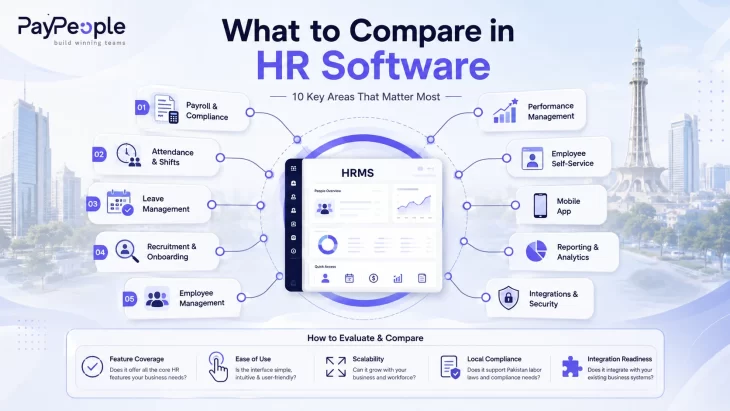
Not every business needs every module — a 15-person startup and a 300-person manufacturer have different priorities. Here’s what’s worth comparing across the vendors you shortlist:
| Software | Best For | Key Features | Main Strength | Deployment |
| PayPeople | SMEs to large, multi-location businesses in Pakistan | Payroll, attendance, recruitment, performance, ESS, LMS, field-force tracking, AI Buddy | Broad module coverage with local compliance focus | Cloud and on-premises |
| PeopleQlik | Larger enterprises needing deep analytics | Talent management, multi-currency payroll, HR analytics | Extensive enterprise feature set | Confirm with vendor |
| Bayt HRMS | Businesses wanting full employee-lifecycle coverage | Recruitment through payroll in one system | Broad lifecycle coverage, user-friendly interface | Confirm with vendor |
| HR Ways | SMEs wanting a lightweight, cloud-first tool | ESS, leave management, time tracking, document management | Simple, accessible interface | Cloud-based |
| Sapphire HRMS | Businesses wanting a highly customizable, locally built system | Configurable modules for specific business processes | Strong customization | Confirm with vendor |
| SAP SuccessFactors | Large enterprises already in the SAP ecosystem | Employee Central, recruiting, performance & goals, learning | Globally established enterprise HCM suite | Cloud-based (confirm local implementation/support) |
| Cresset HRMS | Businesses of all sizes wanting a user-centric HR platform | Employee engagement/surveys, talent acquisition, performance management, learning & development | Emphasis on employee experience | Cloud and on-premises |
Feature availability, pricing, and support terms vary by vendor and plan — confirm current specifics directly with each provider before deciding.
PayPeople is a cloud-based HRMS built for businesses operating in Pakistan, covering the employee lifecycle from recruitment through offboarding. It’s used by 800+ clients across industries including HealthTech, FinTech, EdTech, tech startups and SaaS, manufacturing, retail and e-commerce, logistics and supply chain, food and beverage, green energy, and pharmaceuticals.
SMEs through large, multi-location businesses in Pakistan wanting broad module coverage in a single platform, with either cloud or on-premises deployment.
The module set is wide enough to cover payroll, attendance, recruitment, performance, and learning without stitching together separate tools, and both deployment options give businesses with specific data-residency or infrastructure needs a choice.
As with any provider, confirm current pricing, implementation timelines, and specific integration compatibility for your accounting/ERP stack directly with PayPeople — feature depth can vary by plan.
For a closer look at PayPeople’s full platform, see the AI-powered HRMS for businesses in Pakistan.
PeopleQlik, a product of Bilytica, is aimed at larger enterprises needing a more analytical, feature-dense HR platform.
Larger organizations with complex, multi-entity HR requirements that benefit from deeper analytics and reporting.
The extensive feature set and analytics focus suit enterprises that need granular workforce data, not just core HR processing.
The broader feature set may be more than a smaller business needs — confirm implementation scope and support model before committing.
Bayt is positioned as a comprehensive system covering recruitment and onboarding through payroll in a single platform, with an emphasis on a user-friendly interface.
Businesses wanting one system that covers the full employee lifecycle without assembling separate tools.
Full-lifecycle coverage in one interface can simplify HR operations for teams that don’t want to manage multiple point solutions.
Confirm which modules are included at each pricing tier — “full lifecycle coverage” can mean different things depending on the plan selected.
HR Ways is a Lahore-based, cloud-first HR tool that leans toward small and medium enterprises.
SMEs wanting a simple, accessible platform without a heavier enterprise feature set.
The interface is built for smaller teams that want the essentials — attendance, leave, and self-service — without a steep learning curve.
Ask specifically how the platform handles growth if you expect to scale headcount or add multiple branches.
Sapphire is a locally developed HR software solution known for its customization capabilities.
Businesses with workflows that don’t fit a rigid, one-size-fits-all HR system.
Strong customization can be valuable for businesses with unusual approval chains, org structures, or industry-specific processes.
Highly customized systems can come with longer implementation timelines — confirm current timelines and support terms directly with the vendor.
SAP SuccessFactors is a globally established, cloud-based HCM suite from SAP, covering Employee Central (core HR), recruiting, performance & goals, and learning.
Large enterprises, particularly those already using other SAP products, that need a globally standardized HCM platform.
As a widely used global platform, it offers deep functionality and integration options for large, complex organizations.
It’s built for a global market rather than Pakistan specifically — confirm local implementation partners, support availability, and Pakistan-specific payroll/compliance handling before shortlisting it for local operations.
Cresset HRMS is a modern HR software solution focused on enhancing employee experience, suitable for businesses of all sizes in Lahore.
Businesses that want to prioritize employee engagement and experience alongside core HR functions.
The user-centric design and engagement tools stand out for companies focused on retention and employee satisfaction, not just administrative processing.
Confirm current module pricing and whether cloud or on-premises deployment better fits your infrastructure before deciding.
For a deeper look at how AI is changing what to look for in a platform, see our complete buyer’s guide to AI-powered HR software in Pakistan.
Exact pricing varies by vendor, plan, and modules selected — rather than quote numbers that may be outdated, here’s what actually drives the cost:
Ask each vendor for a current, written quote based on your actual headcount and module needs — that’s the most reliable way to compare cost across providers.
For smaller teams, the priority is usually getting core payroll, attendance, and leave management right without paying for enterprise-scale features you won’t use yet. Lighter, cloud-first tools like HR Ways can be a good starting point, while platforms like PayPeople offer a phased-rollout approach — starting with payroll, attendance, and leave, then adding recruitment or performance management as the business grows.
Larger and multi-branch businesses should weight scalability, role-based permissions, field-force tracking, and reporting more heavily. Platforms with deeper analytics and enterprise-scale support — such as PeopleQlik or SAP SuccessFactors for large-organization reporting needs, or PayPeople for businesses wanting local compliance handling alongside field-force tracking and flexible deployment — tend to fit this profile better than lighter SME-focused tools.
There isn’t a single right answer for “which HR software is best in Lahore” — it depends on your headcount, payroll complexity, number of locations, and which modules you actually need. If local payroll compliance, broad module coverage, and flexible deployment matter most, PayPeople’s complete HR and payroll platform is worth including in your shortlist. If deep customization is the priority, Sapphire is worth a look; if you want a lightweight SME-focused tool, HR Ways may fit better; for enterprise-scale analytics, PeopleQlik or SAP SuccessFactors are reasonable comparison points; and if employee experience is your main lens, Cresset is worth evaluating.
The most reliable next step is the same regardless of which provider you lean toward: request a demo from your top two or three shortlisted vendors and test them against your actual payroll and attendance data, not just their feature lists.