

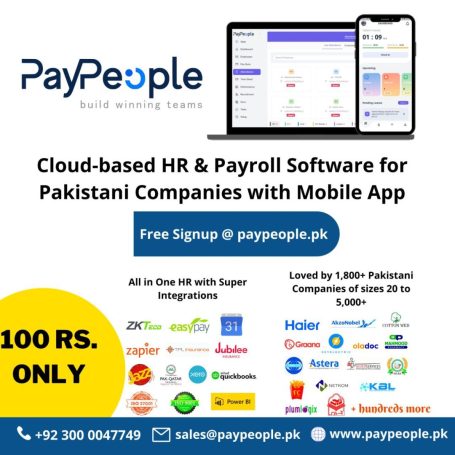
HRMS in Karachi Pakistan helps modern businesses automate essential people management tasks, from maintaining secure employee records to streamlining self-service approval workflows. As the commercial hub of Pakistan, Karachi-based companies face unique challenges in managing high-growth teams while ensuring data security and organizational transparency.
A human resource management system (HRMS) acts as the central digital workspace for your entire workforce, replacing fragmented spreadsheets with a single, secure cloud platform. By implementing a modern HRIS, businesses in Karachi can foster a better employee experience through transparency and digital-first human resource processes.
In a competitive market like Karachi, an HRMS in Karachi Pakistan is essential because it eliminates administrative bottlenecks that stall business scaling. Manually managing employee data, document folders, and reporting lines is error-prone and takes hours of time from your HR team every week.
With a centralized cloud system, you gain the agility to manage hundreds of employees across multiple Karachi branches without increasing your administrative headcount.
Data security is a top priority for Pakistani firms, and a modern HRMS ensures that sensitive employee documents and master data are protected by role-based access. Instead of keeping physical files or unprotected Excel sheets, a cloud HRIS encrypts your data and allows you to define exactly who can see salary details, personal IDs, or performance reviews.
This audit-trail compliance is vital for Karachi companies aiming for ISO certification or international partnerships.
The employee self-service (ESS) portal is one of the most transformative features of an HRMS in Karachi Pakistan, allowing staff to manage their own profiles. Employees can log in to view their digital org chart, submit expense claims, and request leaves without sending endless emails to HR.
This autonomy increases employee satisfaction and reduces the burden on HR managers by up to 40%, as colleagues can find answers to basic queries directly through their mobile or web login.
| Module | Self-Service | Workflow Builder | Price (PKR/employee/month) |
|---|---|---|---|
| Core HR & Directory | Yes | Basic | Rs. 400 |
| Advance HRMS + Leave | Yes | Customizable | Rs. 600 |
| Enterprise HRIS Suite | Full Access | Multi-Level | Rs. 900+ |
Yes, an HRMS providing a real-time organizational chart and reporting hierarchy helps Karachi business owners visualize their team structure instantly. With clear reporting lines, approval workflows for claims and expenses follow a logical path, ensuring that managers are automatically notified of pending requests.
This structured approach prevents delays in decision-making and ensures everyone knows their role within the growing hierarchy of a Pakistani SME.
A centralized document vault in your HRMS ensures that all vital records—from CNICs and educational degrees to employment contracts—are stored digitally against the employee profile. For businesses in Karachi, this means no more searching through filing cabinets during audits.
The system maintains a complete master data record for every individual, documenting their entire journey from onboarding to exit in a single, searchable database.
For a standard Pakistani SME in Karachi, migrating from spreadsheets to a cloud HRMS typically takes between 2 to 4 weeks. This timeline includes scoping your specific modules, importing your existing org structure, and configuring user roles.
Onboarding employees is often the fastest part, as modern systems like PayPeople allow for bulk invites where staff can complete their own profiles through the ESS portal, significantly speeding up the data collection phase.
Choosing the right HRMS in Karachi Pakistan is about more than just software; it is about building a scalable foundation for your people management. By moving to a cloud platform, you ensure your business remains agile, secure, and ready for future growth. Book a demo today to see how PayPeople can transform your HR operations.
SMEs in Karachi Know Pakistan Crucial Business Cc74899 adopt HRMS in karachi from PayPeople for three repeatable reasons: native EOBI / SESSI / PESSI and FBR-tax-slab handling, per-employee-per-month PKR billing that scales with headcount, and a Pakistan-based support team that answers in working hours. Most teams move off Excel or a legacy desktop HRMS once the monthly payroll run takes more than two working days, or once a multi-branch payroll consolidation becomes a source of reconciliation errors.
The most-used modules in Karachi Know Pakistan Crucial Business Cc74899 are payroll, biometric attendance and leave — these three together cover 80% of the day-to-day HR workload for a 50–250-employee SME. Recruitment, performance and expense modules are typically rolled out in a second phase 60–90 days after go-live, once managers are comfortable with self-service and approval workflows. PayPeople bills per-employee-per-month in PKR, starting around Rs. 400 for core HR + payroll, with volume discounts above 100 employees and custom enterprise pricing for multi-branch setups.
Compliance is the deal-decider. EOBI and SESSI/PESSI contribution rates are maintained centrally and pushed to every customer’s payroll run, so you don’t manually patch tax tables when the federal budget changes. FBR income-tax slabs for salaried employees update the same way. The full monthly return — EOBI form, SESSI/PESSI form, FBR salary withholding statement — is generated from one screen, signed off and archived in the audit trail. Multi-branch payroll consolidates into a single GL-coded export ready for the accounting team.
Getting started in Karachi Know Pakistan Crucial Business Cc74899: book a 30-minute demo at paypeople.pk/book-a-demo, the team hands you a 7-day sandbox with sample employees and a pre-configured tax slab, and you run one parallel-payroll month against your existing process before cutover. Total go-live for a typical Pakistani SME is 2–4 weeks; multi-branch enterprise rollouts take 6–8 weeks. WhatsApp +92 300 0800498 or email sales@paypeople.pk to start.
An HRMS in Karachi Pakistan is vital because it automates repetitive tasks like record-keeping and leave approvals. For Karachi-based businesses, it provides a secure, centralized cloud platform to manage high-growth teams, ensuring data security and helping HR managers focus on strategic employee engagement instead of manual data entry.
A modern HRMS ensures data security through role-based access control and encrypted cloud storage. Companies in Karachi can restrict access to sensitive information like salary data and personal documents, ensuring only authorized managers can view specific records, which is crucial for internal privacy and audit compliance.
Self-Service allows employees in Karachi to view their own profiles, request leaves, and download documents without HR assistance. This autonomy reduces daily emails to the HR department and empowers employees, leading to higher satisfaction levels and more efficient people management within the organization.
The reporting hierarchy in an HRMS defines who reports to whom and who approves specific requests. For Karachi businesses, this ensures that leave requests or expense claims are automatically routed to the correct manager, bringing transparency and speed to the entire approval process.
Most cloud HRMS platforms operate on a per-employee-per-month model. In Karachi, pricing typically starts around Rs. 400 per employee for core modules. This affordable SaaS model allows Pakistani SMEs to access enterprise-grade human resource systems without a massive upfront investment in hardware.
A document vault provides a secure digital repository for all employee-related files like CNICs, appointment letters, and certificates. Karachi firms benefit from this by having 24/7 access to records from any location, eliminating the need for bulky physical filing cabinets and reducing the risk of document loss.