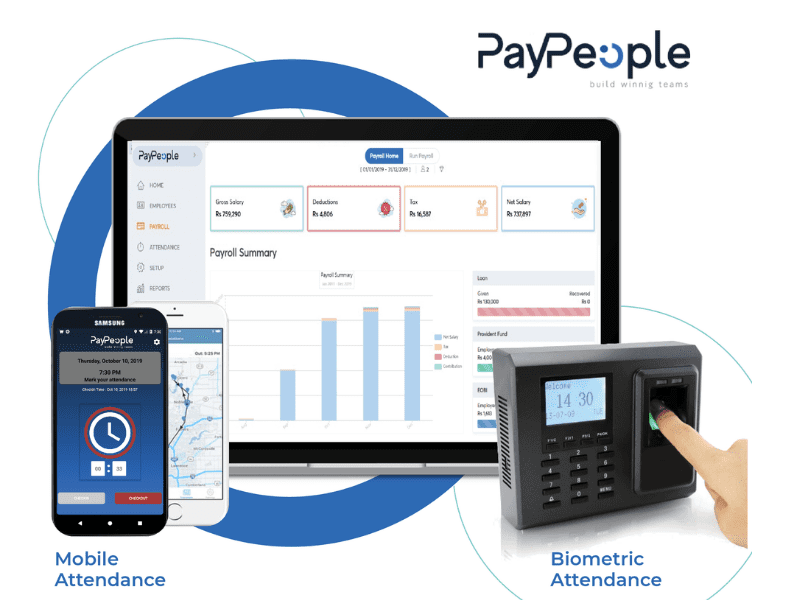

Attendance software in Islamabad Pakistan helps businesses transition from manual registers to automated cloud-based tracking, ensuring precise clock-ins for every employee. In the fast-paced corporate environment of the capital, managing shifts, overtime, and EOBI-integrated attendance is no longer a luxury but a necessity for operational efficiency.
Modern attendance software in Islamabad provides a centralized platform to manage diverse workforces across Blue Area, F-6, or industrial zones like I-9. By automating time tracking, firms eliminate “buddy punching” and manual entry errors that often lead to payroll discrepancies. This digital shift ensures that every minute worked is captured accurately, reflecting a professional and transparent work culture.
Biometric attendance software in Islamabad utilizes fingerprint, facial recognition, or iris scanning to verify identities definitively. This technology ensures that only authorized personnel can record their presence, effectively securing the office perimeter. For Islamabad-based tech firms and government contractors, this layer of security is vital for maintaining audit trails and protecting sensitive facility access while simplifying the daily check-in process.
Cloud-based attendance software in Islamabad is designed to handle remote teams and field staff through mobile app geo-fencing. Sales teams or site engineers working in Rawalpindi or outskirts can clock in via their smartphones, with the system verifying their GPS location in real-time.
This flexibility allows HR managers at headquarters to monitor attendance across multiple sites simultaneously without requiring physical hardware at every location.
Shift and roster management in attendance software in Islamabad allows managers to create complex schedules for 24/7 operations, typical in healthcare or BPO sectors. The system supports rotating shifts, night differentials, and break tracking, automatically alerting supervisors of understaffing or late arrivals.
This automation reduces the administrative burden on HR, allowing them to focus on employee engagement rather than fixing schedule conflicts.
Biometric systems in Pakistan integrate directly with cloud payroll modules to pull real-time attendance strings for automated salary calculation. When an employee marks their attendance, the software calculates late arrivals, half-days, and overtime based on pre-defined company policies.
This seamless sync ensures that month-end payroll is processed in minutes rather than days, with all deductions documented clearly according to Pakistani labor laws.
Attendance software in Islamabad typically supports industry-leading hardware such as ZKTeco, Hikvision, and Suprema devices. These devices connect via LAN or Wi-Fi to the cloud server, pushing logs instantly to the HR dashboard. Whether your company prefers fingerprint sensors for cost-effectiveness or touchless facial recognition for hygiene, the software acts as the intelligent bridge between physical hardware and digital reporting.
| Device Type | Capacity | Sync Frequency | Monthly Cost (PKR) |
|---|---|---|---|
| Fingerprint (ZKTeco) | 1,000 Users | Real-time | Rs. 400/employee |
| Facial Recognition | 3,000 Users | Real-time | Rs. 550/employee |
| Mobile (Geo-fenced) | Unlimited | Instant Push | Rs. 300/employee |
| Hybrid (Face + Thumb) | 5,000 Users | Real-time | Rs. 650/employee |
Implementing reliable attendance software in Islamabad Pakistan is the first step toward a paperless and compliant HR department. For teams looking to scale, PayPeople offers the most localized and secure solution in the capital. Book a demo today to see how we can transform your office management.
SMEs in Islamabad Top Beneficial Company Cc74470 adopt Attendance Software in Islamabad from PayPeople for three repeatable reasons: native EOBI / SESSI / PESSI and FBR-tax-slab handling, per-employee-per-month PKR billing that scales with headcount, and a Pakistan-based support team that answers in working hours. Most teams move off Excel or a legacy desktop HRMS once the monthly payroll run takes more than two working days, or once a multi-branch payroll consolidation becomes a source of reconciliation errors.
The most-used modules in Islamabad Top Beneficial Company Cc74470 are payroll, biometric attendance and leave — these three together cover 80% of the day-to-day HR workload for a 50–250-employee SME. Recruitment, performance and expense modules are typically rolled out in a second phase 60–90 days after go-live, once managers are comfortable with self-service and approval workflows. PayPeople bills per-employee-per-month in PKR, starting around Rs. 400 for core HR + payroll, with volume discounts above 100 employees and custom enterprise pricing for multi-branch setups.
Compliance is the deal-decider. EOBI and SESSI/PESSI contribution rates are maintained centrally and pushed to every customer’s payroll run, so you don’t manually patch tax tables when the federal budget changes. FBR income-tax slabs for salaried employees update the same way. The full monthly return — EOBI form, SESSI/PESSI form, FBR salary withholding statement — is generated from one screen, signed off and archived in the audit trail. Multi-branch payroll consolidates into a single GL-coded export ready for the accounting team.
Getting started in Islamabad Top Beneficial Company Cc74470: book a 30-minute demo at paypeople.pk/book-a-demo, the team hands you a 7-day sandbox with sample employees and a pre-configured tax slab, and you run one parallel-payroll month against your existing process before cutover. Total go-live for a typical Pakistani SME is 2–4 weeks; multi-branch enterprise rollouts take 6–8 weeks. WhatsApp +92 300 0800498 or email sales@paypeople.pk to start.
Attendance software in Islamabad Pakistan helps businesses by automating the tracking of employee clock-ins and outs. It eliminates manual errors, prevents time theft like buddy punching, and ensures that payroll is calculated accurately based on real-time data, which is essential for the capital’s growing corporate sector.
Our attendance software in Islamabad supports a wide range of devices, including ZKTeco, Hikvision, and Suprema. We offer integration for fingerprint, facial recognition, and RFID card readers, ensuring your existing hardware can often be linked directly to our cloud-based HRMS platform.
Yes, the mobile app includes geo-fencing features specifically designed for field staff in Islamabad and Rawalpindi. This allows employees to clock in only when they are within a designated GPS radius, providing HR with verified location data without needing a physical biometric machine.
PayPeople attendance software in Islamabad allows for unlimited shift configurations. You can set up rotating rosters, night shifts, and flexible timings. The system automatically identifies which shift an employee is working based on their clock-in time, making roster management effortless for HR.
The software automatically calculates late-coming and short-leave based on your specific company rules. You can define grace periods (e.g., 15 minutes) and set logic for half-day deductions or “3 lates equals 1 leave” policies, ensuring consistent policy application across your Islamabad office.
Attendance logs sync instantly with our payroll module. At the end of the month, the software reconciles total hours worked, overtime, and unpaid absences to generate precise payslips. This local integration is specifically built to handle Pakistani tax and labor configurations.