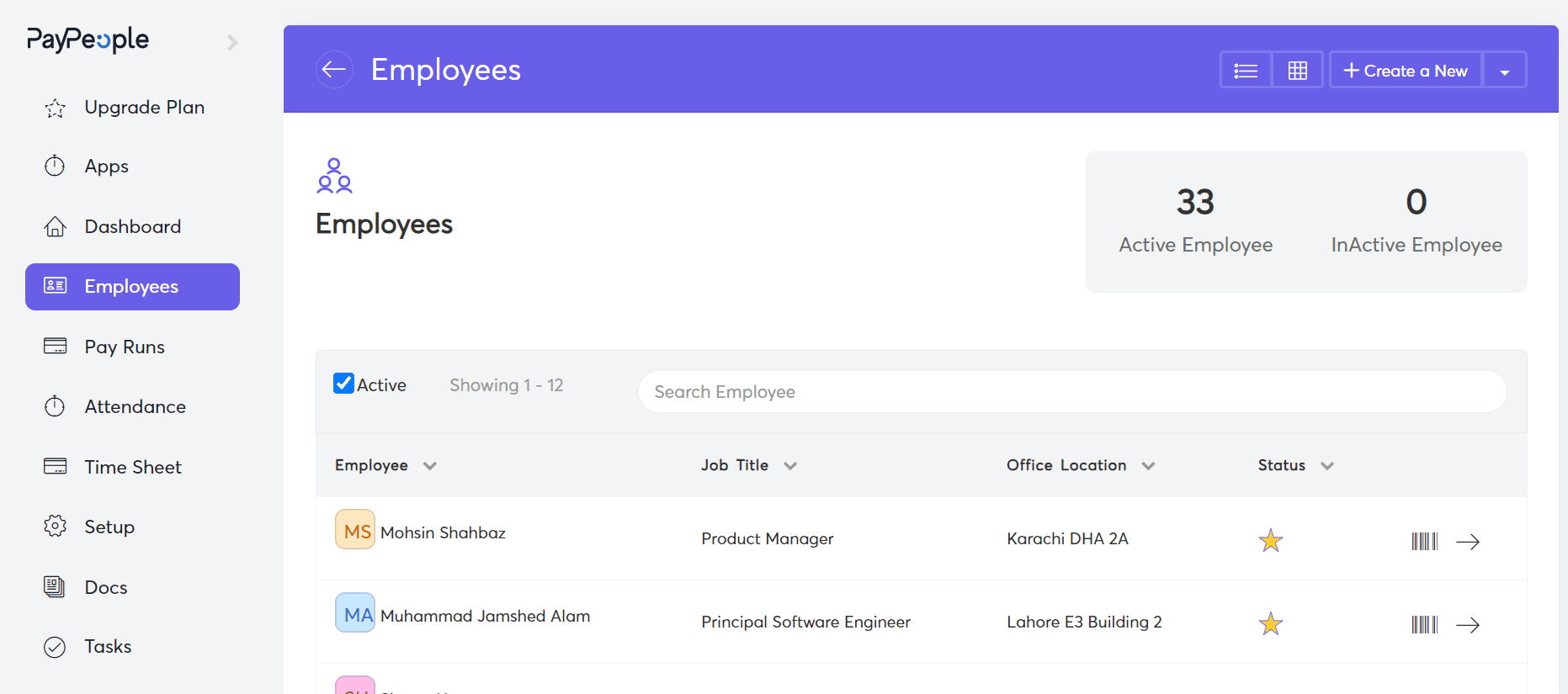

Payroll software in Pakistan is essential for organizations looking to move away from error-prone manual Excel sheets to automated, localized salary processing. Whether you are an SME in Lahore or a large enterprise in Karachi, managing monthly wages while staying compliant with EOBI, FBR tax slabs, and SESSI contributions requires a dedicated cloud-based system.
Payroll software in Pakistan must automatically calculate EOBI and SESSI contributions based on the latest government wage limits. For instance, the system should deduct the employee’s share and calculate the employer’s contribution without manual intervention, ensuring your monthly vouchers are accurate for submission to provincial authorities like PESSI or SESSI.
Automating FBR income tax slabs for salaried employees is a core feature of PayPeople, ensuring that as tax laws change in the annual budget (e.g., June/July updates), your payroll calculations adjust instantly. The software handles progressive tax brackets, rebates, and tax-on-tax scenarios, generating professional payslips that clearly show all statutory deductions at a glance.
The benefits of bank-file export for monthly salary include the ability to generate bulk transfer files (IBFT) compatible with all major Pakistani banks like HBL, Meezan, and Bank Alfalah. Instead of manual data entry on bank portals, you simply upload the export file from PayPeople, reducing the risk of payment errors and significantly speeding up the disbursement of wages.
The software supports multi-branch payroll consolidation, allowing companies with offices in Lahore, Karachi, and Islamabad to manage everything from a single dashboard. You can set different holiday calendars for different regions or provinces while maintaining a unified salary processing workflow that rolls up into a master financial report for the CFO.
Final settlement and gratuity are calculated by accounting for the employee’s total tenure, unused leaves, and final month’s salary components according to Pakistan’s labor laws. The system automates the clearance process, ensuring that notice period adjustments and provident fund balances are reconciled accurately before the final payment is disbursed.
WhatsApp and email payslip delivery is important for modern Pakistani workforces who favor mobile accessibility. Instead of printing paper slips, PayPeople sends secure, password-protected PDF payslips directly to employees’ phones. This not only saves administrative costs but also provides workers with an instant record of their earnings and deductions.
| Module | Tier | Price (PKR/employee/month) | Notes |
|---|---|---|---|
| Basic Payroll | SME | Rs. 300 | FBR tax + Automated Payslips |
| Standard HRMS | Growth | Rs. 500 | EOBI/SESSI + Bank Transfers |
| Enterprise | Corporate | Rs. 800+ | Multi-branch + Custom Workflows |
Choosing the right payroll software in Pakistan allows your HR team to focus on talent growth rather than data entry. By automating statutory compliance and salary processing, you ensure peace of mind for both management and employees. Book a demo with PayPeople today to streamline your organization’s payroll.
SMEs in Pakistan For Your Organization adopt Payroll Software in Pakistan from PayPeople for three repeatable reasons: native EOBI / SESSI / PESSI and FBR-tax-slab handling, per-employee-per-month PKR billing that scales with headcount, and a Pakistan-based support team that answers in working hours. Most teams move off Excel or a legacy desktop HRMS once the monthly payroll run takes more than two working days, or once a multi-branch payroll consolidation becomes a source of reconciliation errors.
The most-used modules in Pakistan For Your Organization are payroll, biometric attendance and leave — these three together cover 80% of the day-to-day HR workload for a 50–250-employee SME. Recruitment, performance and expense modules are typically rolled out in a second phase 60–90 days after go-live, once managers are comfortable with self-service and approval workflows. PayPeople bills per-employee-per-month in PKR, starting around Rs. 400 for core HR + payroll, with volume discounts above 100 employees and custom enterprise pricing for multi-branch setups.
Compliance is the deal-decider. EOBI and SESSI/PESSI contribution rates are maintained centrally and pushed to every customer’s payroll run, so you don’t manually patch tax tables when the federal budget changes. FBR income-tax slabs for salaried employees update the same way. The full monthly return — EOBI form, SESSI/PESSI form, FBR salary withholding statement — is generated from one screen, signed off and archived in the audit trail. Multi-branch payroll consolidates into a single GL-coded export ready for the accounting team.
Getting started in Pakistan For Your Organization: book a 30-minute demo at paypeople.pk/book-a-demo, the team hands you a 7-day sandbox with sample employees and a pre-configured tax slab, and you run one parallel-payroll month against your existing process before cutover. Total go-live for a typical Pakistani SME is 2–4 weeks; multi-branch enterprise rollouts take 6–8 weeks. WhatsApp +92 300 0800498 or email sales@paypeople.pk to start.
PayPeople automatically applies the current EOBI and SESSI/PESSI contribution rates for Pakistani employees. It generates monthly contribution reports and vouchers, ensuring your business stays compliant with provincial and federal labor laws without needing manual Excel calculations.
Yes, the software is updated annually following the FBR budget announcement. It handles the progressive tax slabs for salaried individuals, including tax credits and excess tax adjustments, ensuring monthly FBR tax withholding is 100% accurate.
PayPeople generates bank-ready CSV and Excel files compatible with all major commercial banks in Pakistan (HBL, Alfalah, Meezan, etc.). You can simply download the file from the payroll module and upload it to your corporate banking portal for instant IBFT transfers.
Absolutely. PayPeople allows you to manage multiple office locations (e.g., Karachi, Lahore, and Islamabad) under one account. You can configure branch-specific holiday calendars and cost centers while processing a single consolidated payroll for the entire company.
PayPeople offers a secure employee self-service portal where staff can download their monthly payslips. Additionally, the system can automatically send payslips via email or WhatsApp as soon as the salary is disbursed.
The final settlement module automates the calculation of notice period pay, leave encashment, gratuity, and any outstanding provident fund balances. It ensures that the exit process is legally compliant and documented for both the employer and employee.