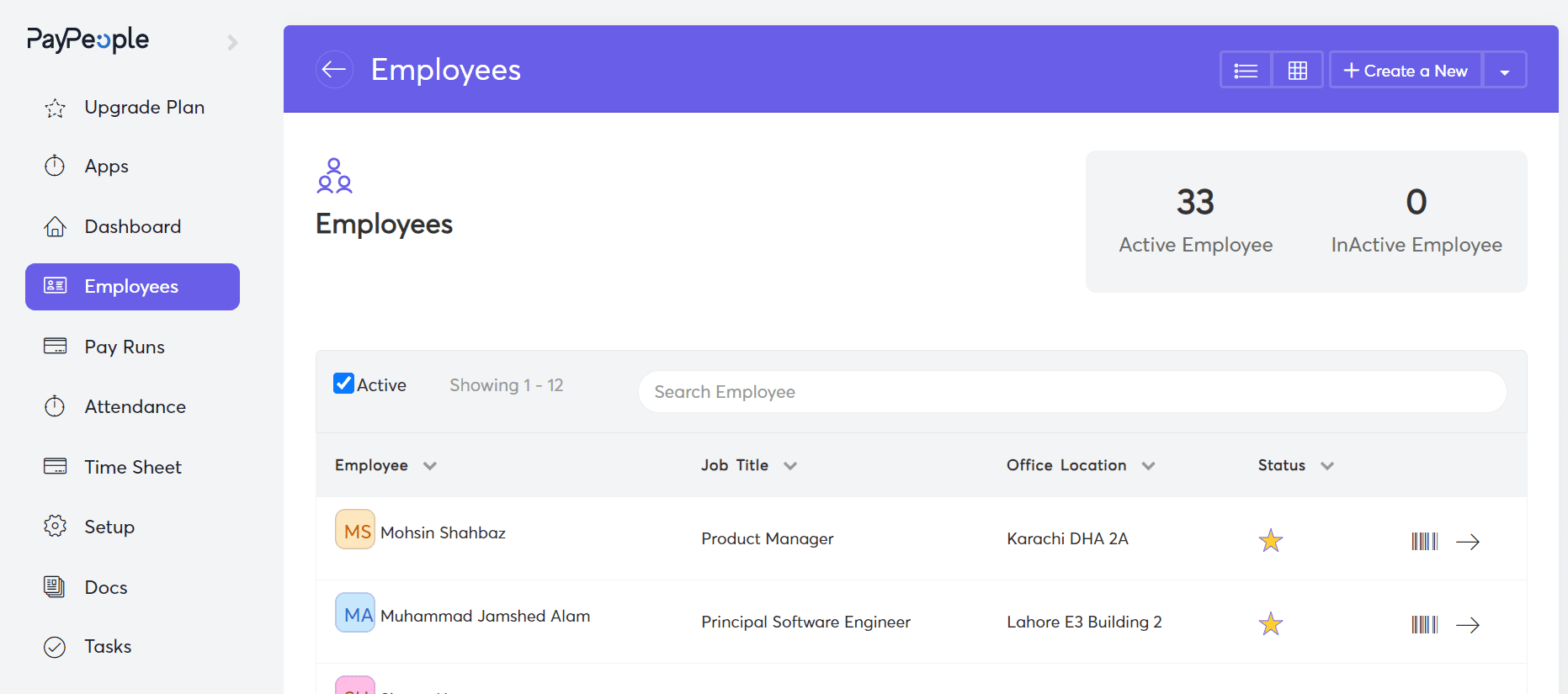

Payroll software in Pakistan helps business owners automate salary processing, ensure EOBI compliance, and manage FBR income tax slabs without the manual errors of Excel. As Pakistani businesses scale, managing monthly wages, bank file exports (IBFT), and final settlements becomes a legal necessity under labor laws. PayPeople provides a localized cloud solution designed specifically for the unique regulatory landscape of Karachi, Lahore, Islamabad, and beyond.
The primary function of payroll software in Pakistan is to automate the calculation of “Gross to Net” salary while factoring in local statutory deductions. This includes automatic calculation of income tax based on the latest FBR slabs, EOBI contributions, and SESSI/PESSI requirements.
By automating these, businesses eliminate the risk of non-compliance fines. A professional system also generates automated payslips that can be delivered via WhatsApp or email, ensuring transparency for the workforce.
FBR income tax slabs for salaried individuals often change during the annual federal budget in June. Modern payroll software in Pakistan must be agile enough to update these tax brackets instantly so that July salaries reflect accurate deductions.
The system calculates taxable income by considering basic salary, house rent, utilities, and other allowances, then applies the progressive tax rates automatically, saving the finance team hours of manual tax planning and calculation.
EOBI (Employees’ Old-Age Benefits Institution) and SESSI/PESSI (Social Security) contributions are mandatory for most registered businesses in Pakistan. The software maintains the current minimum wage baseline and contribution percentages (e.g., 5% employer and 1% employee for EOBI).
Instead of calculating these per person in a spreadsheet, the payroll engine identifies eligible employees and generates the monthly contribution reports in a single click, ready for portal submission.
One of the biggest time-savers for Pakistani SMEs is the bank file export function. Rather than manually entering 50 or 500 bank account numbers into a portal like Allied Bank, HBL, or Meezan, the software generates a bulk transfer file (CSV or XLS) in the bank’s exact format.
This allows for instant salary disbursement via IBFT, significantly reducing the gap between salary generation and actual payment arrival in employee accounts.
The final settlement (Full and Final) for a departing employee is often a complex calculation involving notice period pay, encashable leaves, and gratuity or provident fund balances. Cloud payroll software in Pakistan automates this by pulling data from the employee’s entire tenure.
It calculates the gratuity based on the last drawn salary and years of service as per Pakistani labor law, ensuring the business and the employee reach a fair, legally compliant closing figure.
For businesses with offices in different cities—like a head office in Karachi and factory in Faisalabad—centralized payroll software is vital. It allows for location-specific cost centers while maintaining a unified group payroll.
Furthermore, for IT companies or exporters in Pakistan who may peg salaries to the USD or other currencies, the system handles real-time currency conversion and tax calculation based on the PKR value at the time of processing.
| Module | Tier | Price (PKR/employee/month) | Notes |
|---|---|---|---|
| Core Payroll | Starter | Rs. 300 | FBR tax slabs, EOBI, and Digital Payslips. |
| Compliance Plus | Professional | Rs. 450 | SESSI/PESSI, Bulk Bank Files, and Gratuity. |
| Enterprise HRMS | Custom | Contact Sales | Multi-branch, Multi-currency, and API access. |
Choosing the right payroll software in Pakistan ensures that your business stays compliant with EOBI and FBR while providing a professional experience to your employees through timely wages and transparent payslips. Book a demo today to see how PayPeople can transform your HR operations.
SMEs in Pakistan That Every Business Owner Should adopt Payroll Software in Pakistan from PayPeople for three repeatable reasons: native EOBI / SESSI / PESSI and FBR-tax-slab handling, per-employee-per-month PKR billing that scales with headcount, and a Pakistan-based support team that answers in working hours. Most teams move off Excel or a legacy desktop HRMS once the monthly payroll run takes more than two working days, or once a multi-branch payroll consolidation becomes a source of reconciliation errors.
The most-used modules in Pakistan That Every Business Owner Should are payroll, biometric attendance and leave — these three together cover 80% of the day-to-day HR workload for a 50–250-employee SME. Recruitment, performance and expense modules are typically rolled out in a second phase 60–90 days after go-live, once managers are comfortable with self-service and approval workflows. PayPeople bills per-employee-per-month in PKR, starting around Rs. 400 for core HR + payroll, with volume discounts above 100 employees and custom enterprise pricing for multi-branch setups.
Compliance is the deal-decider. EOBI and SESSI/PESSI contribution rates are maintained centrally and pushed to every customer’s payroll run, so you don’t manually patch tax tables when the federal budget changes. FBR income-tax slabs for salaried employees update the same way. The full monthly return — EOBI form, SESSI/PESSI form, FBR salary withholding statement — is generated from one screen, signed off and archived in the audit trail. Multi-branch payroll consolidates into a single GL-coded export ready for the accounting team.
Getting started in Pakistan That Every Business Owner Should: book a 30-minute demo at paypeople.pk/book-a-demo, the team hands you a 7-day sandbox with sample employees and a pre-configured tax slab, and you run one parallel-payroll month against your existing process before cutover. Total go-live for a typical Pakistani SME is 2–4 weeks; multi-branch enterprise rollouts take 6–8 weeks. WhatsApp +92 300 0800498 or email sales@paypeople.pk to start.
Payroll software in Pakistan like PayPeople is updated annually to reflect the latest FBR tax slabs for salaried individuals. It automatically calculates the monthly tax withholding based on the employee’s annual projected income, allowances, and perquisites, ensuring you never face penalties during tax audits.
Yes, the software automatically calculates both employer and employee contributions for EOBI and SESSI/PESSI. It uses the current government-mandated minimum wage and percentage rates to generate monthly contribution reports, saving HR teams from manual calculation errors.
Absolutely. You can generate bulk salary transfer files compatible with major Pakistani banks like HBL, Meezan, and Bank Alfalah. These files allow you to upload hundreds of payments to your corporate banking portal for instant IBFT disbursement.
Cloud payroll software allows you to manage multiple branches—such as offices in Lahore and Karachi—within a single dashboard. You can set up localized holidays and cost centers while processing group-wide payroll centrally.
The software automates the entire ‘Full and Final’ settlement process. It calculates gratuity according to Pakistani labor laws, adjusts remaining leave balances, and computes the final tax liability for the departing employee in a single step.
PayPeople is a localized, Pakistan-built cloud solution that handles specific local needs like EOBI, FBR tax slabs, and local bank formats. Unlike international software, we provide local support and currency-compliant billing in PKR.