


Quick answer: The Punjab Labour Code 2026 (Act IX of 2026) was enacted on 10 February 2026, consolidating more than two dozen older Punjab labour laws into one code. It has not yet taken legal effect — commencement depends on a separate notification the Punjab government has yet to confirm as issued. Once it does commence, the biggest payroll-relevant changes are: annual leave rising from 14 to 18 days, maternity leave rising from 12 to 14 weeks, and end-of-service gratuity extending to management, fixed-term, and contract staff after just one year of service, instead of five.
If you read our HR compliance guide for Pakistan, you’ve already seen the current leave and gratuity figures under existing law. This article explains what changes once the Punjab Labour Code 2026 takes effect, and — just as importantly — how to check whether it already has.
This is the question every other question depends on, and it’s the one most coverage of the Code gets wrong by omission.
The Punjab Provincial Assembly passed the Code on 4 February 2026. It received the Governor’s assent and was published in the Punjab Gazette as Act IX of 2026 on 10 February 2026. That is enactment — the law formally exists.
Enactment is not the same as commencement. Under the Code’s own commencement clause, its substantive provisions come into force only on a date the Punjab government specifies through a separate notification in the official Gazette. Legal commentary published as recently as early September 2026 states this notification had still not been confirmed as issued, and that the pre-existing legal framework — the laws the Code is meant to replace — remains in force until it is. One earlier news report, from May 2026, described the law as having been “enforced,” but this appears to conflate the enactment date with a confirmed commencement notification, and more recent, source-cited legal analysis does not support that the substantive provisions are yet operative.
The Punjab Provincial Assembly passed the Code on 4 February 2026. It received the Governor’s assent and was published in the Punjab Gazette as Act IX of 2026 on 10 February 2026. View the Punjab Labour Code 2026 on the official Punjab Laws website
What this means practically: do not change your payroll configuration, leave policy, or gratuity calculations based on the Punjab Labour Code today. Continue applying the leave, gratuity, and termination rules described in our compliance guide. Before making any change, verify the current commencement status directly with the Punjab Labour Department or your legal advisor — this is a fast-moving situation and any date given in an article, including this one, should be checked against the current official Gazette rather than assumed current.
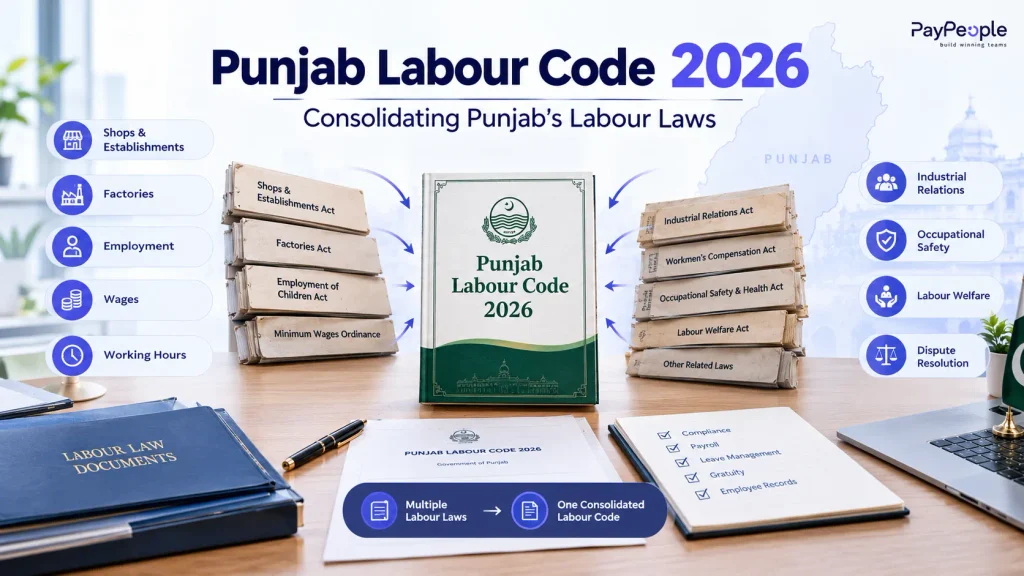
The Punjab Labour Code consolidates more than 20 separate Punjab labour statutes — most significantly the West Pakistan Shops and Establishments Ordinance and the Factories Act 1934 (with its provincial amendments) — into a single unified code covering employment terms, wages, working time, industrial relations, occupational safety and health, labour welfare, and dispute resolution. It’s described by legal commentators as the most comprehensive labour law reform in Pakistan in nearly eight decades, directly affecting Punjab’s roughly 48-million-strong labour force.
The Code’s most structural change is who counts as a protected “worker.” Under the laws it replaces, statutory protections were often tied to whether someone fell within a narrow “workman” classification — commonly excluding managerial staff, and treating fixed-term, part-time, contract, and gig-platform workers inconsistently.
The Code removes that distinction. Once in force, it is designed to extend coverage broadly across categories of work, including domestic workers, home-based workers, agricultural workers, road-transport workers, and digital-platform (gig) workers, alongside conventional employees and management. The Code also introduces specific tests for determining whether an employment relationship exists, addressing situations where a worker is classified as an independent contractor to avoid statutory obligations.
Exclusions that remain: civil servants covered under the Punjab Civil Servants Act 1974, defence services, and police or other specified law-enforcement services.
Under the Factories Act framework our compliance guide currently references, annual leave is 14 days with full pay after 12 months of continuous service. Under the Punjab Labour Code, this rises to a minimum of 18 calendar days after one year of service. Encashment of unused leave also changes — from basic pay only to full pay — and the Code expressly defines the leave year as the calendar year, removing ambiguity some employers currently handle inconsistently. For how leave entitlements currently vary by province, see our leave entitlement laws in Pakistan guide — a resource worth revisiting once Punjab’s figures are confirmed as commenced.
Maternity leave under the Maternity Benefit Ordinance framework is currently 12 weeks (6 pre-natal, 6 post-natal). Under the Code, this rises to 14 weeks, with explicit protection against termination during pregnancy and paid nursing breaks for up to 12 months after childbirth. This termination protection sits alongside the general termination rules covered in our employee termination process guide — worth checking if a pregnancy-related termination question ever comes up, since the general process doesn’t cover this protected-leave exception.
The Code introduces two leave categories with no equivalent in the pillar’s current leave table: Iddat leave for Muslim widows (130 days), and quarantine leave for pandemic or epidemic illness (14 days). Neither of these has a precedent in the frameworks Pakistani payroll systems currently track, so both will likely require new leave-type configuration rather than an adjustment to an existing one.
This is the change most likely to catch a payroll or finance team off guard, because it doesn’t just adjust a number — it changes who’s eligible.
Under the framework in our compliance guide, gratuity is calculated as one month’s last-drawn gross salary per completed year of service, payable from the fifth year of continuous service onward, and applies broadly to eligible employees. Under the Punjab Labour Code, end-of-service gratuity eligibility extends explicitly to management, fixed-term employees, and contract employees — categories that were often excluded or treated inconsistently before — and the qualifying period drops to one year of continuous service, rather than five.
Two things stay the same: establishments can still offer a provident fund in place of end-of-service gratuity, and establishments with fewer than 20 employees remain exempt from the mandatory gratuity requirement.
Take a management-level employee in a 40-person Lahore company, earning PKR 200,000/month gross, who has completed 2 years of service.
For a company with several managerial and fixed-term staff in this service-length range, the shift from “not yet liable” to “already liable” can represent a substantial, previously unbudgeted gratuity balance the moment the Code commences — which is exactly why this is worth tracking now, even before the commencement date is confirmed. Our payroll compliance guide for Pakistan covers how to build this kind of accrual tracking into a monthly payroll process.
The Code also extends eligibility for mandatory profit sharing under the Workers’ Profit Participation Fund to all staff, including managerial employees who were previously excluded. Separately, it introduces an equal-pay-for-equal-value mandate, a broad non-discrimination framework covering gender, pregnancy, disability, caste, and family responsibilities, a prohibition on employers imposing pay secrecy, and new restrictions on post-employment noncompete agreements. Employees with at least one year of continuous service also gain the right to request flexible working hours.
These are meaningful HR-policy changes, but they sit more in the legal/HR-policy domain than the payroll-calculation domain this article focuses on — if any of these affect an existing contract template or compensation structure you use, that’s worth a specific conversation with legal counsel rather than a generic checklist item here.
The Code applies to establishments and workplaces in Punjab specifically — it does not automatically extend to Sindh, Khyber Pakhtunkhwa, or Balochistan, which retain their own provincial labour frameworks. However, because Punjab accounts for a large share of Pakistan’s labour force and GDP, legal commentators expect other provinces to face pressure to modernize their own frameworks in similar directions over time. If your company operates in multiple provinces, this Code changes the calculus specifically for your Punjab-based staff, while Sindh, KPK, and Balochistan staff continue under their existing provincial rules until those provinces act separately.
Do now, regardless of commencement status
Do once commencement is officially confirmed
It was enacted and gazetted on 10 February 2026, but as of the most recent legal commentary available, its substantive provisions had not yet commenced — commencement requires a separate government notification. Employers should verify current status with the Punjab Labour Department before treating any provision as binding.
No. It applies specifically to workplaces and establishments in Punjab. Sindh, Khyber Pakhtunkhwa, and Balochistan continue to operate under their own provincial labour frameworks.
Once the Code is in force, yes — end-of-service gratuity eligibility extends to management, fixed-term, and contract employees after one year of continuous service, down from the five-year threshold under the previous framework. This has not yet taken legal effect as of publication.
Eighteen calendar days after one year of service, up from 14 days under the Factories Act framework, once the Code commences. Unused leave is encashable at full pay.
Yes. The Code preserves the exemption from mandatory end-of-service gratuity for establishments with fewer than 20 employees, and still allows a provident fund to be offered in lieu of gratuity.