


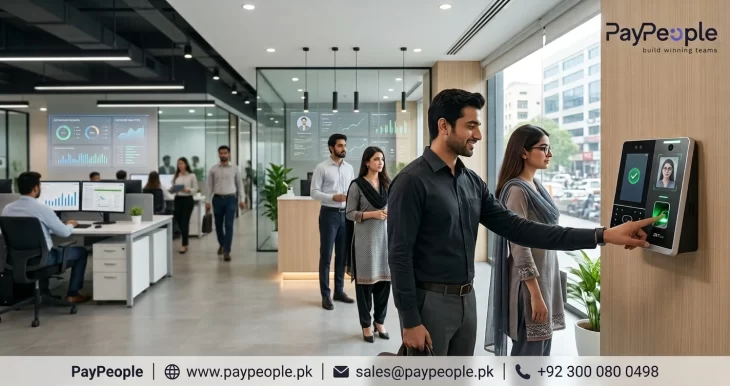
Quick answer: Attendance software in Pakistan is a cloud-based system that automates employee clock-ins through biometric verification, GPS check-ins, or RFID cards, then syncs those records directly into payroll. PayPeople’s attendance module bills as part of its per-employee-per-month HR and payroll plans (starting around Rs. 300–400/employee for core modules), and includes native EOBI, SESSI/PESSI, and FBR compliance so attendance data flows straight into a compliant, audit-ready payroll run.
Attendance software in Pakistan is a digital system that replaces manual sign-in registers with automated time-tracking — capturing when employees start, pause, and end their workday through a fingerprint scan, facial recognition, RFID card, or mobile GPS check-in. The record then feeds directly into shift management, leave reconciliation, and payroll, instead of sitting in a separate spreadsheet someone has to manually reconcile every month.
The distinction that matters for buyers: a device (a biometric machine) only solves data capture. Software is what turns that raw punch data into accurate hours, overtime, and salaries without a human re-typing anything in between.
Manual attendance — paper registers or shared Excel sheets — breaks down for a specific, recurring reason: it separates the record of “who was here” from the record of “what they should be paid,” and someone has to manually reconcile the two every payroll cycle. That reconciliation step is where late-coming disputes, “buddy punching,” and payroll errors creep in.
A cloud-based system removes that reconciliation step. Attendance is captured once, verified against the employee’s actual shift and leave status, and pushed straight to payroll — so a 10-person retail shop and a 300-person factory floor are working from the same live, auditable number instead of a spreadsheet someone updates at month-end.
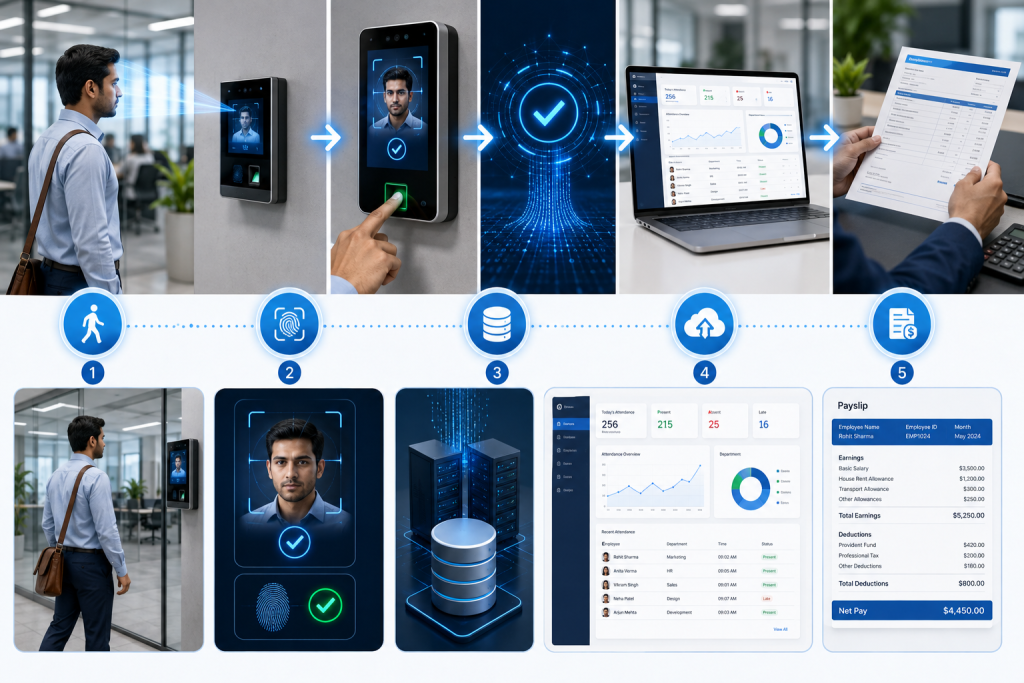
Biometric attendance software works by connecting a fingerprint, facial-recognition, or RFID terminal to a cloud dashboard, so a clock-in at one branch is visible to HR anywhere in the country within seconds. The device verifies that the person clocking in is physically present — which is the specific problem biometric systems solve that a shared PIN or card can’t: they make “buddy punching” (one employee clocking in for another) much harder.
For multi-branch businesses, this is the practical value: an employee touching the sensor at a Lahore branch shows up on an HR manager’s dashboard in Karachi in real time, without anyone maintaining a local server at each site. PayPeople integrates with 200+ biometric devices, including widely-used ZKTeco and BioSense hardware, syncing punch data to the cloud dashboard in real time across locations.
Yes — mobile attendance apps let field sales staff, technicians, and delivery teams clock in from a client site or job location instead of returning to a fixed office terminal, with GPS confirming they were actually there. In stricter setups, geofencing blocks a check-in from registering outside a pre-defined radius around an approved site.
This matters most for service businesses with distributed teams: a field technician in a city like Faisalabad or Sialkot can mark attendance from the client’s premises through PayPeople’s mobile app, cutting the fuel and time cost of a round trip to head office just to punch in.
Attendance software should let you define custom rosters — rotating shifts, night shifts, split shifts — and assign them per team, with the system automatically detecting which shift an employee worked based on their clock-in time and applying your overtime and grace-period rules without manual calculation.
This is a real gap in cheaper, single-location tools: they handle a fixed 9-to-5 well but fall apart around rotating factory shifts, seasonal Ramadan hours, or public-holiday rosters. A system built for Pakistani operations should let HR configure grace periods for late arrivals, short-leave and half-day rules, and shift-specific overtime — once, at the policy level — rather than re-applying them manually every pay cycle.
Attendance syncs with payroll by pushing verified hours — not raw punch logs — directly into the payroll engine, so unpaid leave, overtime, and late-coming deductions are calculated automatically instead of someone exporting Excel files and recalculating them by hand. When an employee’s leave is approved in the system, it’s automatically reconciled against their attendance record, which prevents the double-counting or incorrect deductions that happen when leave approvals live in a separate channel (a manager’s WhatsApp, for instance).
For Pakistani businesses specifically, this integration is also where compliance lives. PayPeople maintains EOBI and SESSI/PESSI contribution rates and current FBR income-tax slabs centrally, so payroll doesn’t need manual patching when the federal budget changes — the monthly EOBI form, SESSI/PESSI form, and FBR salary-withholding statement generate from the same verified attendance-to-payroll data, with a full audit trail from biometric scan to final payslip.
| Plan tier | What’s included | Price (PKR/employee/month) |
| Core HR & Attendance | Biometric/mobile attendance, basic reporting, self-service profile | Rs. 300 – 400 |
| Standard HRMS | Attendance + payroll integration, mobile app, standard leave workflows | Rs. 450 – 600 |
| Advanced Enterprise | Multi-branch attendance, custom approval workflows, full HR suite | Rs. 700 – 900 |
Pricing reflects PayPeople’s published per-employee-per-month structure; volume discounts apply above 100 employees, and multi-branch enterprise deployments are quoted separately. Confirm current rates for your headcount at paypeople.pk/book-a-demo.
Pro tip for Pakistani SMEs: Ask any vendor specifically about offline handling before signing. Given occasional load-shedding in cities like Karachi and Multan, your biometric devices should store attendance logs locally and auto-sync once power or internet returns — otherwise you get data gaps exactly when reconciliation is hardest.
Cloud-based attendance software is generally more secure than local spreadsheets or on-premise desktop systems, because data is encrypted, backed up automatically, and doesn’t disappear if an office computer fails. For biometric data specifically, ask any vendor directly how fingerprint or facial templates are stored and encrypted — this is a legitimate question to push on rather than accept a generic “it’s secure” answer.
Cloud systems also typically include employee self-service: staff can view their own attendance history, check remaining leave balances, and request corrections through a portal or app, which reduces the volume of routine queries landing on HR and gives businesses a reliable historical record for EOBI or labour audits.
For a typical Pakistani SME, this timeline runs 2–4 weeks from kickoff to go-live; multi-branch enterprise rollouts typically take 6–8 weeks. PayPeople’s onboarding includes a 7-day sandbox with sample employees and a pre-configured tax slab so you can run that parallel-payroll month before switching over.
Pakistani SMEs typically move off Excel or a legacy desktop system once the monthly payroll run starts taking more than two working days, or once reconciling attendance across branches becomes a recurring source of errors. PayPeople is used by more than 2,000 companies across Lahore, Karachi, and Islamabad, and holds the HBL P@SHA ICT Award 2024 and the President’s IT Award 2021 — the only HR software in Pakistan to hold both.
For most 50–250-employee businesses, payroll, biometric attendance, and leave together cover roughly 80% of the day-to-day HR workload; recruitment, performance, and expense modules are usually added in a second phase once managers are comfortable with the core self-service workflows. Attendance data flows into a single system that also handles EOBI, SESSI/PESSI, and FBR salary-tax compliance — so the same record used to calculate a paycheck is also the one you’d hand an auditor.
Attendance software in Pakistan is a digital system that automates employee time tracking through biometric verification, mobile GPS check-ins, or RFID cards, then syncs that data with shift management and payroll so hours don’t need to be manually reconciled.
Pricing typically runs Rs. 300–900 per employee per month depending on the plan tier, with core attendance and basic reporting at the lower end and multi-branch, full-HRMS plans at the upper end. Most vendors, including PayPeople, offer volume discounts above 100 employees and custom quotes for multi-branch enterprise rollouts.
Most cloud attendance platforms support standard fingerprint, facial-recognition, and RFID terminals widely available in Pakistan. Confirm specific hardware compatibility with your vendor before purchasing devices, since supported models and connection methods (API, SDK, or direct sync) vary by platform.
Yes. Field employees can clock in through a mobile app that verifies their location via GPS, and geofencing can restrict check-ins to a defined radius around an approved site — useful for sales teams, technicians, and delivery staff who aren’t at a fixed office location.
The market includes both dedicated attendance tools and full HRMS platforms with attendance built in. PayPeople covers attendance, payroll, and local compliance (EOBI, SESSI/PESSI, FBR) in one platform; other established names include TimeTrax (biometric-heavy, factory and multi-city deployments), Paismo (all-in-one HRMS with attendance and recruitment), and Evoucher (biometric attendance with payroll integration for SMEs). The right pick depends less on brand and more on whether it handles your specific shift structure, branch count, and payroll integration needs — the checklist earlier in this guide is a useful way to compare any of them apples-to-apples.
Most attendance software sold in Pakistan today is cloud-based rather than on-premise, since it lets HR see attendance across multiple branches without maintaining local servers at each site. PayPeople, Paismo, and TrackQlik are among the cloud-hosted options commonly used by Pakistani SMEs and multi-branch businesses; on-premise systems still exist but are now mostly limited to sites with strict data-residency requirements or unreliable internet access.