


Quick answer: HR software (HRMS) centralizes payroll, attendance, leave, recruitment, and compliance in one system. The right choice for a Pakistani business depends on company size and must-have modules — not a single “best” pick. Priorities in 2026: automated EOBI/tax compliance, employee self-service, and genuinely functional AI features (anomaly detection, compliance checks) rather than AI as a marketing label. See the buying framework and FAQs below.
Choosing HR software in Pakistan in 2026 means choosing between dozens of platforms that all claim to be “cloud-based,” “AI-powered,” and “the best.” Most HR and admin teams don’t have time to trial ten different tools — they need a clear, honest comparison framework and a shortlist that actually fits how Pakistani businesses operate: multi-city teams, FBR and EOBI compliance obligations, biometric attendance requirements, and a mix of on-site and remote staff.
This guide breaks down what HR software actually does, which features matter most for companies operating in Pakistan specifically, how AI is changing the category in 2026, and how to evaluate vendors — including PayPeople — without getting distracted by marketing claims.
HR software — also called an HRMS (Human Resource Management System) or HRIS (Human Resource Information System) — is a platform that centralizes attendance, payroll, leave, recruitment, performance, and compliance in one system, replacing separate spreadsheets, WhatsApp groups, and paper files with role-based access for HR, finance, managers, and employees.
In Pakistan, “HR software” is frequently used interchangeably with “HRMS software” and “payroll software,” though technically:
• HRMS/HRIS refers to the full employee-data and workflow system.
• Payroll software may exist as a standalone tool or as a module inside a broader HRMS.
• Attendance software is often sold separately (especially biometric-focused vendors) but is a core HRMS module in most modern platforms.
Understanding this distinction matters when comparing vendors, because some “HR software” listings you’ll find are really narrow point solutions rather than full systems.
Four forces are driving adoption in the Pakistani market right now: tightening tax/compliance rules, multi-city operations, rising self-service expectations, and genuinely useful AI features.
1. FBR and tax digitization. As FBR compliance and digital tax filing requirements tighten, manual payroll calculation carries more risk. HR software that auto-calculates income tax slabs, EOBI contributions, and provincial levies reduces the chance of compliance errors that can trigger penalties.
2. Multi-city operations. Companies with offices in Karachi, Lahore, and Islamabad — or field staff spread across multiple cities — need centralized visibility into attendance and headcount that spreadsheets can’t provide in real time.
3. Rising expectations for employee self-service. Employees increasingly expect to check their own payslips, apply for leave, and view attendance history without emailing HR. A self-service portal has gone from “nice to have” to a baseline expectation.
4. AI-assisted HR work. 2026 is the first year AI features have moved from marketing buzzword to genuinely useful functionality inside HR platforms — see the section below.
AI in HR software has moved past chatbot gimmicks. The practical, currently-useful applications include:
• Anomaly detection in attendance and payroll — flagging unusual patterns (e.g., a sudden spike in late clock-ins from one department, or a payroll variance that doesn’t match headcount changes) before they become bigger problems.
• Automated leave-balance and compliance checks — cross-referencing leave requests against Pakistani labor law entitlements (see our leave laws guide) so HR doesn’t have to manually verify eligibility.
• Resume screening and candidate matching for recruitment modules, reducing time-to-shortlist for high-volume hiring.
• Predictive attrition signals — surfacing employees who show engagement or attendance patterns correlated with resignation risk, giving managers a chance to intervene earlier.
• Natural-language reporting — letting HR managers ask a plain-language question (“which department had the most late arrivals last month?”) instead of building a custom report.
Vendors that genuinely ship these features are differentiated from vendors that use “AI-powered” purely as marketing language with no functional AI underneath. When evaluating a platform, ask for a live demo of the specific AI feature rather than accepting the claim at face value.
Whatever vendor you’re comparing, these are the modules that matter for most mid-sized to large Pakistani businesses:
Automated salary calculation, tax deduction, EOBI/PESSI contributions, payslip generation, and bank-file export for salary disbursement. Look for built-in support for Pakistan’s provincial tax variations if you operate across more than one province.
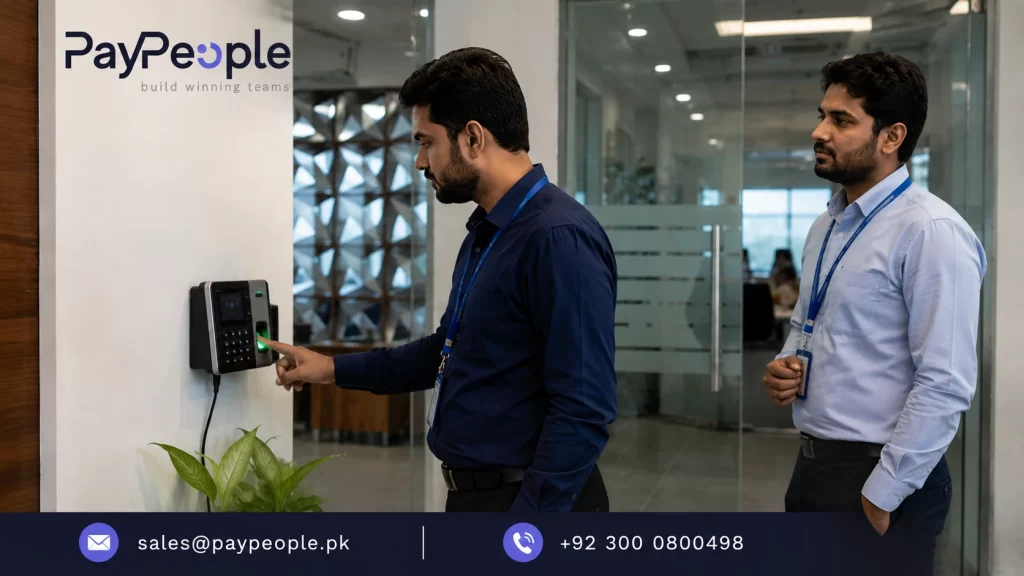
Biometric device integration, GPS/geofenced mobile check-in for field staff, shift scheduling, and overtime calculation. This is especially important for manufacturing, retail, and field-sales-heavy organizations.
Configurable leave policies matched to Pakistani labor law entitlements, approval workflows, and a self-service leave-request interface.
A portal (mobile and web) where employees can view payslips, apply for leave, update personal information, and see attendance history — reducing HR’s administrative load.
Job posting, applicant tracking, interview scheduling, and — increasingly — AI-assisted resume screening. See our dedicated AI-powered ATS guide if recruitment is your primary need.
Goal-setting, review cycles, and performance analytics, ideally tied back to compensation and promotion decisions.
Automated EOBI registration tracking, labor law compliance checks, and audit-ready reporting. See our HR compliance guide and EOBI registration guide for the regulatory detail behind this module.
Not every business needs every module on day one. A useful shortcut:
• Small businesses (under 50 employees): Start with payroll + attendance + leave. Add recruitment and performance modules as you scale.
• Manufacturing and multi-site operations: Prioritize biometric attendance, shift management, and multi-location reporting.
• Public sector organizations: Compliance, audit trails, and role-based access control matter more than AI bells and whistles — see our public sector HR software guide.
• IT and tech companies: Prioritize self-service, flexible leave policies, and integration with existing tools — see our HR software for IT companies guide.
• Enterprises with 500+ employees: Look for dedicated implementation support, custom reporting, and API access — see our enterprise HR solutions guide.
1.List your must-have modules first. Don’t buy a 10-module platform if you only need payroll and attendance — you’ll pay for complexity you don’t use.
2. Check compliance depth, not just compliance claims. Ask specifically: does the system auto-calculate EOBI contributions? Does it handle provincial tax differences? Can it produce an audit-ready report on demand?
3. Test the self-service experience yourself. Log in as an employee during the demo, not just as an admin. This is what your workforce will actually use daily.
4. Ask about implementation timeline and support. See our implementation guide for what a realistic rollout looks like — vendors that promise same-day go-live for a 500-person company are usually oversimplifying.
5. Understand the full cost, not just the sticker price. Setup fees, per-employee pricing tiers, and support costs vary significantly between vendors
6. Ask for references from businesses your size, in your industry. A platform that works well for a 20-person startup may not hold up for a 2,000-person manufacturer, and vice versa.
Many Pakistani businesses run HR on Excel and WhatsApp for years before switching — and there’s no fixed employee-count threshold at which you “must” switch. Instead, watch for these operational signals:
• Payroll takes more than a day to process each month, or requires one person who “just knows” the spreadsheet formulas and can’t take leave during payroll week.
• You’ve had a compliance near-miss — a missed EOBI contribution, an incorrect tax deduction, or an audit that surfaced a record-keeping gap.
• Attendance disputes are common and hard to resolve because there’s no single source of truth (paper registers vs. biometric logs vs. manager sign-off).
• HR spends more time answering “where’s my payslip” questions than doing strategic work.
You’re opening a second city location and realize your current process doesn’t scale beyond one office.
If two or more of these sound familiar, the ROI case for HR software is usually already there — the question becomes which vendor and which modules, not whether to switch at all.
Most new HR software deployments in Pakistan in 2026 are cloud-based (SaaS), but on-premise still exists, particularly in some public-sector and highly regulated environments. The trade-offs:
| Factor | Cloud (SaaS) | On-Premise |
| Upfront cost | Low — subscription-based | Higher — hardware + licensing |
| Maintenance | Handled by vendor | Handled by your IT team |
| Access | Any device, anywhere | Typically office-network only |
| Updates | Automatic | Manual, scheduled by IT |
| Data control | Vendor-hosted (check data residency terms) | Fully in-house |
| Typical fit | Most SMEs and mid-market companies | Some government bodies, highly regulated industries |
For most private-sector businesses, cloud HR software is the practical default in 2026 — the mobility and lower maintenance burden generally outweigh the data-control benefits of on-premise, unless your industry has a specific regulatory requirement for in-house hosting. Public sector organizations should read our dedicated guide on the specific considerations that apply there.
•Accounting/ERP systems — so payroll data flows into your general ledger without manual re-entry.
• Biometric attendance devices you already own, if you’re not starting from scratch.
• Banking systems for salary disbursement — check whether the vendor supports direct bank-file export for the banks your employees use.
• Communication tools (email, WhatsApp Business API) for leave and attendance notifications, since Pakistani teams often expect updates outside the platform itself as well as inside it.
Before choosing a platform, confirm it integrates cleanly with:
Ask each vendor for a specific list of pre-built integrations rather than a general “we support integrations” answer — the difference between a pre-built connector and a custom-built one can add weeks to your implementation timeline.
A properly scoped HR software rollout for a mid-sized Pakistani company typically follows four phases:
Vendors that promise a same-week go-live for a company with more than a hundred employees are usually skipping the pilot phase — which is where most real implementation risk gets caught.
• Choosing based on feature-list length, not fit. More modules isn’t better if your team never uses half of them.
• Underestimating change management. The best software fails without proper training and onboarding.
• Ignoring data migration complexity. Moving years of history from spreadsheets takes real planning.
• Not checking mobile experience. A desktop-only platform creates friction for field-based staff.
HR software holds sensitive data — salary figures, national ID numbers, bank details, performance records. Before signing with any vendor, confirm:
• Where your data is hosted and whether the vendor can specify data residency (some regulated industries and public sector bodies require this).
• Role-based access control — can you restrict who sees salary data vs. who sees only attendance data? A finance manager and a line manager should not have identical access levels.
• Audit logs — can you see who accessed or changed a record, and when? This matters both for internal accountability and for responding to any compliance audit.
• Data export rights — if you ever switch vendors, can you export your full historical data in a usable format, or are you locked in? Ask this before signing, not after.
• Backup and uptime guarantees — payroll running late because of a platform outage is a real operational risk; ask what SLA the vendor commits to.
These questions are easy to skip during a sales conversation focused on features, but they matter more over a multi-year relationship than almost any individual feature on the comparison sheet.
If you’re evaluating HR software for your business in Pakistan, start by mapping your must-have modules against the framework above, then request live demos — not sales decks — from your shortlist. For a closer look at how PayPeople approaches this, see how we compare in our PayPeople WebHR and PayPeople vs FlowHCM breakdowns, or explore our Services for attendance software and HRMS if a specific module is your priority.