


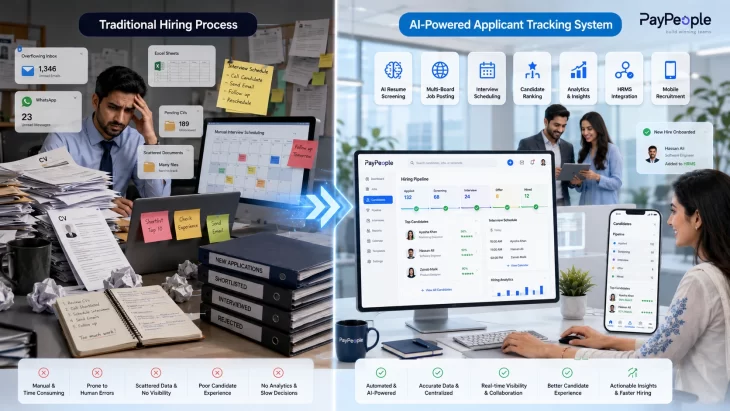
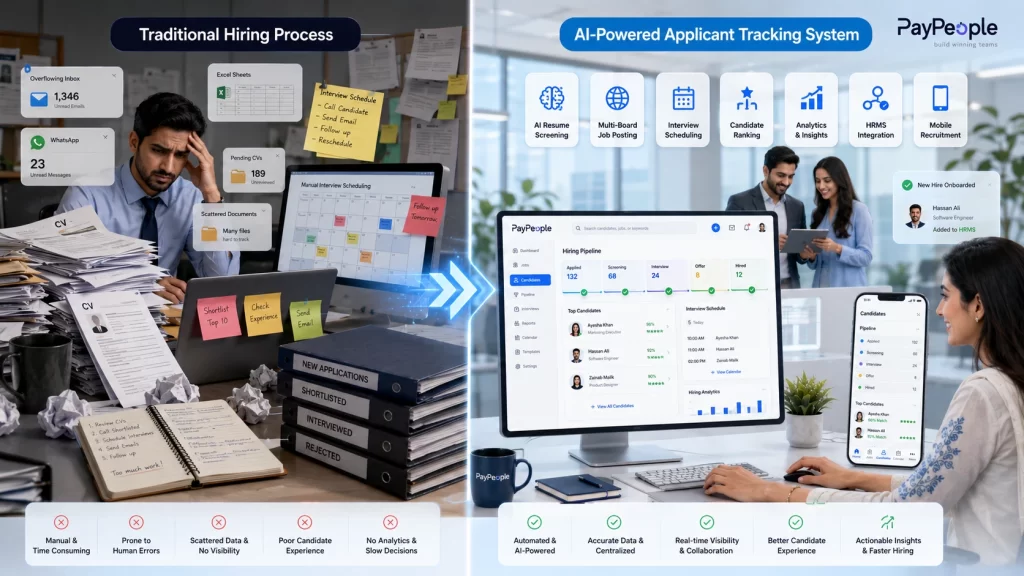
An Applicant Tracking System (ATS) is software that manages every stage of hiring — job posting, resume collection, candidate screening, interview scheduling, and offer management — in one place. For companies in Pakistan hiring across Karachi, Lahore, and Islamabad simultaneously, an ATS replaces scattered WhatsApp groups, email inboxes, and Excel sheets with one searchable, auditable hiring pipeline.
Applicant Tracking System (ATS): A recruitment software platform that automates the collection, sorting, and tracking of job applicants throughout the hiring pipeline, from job posting through to offer letter.
An ATS is the digital front door to your company’s hiring process. Instead of a recruiter manually opening 200 emailed CVs for one Lahore-based sales role, the system collects them automatically, extracts candidate details, ranks them against the job requirements, and hands the recruiter a shortlist.
It sits between your job advertisement and your onboarding process. Everything that happens to a candidate — application, screening, interview, offer, rejection — is logged, timestamped, and searchable later.
A common point of confusion, so here’s the distinction in one table.
| System | Core Job | When You Use It |
| ATS | Manages candidates before they’re hired | During active recruitment only |
| HRIS/HRMS | Manages employees after they’re hired (payroll, leave, attendance) | Throughout employment |
| Recruitment CRM | Nurtures passive candidates and talent pools before a role even opens | Long-term talent pipelining |
Most Pakistani businesses don’t need all three as separate tools — a unified HR platform with a built-in ATS module (like PayPeople’s Applicant Tracking System) avoids the data re-entry that comes from stitching three vendors together.
| Type | Best For | Trade-off |
| Cloud-based / SaaS | Most SMEs and mid-size companies | Ongoing subscription cost |
| On-premise | Banks, regulated sectors needing data on local servers | High setup and maintenance cost |
| Enterprise ATS | 500+ employee organizations with layered approval chains | Overkill for smaller teams |
| Standalone ATS | Companies happy to manage a separate HR system | Manual data transfer at hiring |
| Integrated ATS (part of an HRMS) | Companies that want hire-to-retire in one record | Fewer third-party integrations |
Three shifts make ATS adoption more urgent for Pakistani companies now:
A recorded, timestamped hiring trail also protects employers if a rejected candidate disputes the process, and simplifies documentation during audits.
AI-powered ATS platforms in 2026 go beyond keyword matching. They score candidates against the actual competencies a role needs and flag likely drop-off risks before a candidate goes cold. PayPeople’s AI-powered recruitment and onboarding agent applies this to local hiring — ranking applicants by fit rather than how well their CV happens to be worded. The same AI approach carries through after hiring too, with PayPeople’s AI-driven performance management tools picking up where recruitment leaves off, so the skills data collected at hiring stage doesn’t go to waste once someone joins.
The honest caveat: AI screening still depends on how well a job’s requirements are defined upfront. Vague criteria produce vague shortlists. Treat AI as a filter that narrows 300 applicants to 30 — not a replacement for a recruiter’s final judgment.
Work through these questions in order:
For a side-by-side look at how the leading platforms stack up on these points, see our breakdown of the best ATS tools for 2026.
Pros: Faster time-to-hire, centralized candidate data, better hiring-panel collaboration, cleaner compliance trail, reduced manual admin.
Cons: Upfront setup and training time, risk of over-filtering strong candidates if criteria are poorly configured, subscription cost for smaller teams.
An ATS isn’t just a resume filing cabinet — it’s the operational backbone of hiring for any Pakistani business fielding real application volume across multiple cities. The right choice depends less on feature count and more on whether it fits your hiring volume, integrates with your existing HR and payroll systems, and gives your team a shortlist they can trust. PayPeople’s Recruitment Management module, backed by AI-powered screening, connects hiring directly into payroll, attendance, and performance management — so a hired candidate’s data never needs re-entering.
Ready to see it in action? Book a free PayPeople demo and walk through your own hiring pipeline with our team.