


A new hire pushes your headcount to five, and EOBI registration lands on your desk with a 30-day clock attached. Most HR managers hit this moment once and spend years fixing what they got wrong the first time. This guide covers what to prepare, where to submit it, and what happens next.
EOBI registration enrolls your business and eligible staff with the Employees’ Old-Age Benefits Institution, Pakistan’s federal old-age pension scheme created under the EOBI Act 1976. It gives you the employer code needed to submit monthly contributions for covered workers.
Any commercial or industrial establishment employing five or more workers falls under the EOB Act. That count includes contract staff and part-timers, not just permanent employees. Once you cross that threshold, registration isn’t optional and it isn’t something to schedule for later.
A few categories sit outside compulsory coverage: government employees with their own pension schemes, armed forces personnel, and most agricultural or domestic workers. Everyone else on a covered payroll, aged 18 to 60 for men and 18 to 55 for women, needs registration as an insured person.
Registration protects your business as much as your staff:
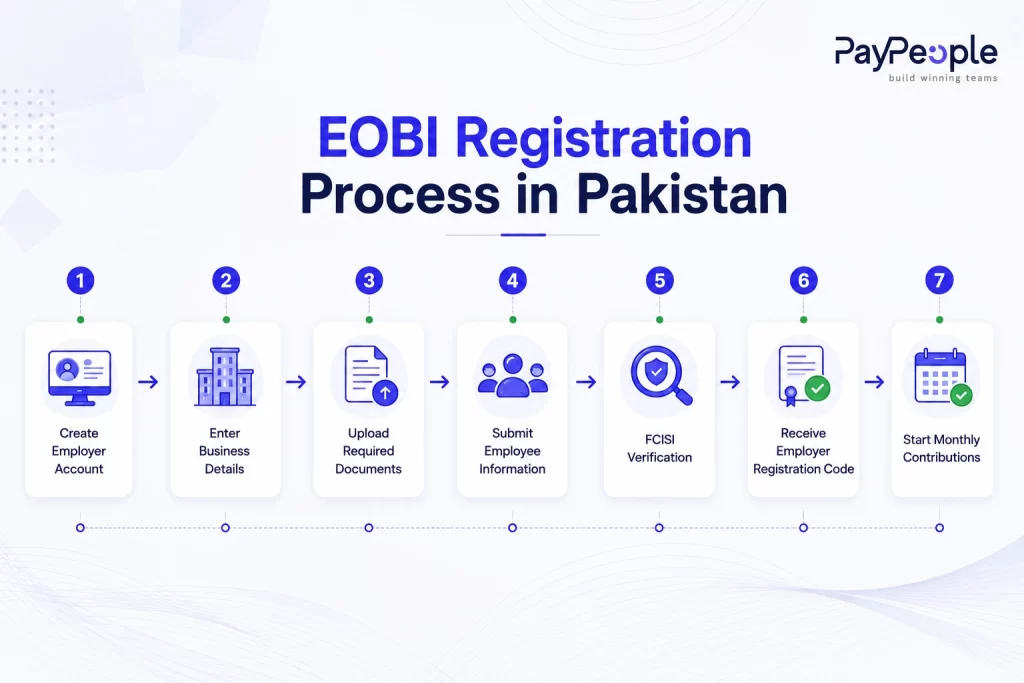
Keep these ready before applying, since a missing document is the most common cause of delay:
| Business Type | Extra Documents Typically Needed |
| Sole proprietorship | Owner’s CNIC and NTN registration certificate |
| Partnership firm | Partnership deed and registration certificate |
| Private limited company | SECP incorporation certificate and Form A/B |
| Branch of a foreign company | SECP registration and board resolution authorizing the signatory |
Getting the code is the start, not the finish. Each month, calculate contributions against the wage ceiling, deposit the combined share by deadline, and keep the receipt. Add new hires to your insured list as soon as they join, and remove anyone who leaves so records stay accurate.
Field verification doesn’t stop at registration. Inspectors can visit anytime to cross-check your headcount against actual staff. Current wage ceiling figures are published on the official EOBI website and worth checking before each payroll run.
Businesses repeatedly trip on the same errors:
Manual EOBI tracking works at five employees and falls apart well before fifty. A payroll platform like PayPeople keeps your insured employee list synced with actual headcount, flags new joiners who still need registration, and calculates monthly contributions against the correct wage ceiling instead of full salary. That removes the guesswork behind most mistakes above.
EOBI registration is one piece of a larger compliance picture that includes tax withholding, provincial social security, and labor law obligations. For a full breakdown of every requirement Pakistani employers face, the complete HR compliance guide covers the rest of the framework.
EOBI registration is small but carries real financial consequences if rushed. Register within the 30-day window, keep documents organized, and treat your insured employee list as a living record, not a one-time submission.
Timelines vary by region and how complete your application is. Straightforward cases with all documents in order typically clear verification faster than applications missing employee CNIC details or address proof, which get held up for follow-up requests.
Compulsory registration applies at five or more workers, but the scheme allows limited voluntary participation in certain cases. Smaller businesses planning to grow often register early so payroll systems and documentation are already in place.
Late registration doesn’t erase the obligation for the period already worked. EOBI can require retroactive contributions covering the gap, plus scrutiny of your records during the next inspection, so registering within 30 days avoids that exposure.
Yes. EOBI counts everyone on your payroll, including contract and part-time staff, when determining whether your establishment has reached the compulsory registration threshold, not just permanent full-time hires.
The official EOBI website publishes the current wage ceiling and contribution structure. Since these figures are revised periodically, checking the source directly before each payroll cycle avoids calculation errors based on outdated numbers.