HR Compliance in Pakistan: The Complete Guide for Employers (2026)
Quick Answer HR compliance in Pakistan covers six legal frameworks: FBR income tax, EOBI contributions, provincial social security (PESSI/SESSI), the Industrial & Commercial Employment Ordinance, the Factories Act, and Companies Act record-keeping. Every employer must follow all six — no company is exempt. Penalties range from 100% of unpaid tax under Section 182 of the Income Tax Ordinance 2001 to liability in labor courts. An HRMS is not legally required, but for teams above 20 people, manual systems reliably produce the errors that trigger those penalties.
What HR Compliance Actually Means in Pakistan
HR compliance in Pakistan is the legal obligation to follow every rule governing your relationship with employees — from the day they are hired to the day they leave. It is not one law. It is six overlapping frameworks administered by federal and provincial authorities simultaneously.The 18th Constitutional Amendment (2010) moved labor legislation from the federal exclusive list to the concurrent list, giving Punjab, Sindh, Khyber Pakhtunkhwa, and Balochistan the authority to pass their own labor laws. They have all done so. A company with offices in both Lahore and Karachi is, in legal terms, subject to two different provincial compliance frameworks at the same time.Three of the six frameworks change annually: FBR revises income tax slabs every Finance Act, EOBI updates its wage ceiling independently, and each province issues new minimum wage notifications. Compliance is not a one-time setup — it is a system that needs quarterly attention.
The Six Compliance Frameworks
These are the six areas every Pakistani employer must cover. Each carries its own penalty structure. Failing one does not reduce the obligation on another.
Framework
Governing Law
Core Obligation
Penalty for Non-Compliance
FBR Income Tax
Income Tax Ordinance 2001
Deduct at source monthly; file Form 149
Up to 100% of undeducted tax + default surcharge (Sections 161 & 182)
EOBI
EOBI Act 1976
Register at 5 employees; pay monthly
Retroactive contributions + fines
Provincial Social Security
PESSI / SESSI / KPK / Balochistan ordinances
Register and contribute monthly
Penalties under respective provincial ordinance
Labor Ordinance
Industrial & Commercial Employment Ordinance 1968
Written contracts, notice periods, standing orders
Prosecution under relevant provincial factories act
Companies Act
Companies Act 2017
Maintain employment records
Director-level liability for record-keeping failures
FBR Income Tax — Step-by-Step Obligations
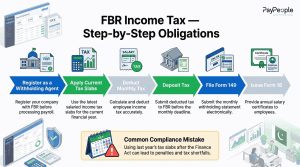
Employers are registered withholding agents under the Income Tax Ordinance 2001. The obligation to deduct tax sits on the company, not the employee. If deductions are missed, FBR assesses the employer — not the worker.Follow these steps every month:
Register as a withholding agent at fbr.gov.pk — a one-time step required before running your first payroll
Apply the current FBR income tax slabs for salaried individuals to each employee’s projected annual salary
Deduct the calculated monthly tax from the employee’s net pay
Deposit the full deducted amount to FBR by the 15th of the following month
File the monthly withholding statement (Form 149) by the same 15th deadline
Issue annual salary certificates (Form 16) to every employee before the tax year closes
Failure
Penalty Reference
Penalty Amount
Late or missing deduction
Section 161, ITO 2001
Full tax amount becomes employer liability
Late or missing Form 149
Section 182, ITO 2001
Up to 100% of unpaid tax
Failure to issue Form 16
Section 182, ITO 2001
Fixed penalty per instance
The most common error is running July payroll on the previous year’s tax slabs. The Finance Act passes in June, and the new slabs apply from 1 July. Update your payroll system before running the first salary of the new tax year.
EOBI — Contribution Rates and Registration Steps
EOBI registration is mandatory for all establishments with five or more employees, under the EOBI Act 1976. Registration must happen within 30 days of reaching the five-employee threshold.
Contribution Rates
Party
Rate
Calculated On
Employer
5%
EOBI-defined wage ceiling (not the full salary)
Employee
1%
Employee’s actual monthly wages
The employer’s contribution is capped at the EOBI wage ceiling — this is a specific figure that EOBI revises periodically and it is not the same as the national minimum wage. Applying 5% to the employee’s full salary is the most common EOBI calculation error. Always verify the current ceiling at eobi.gov.pk before calculating.
How to Register for EOBI
Go to eobi.org.pk and create an employer portal account
Upload your company registration certificate, National Tax Number (NTN), and a list of covered employees
Receive your EOBI employer registration code
Begin monthly contributions by the 15th of each month for the previous month
Generate and keep EOBI payment receipts — these are audit documentation
Provincial social security provides health coverage for registered employees. Each province runs its own institution, and each has its own contribution rate.
Province
Institution
Applicable Law
Punjab
PESSI — Punjab Employees Social Security Institution
Punjab Employees Social Security Ordinance 1965 (amended)
Sindh
SESSI — Sindh Employees Social Security Institution
Sindh Social Security Ordinance
Khyber Pakhtunkhwa
KPK ESSI
KPK Social Security Act
Balochistan
Balochistan ESSI
Balochistan Employees Social Security Ordinance
Contribution rates vary by province and are updated without a fixed schedule. Contact the relevant provincial institution directly for current rates — do not apply last year’s percentages without verifying. A company with employees in both Punjab and Sindh must maintain two separate social security registrations and contribution accounts.
Payroll Compliance — Where Most Employers Go Wrong
Payroll is where most compliance failures happen. Not from bad intent — from relying on systems that cannot track regulatory changes fast enough.
The Four Mistakes That Generate the Most Liability
Mistake
Root Cause
Legal Consequence
Wrong FBR slabs applied
Not updating after June Finance Act
FBR assessment for full shortfall + surcharge
EOBI applied to wrong base
Confusing wage ceiling with full salary
Over/under-deduction; EOBI audit liability
Overtime below legal rate
Flat-rate overtime policy not checked against Factories Act
Labor court award for underpaid overtime hours
No payslip audit trail
Verbal explanations for deductions
Indefensible in labor court when an employee disputes
Payslips are not optional administrative paperwork. They are your legal record when an employee challenges a deduction — and without them, the labor court default is to rule in the employee’s favor.For FBR slab tables and payroll calculation examples by salary bracket, see our complete payroll compliance guide for Pakistan.
Employment Contracts and Leave Entitlements
Written Contracts Are Legally Required
Under the Industrial and Commercial Employment Ordinance 1968, employment terms must be communicated in writing. Verbal agreements do not hold up in labor courts. When there is no written contract, courts consistently interpret ambiguity in the employee’s favor.A compliant employment contract must include:
Job title and core duties
Monthly salary, allowances, and pay schedule
Standard working hours
Probation period (if applicable) — typically 3–6 months
Leave entitlements (by type)
Notice period for termination
Disciplinary procedure reference
A contract that states only a salary and a start date provides minimal legal protection for the employer.
Leave Entitlements Under Pakistani Law
Leave Type
Annual Entitlement
Governing Law
Qualifying Condition
Annual Leave
14 days with full pay
Factories Act 1934
12 months of continuous service
Casual Leave
10 days
Provincial labor ordinances
Per calendar year
Sick Leave
10 days
Provincial labor ordinances
Medical certificate required after initial days
Maternity Leave
12 weeks (6 pre + 6 post)
Maternity Benefit Ordinance 1958
Female employees in covered establishments
Hajj Leave
Once during employment
Federal Hajj leave regulations
Unpaid; right is legally protected
Tracking leave incorrectly creates a specific termination-time liability: employees claim unused leave as a cash entitlement. A digital leave management system eliminates the dispute before it starts because every leave balance is date-stamped and documented.For provincial variations on entitlement periods, see our leave entitlement laws in Pakistan guide.
Termination and Gratuity Rules
Termination is the highest-risk compliance area for most employers. The procedural burden sits entirely on the company. Get the steps wrong and the case goes to labor court, where the default position favors the employee.
The Legal Termination Process
Issue written notice of one month to the employee (or pay one month’s salary in lieu)
Provide a written explanation of the reason — required for termination with cause
Complete all full and final settlement within 30 days of the last working day
Calculate and include all outstanding items: unpaid salary, leave encashment, and gratuity (if applicable)
Gratuity Calculation
Years of Continuous Service
Gratuity Entitlement
Less than 5 years
Not payable
5 years
5 months’ gross salary
8 years
8 months’ gross salary
12 years
12 months’ gross salary
The formula is one month’s last-drawn gross salary for each completed year of service, from year five onward. This liability grows silently. An employee earning PKR 80,000/month who has worked for 12 years represents a minimum gratuity obligation of PKR 960,000 at separation. That figure should be calculated quarterly in your HR system — not discovered when they hand in their resignation.
Is HRMS Mandatory in Pakistan?
No law in Pakistan requires employers to use HR management software. The law requires compliance outcomes — accurate deductions, EOBI filings, proper employment records. The tool the employer uses to achieve those outcomes is their own decision. If you’re actively evaluating HR/payroll software for compliance, our software buyer’s checklist for Pakistani compliance covers exactly what to test before signing a contractThe practical answer by company size:
Employees
Can Manual Systems Work?
Recommendation
1–15
Yes, with disciplined upkeep
Manual acceptable
16–30
Error rate becomes significant
HRMS strongly recommended
31–60
Manual systems routinely fail at this volume
HRMS required
60+
Not viable for accurate compliance
HRMS is essential
The economics are clear above 30 employees. A single FBR notice — including accountant fees, penalty, and the cost of correcting backdated records — typically exceeds an annual HRMS subscription by two to three times. You are not buying software. You are buying audit protection.For a size-by-size cost comparison, see our guide to when HRMS becomes necessary for Pakistani companies.
How to Choose HR Software That Keeps You Compliant
HR software that is not built for Pakistan’s regulatory environment creates new compliance risk, not less of it. International platforms often require months of custom configuration just to handle EOBI correctly. Evaluate any platform on these six points — not in a sales demo, but in a live test:
FBR slab update speed — Ask the vendor for the exact date they updated tax slabs after the last Finance Act. A compliant system updates within days, not weeks.
EOBI wage ceiling logic — Test this yourself: enter a high-salary employee and confirm the employer contribution applies to the ceiling, not the full salary.
Dual-province social security — If you have employees in both Punjab and Sindh, confirm the system generates separate PESSI and SESSI reports and handles both contribution rates.
Leave tracking by type — Annual, casual, sick, maternity, and Hajj leave must be tracked separately with province-correct entitlements. Ask for a demo leave report for a five-year employee.
Audit-ready reporting — Ask the system to generate a full payroll register and deduction history for any employee over the last two years. If it takes more than two minutes, it is not audit-ready.
Local support response — FBR deadlines do not move. Confirm the vendor has a local Pakistan team available before the 15th of each month, not just a global help desk.
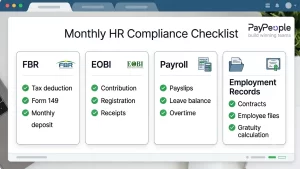
Run this before closing payroll each month. Any unchecked item is an open compliance gap.FBR and Payroll
FBR income tax slabs confirmed current (update every July)
Monthly income tax deducted from every employee’s salary
Tax amount deposited to FBR by the 15th
Form 149 filed by the 15th
Payslips issued showing all deductions with basis
EOBI and Social Security
EOBI contributions calculated against correct wage ceiling
EOBI payment deposited by the 15th of the month
PESSI / SESSI payment made (by province)
Contribution receipts saved to employee records
Employment Records
All new hires have signed employment contracts on file
Leave balances updated across all leave types
Any exit from previous month fully settled within 30 days
Audit Readiness
3-year employee record look-back accessible in minutes
Gratuity liability calculated for all staff past the 5-year mark
Getting Your Compliance Right in 2026
HR compliance in Pakistan has six frameworks, and at least three of them reset every year. The companies that avoid FBR notices and labor court cases are the ones that treat compliance as a system — not a task they remember to check when something goes wrong.PayPeople handles FBR automation, EOBI filings, dual-province social security, and audit-ready reporting for Pakistani companies from 10-person startups to public-sector organizations. Book a free demo to see how it works with your specific team structure and province setup.




 Employers are registered withholding agents under the Income Tax Ordinance 2001. The obligation to deduct tax sits on the company, not the employee. If deductions are missed, FBR assesses the employer — not the worker.Follow these steps every month:
 HR software that is not built for Pakistan’s regulatory environment creates new compliance risk, not less of it. International platforms often require months of custom configuration just to handle EOBI correctly. Evaluate any platform on these six points — not in a sales demo, but in a live test: