

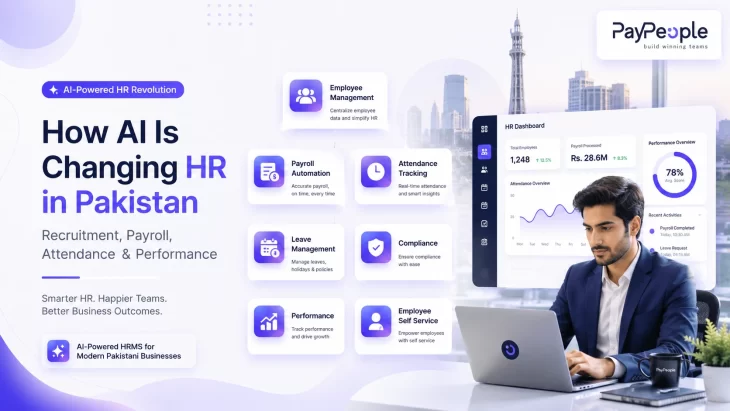
Quick answer: AI is changing HR in Pakistan by automating the repetitive parts of recruitment, payroll, attendance, and performance management, so HR teams spend less time on paperwork and more time on strategy, culture, and people. Businesses using connected, AI-powered platforms like PayPeople typically see faster hiring, fewer payroll errors, and clearer workforce data — without replacing the human judgment HR still requires.
Every HR department in Pakistan is dealing with some version of the same problem: teams are growing, expectations are rising, and the tools built to manage people haven’t kept up. Reviewing CVs by hand, chasing attendance records, running payroll on spreadsheets, and preparing performance reviews once a year all take time that HR professionals would rather spend on the work that actually moves a business forward — hiring well, developing people, and building a culture worth staying for.
That’s the gap AI is closing. Not by replacing HR, but by taking the repetitive work off HR’s plate.
Strip away the buzzwords and AI in HR comes down to three things: it automates routine tasks, it finds patterns in employee data that a person scanning a spreadsheet would miss, and it gives managers faster, clearer information to act on.
In practice, that looks like:
None of this requires HR to hand over decision-making to a machine. It just means the administrative weight that used to eat up a week gets handled in minutes, freeing HR to focus on people rather than paperwork.
Open roles are expensive. Every week a position sits unfilled is a week of lost productivity, and traditional hiring — sorting through CVs manually, coordinating interview schedules over email, following up with dozens of candidates one at a time — is exactly where that time gets lost.
AI speeds this up by:
With Recruitment Software in Pakistan, this isn’t a separate tool bolted onto HR — it’s part of the same system that already holds your employee data, which means a hire moves straight into onboarding without anyone re-entering information.
Payroll is the one HR function with zero room for error. A single miscalculated payslip doesn’t just cost time to fix — it costs trust, and in a market where skilled employees have options, that trust is hard to win back.
Manual payroll in Pakistan carries specific risk: businesses have to calculate salaries and deductions in line with FBR income tax slabs, apply EOBI contributions correctly, and handle SESSI/PESSI social security deductions depending on the province — all of which shift when the federal Finance Act updates tax brackets each year. A spreadsheet doesn’t know the rules changed. Software built for it does.
AI-supported payroll helps by:
With Payroll Software in Pakistan, payroll teams spend less time correcting mistakes and more time on compensation planning — the part of the job that actually requires judgment.
Attendance looks simple until you’re managing shift workers, remote staff, and multiple office locations at once. Manual tracking creates disputes (“I wasn’t late, the system’s wrong”) and gives managers no early warning when absenteeism starts to climb in one department.
AI-supported attendance tools help by:
With Attendance Software in Pakistan, attendance stops being a source of disputes and becomes a source of workforce visibility — which departments are stretched, which shifts are under-covered, and where absenteeism is starting to trend upward.
An annual review tells an employee how they did eleven months ago. It doesn’t help them course-correct in month three, and it gives managers almost nothing to act on in real time.
AI shifts performance management from a once-a-year event to a continuous one:
With Performance Management Software in Pakistan, performance reviews stop being a compliance exercise and start being a growth tool — for the employee and for the business.
Beyond the four core functions above, AI also helps HR understand how people feel about working there — not just how they’re performing.
By analyzing feedback, survey responses, and behavioural signals like attendance or engagement with internal systems, AI can help HR teams spot early signs of disengagement or flight risk, rather than finding out when a resignation letter arrives. Combined with workforce planning data, this also helps businesses forecast hiring needs and skill gaps before they become urgent.
Organizations can take this a step further by using predictive analytics in HR to identify employees who may be at risk of leaving before turnover becomes a problem. Discover how Pakistani companies are using AI to reduce employee attrition through predictive insights in our guide on predictive analytics in HR.
Speed gets most of the attention in conversations about AI, but consistency matters just as much. Employees notice when payroll, attendance policies, or promotion decisions feel arbitrary — and that perception erodes trust faster than almost anything else in a workplace.
AI helps here by applying the same rules the same way, every time, to every employee. It doesn’t replace a manager’s judgment on a promotion decision, but it does mean the data behind that decision — attendance record, performance history, goal completion — is accurate, consistent, and visible to everyone involved. Workplaces that get this right tend to see stronger trust, better engagement, and lower turnover, simply because people believe the system is treating them fairly.
The pressure driving AI adoption looks a little different depending on where a business sits. Lahore’s fast-growing corporate sector needs systems that scale quickly as teams expand. Karachi’s larger, more complex operations need payroll and attendance centralized instead of scattered across departments or spreadsheets. Islamabad-based organizations, often more compliance-focused, need reliable reporting and transparent, audit-ready data.
Different pressure points, same underlying need: a connected system that removes manual bottlenecks specific to how each business actually operates.
AI in HR isn’t a plug-and-play fix, and it’s worth going in with realistic expectations.
Change management. Teams that have run payroll or attendance manually for years may resist a new system at first — not because it’s worse, but because it’s unfamiliar. Rollout works better in stages than all at once.
Training needs. Employees and managers both need a short onboarding period to trust an AI-supported system enough to actually rely on its outputs, rather than double-checking everything manually out of habit.
Data quality. AI is only as good as the data behind it. If employee records are incomplete or inconsistent going in, the insights coming out will be too — cleaning up master data before go-live matters more than most businesses expect.
Choosing the right platform. Not every HR tool marketed as “AI-powered” is built for how businesses actually operate in Pakistan — local tax compliance (FBR, EOBI, SESSI/PESSI) and provincial labour rules should be a real evaluation criterion, not an afterthought.
None of these are reasons to avoid AI in HR. They’re just the difference between a rollout that sticks and one that gets abandoned three months in.
Adoption is still early-stage across most industries here, but it’s accelerating in IT, retail, healthcare, education, manufacturing, and logistics as teams grow and competition for skilled talent increases. The direction is consistent: more predictive (flagging problems before they show up in a report, not after), more personalized (tailored learning paths and career development, not generic training), and more automated across the full employee lifecycle rather than one function at a time.
Businesses that start connecting their HR data now — even before every AI feature is in use — will be better positioned to take advantage of what comes next than those still working from spreadsheets when it arrives.
| Function | Traditional HR | AI-Powered HR |
|---|---|---|
| Recruitment | Manual CV screening, slow shortlisting | Automated screening and ranking, faster time-to-hire |
| Payroll | Manual calculations, error-prone | Automated calculations aligned to current tax rules |
| Attendance | Manual records, disputes | Real-time tracking, early pattern detection |
| Performance | Annual reviews | Continuous, real-time feedback |
| Decision-making | Experience-based, reactive | Data-driven, proactive |
AI delivers the most value when recruitment, payroll, attendance, and performance data all live in one system rather than four disconnected tools. When they’re separate, businesses lose time reconciling data between systems and lose the ability to see the full picture — for example, connecting a spike in attrition to a specific onboarding gap, or linking overtime trends to burnout risk.
That’s the reasoning behind all-in-one platforms like PayPeople, which bring recruitment, payroll, attendance, leave management, performance management, and employee records into a single Human Resource Management System, with automation and analytics running across all of it rather than bolted onto one module.
The most common fear around AI in HR is job displacement — and it’s worth addressing directly, because it’s not what’s actually happening. AI takes over the repetitive, rules-based parts of HR: sorting, calculating, flagging, reminding. It does not handle the parts of the job that require judgment, empathy, or relationship-building — deciding who to promote, coaching a struggling manager, resolving a conflict between team members, or shaping culture.
The HR teams getting the most value from AI right now aren’t the ones that adopted it and stepped back. They’re the ones using the time it frees up to do more of the human work that a machine was never going to do anyway.
AI isn’t changing what HR is for — it’s changing how much of HR’s time gets consumed by administration versus actual people work. Businesses in Pakistan that connect recruitment, payroll, attendance, and performance management into one AI-supported platform are seeing faster hiring, more accurate payroll, and workforce data they can actually act on.
Book a free PayPeople demo to see how this works for your team, or message us on WhatsApp with any questions.
Mainly recruitment (screening and ranking candidates), payroll (automated calculations and compliance), attendance (real-time tracking and pattern detection), and performance management (continuous feedback instead of annual reviews). It's also increasingly used for engagement analysis and workforce planning.
No. AI handles repetitive, rules-based tasks. Decisions that require judgment — hiring calls, promotions, conflict resolution, culture-building — still need a person.
Both. Smaller teams often feel the administrative burden more acutely, since there's no dedicated payroll or recruitment specialist to absorb it — automation gives that time back regardless of company size.
By calculating salaries and deductions against current FBR tax slabs and EOBI/SESSI/PESSI rules automatically, and updating those calculations when the Finance Act changes tax brackets — rather than relying on someone to manually track every regulatory update.
AI works best with a connected system behind it, since it needs consistent, centralized employee data to spot patterns accurately. Bolting AI onto scattered spreadsheets limits how much it can actually help.
Typically not, if the rollout is staged — most businesses start with one function (often payroll or attendance) before expanding to recruitment and performance management, rather than switching everything at once.
