


Public sector organizations in Pakistan manage some of the largest and most complex workforces in the country. Government ministries, departments, universities, hospitals, and regulatory bodies often employ hundreds or even thousands of staff members.
Managing such a large workforce with spreadsheets or manual records can be slow, inefficient, and error-prone.
This is why many institutions in Pakistan are exploring HR software for public-sector organizations to modernize their HR operations.
Human Resource Management Systems (HRMS) help government organizations automate HR tasks, manage employee records, process payroll, and improve transparency.
In this guide, we explain how HR software supports the public sector, what features organizations should look for, and how digital HR transformation is shaping the future of government workforce management.
PublicHR Software for Public Sector Organizations in Pakistan institutions operate differently from private companies. They follow structured administrative processes and often deal with large employee bases across multiple departments.
Manual HR systems create several operational challenges.
Government organizations typically include:
Managing such diverse employment structures manually can lead to data inconsistencies and delays.
HR teams in public sector organizations spend a large portion of their time performing repetitive tasks such as:
HR software automates these tasks, significantly reducing administrative workload.
Without centralized HR systems, employee information is often scattered across files and spreadsheets.
HR software creates a centralized employee database that allows all workforce information to be accessed instantly.
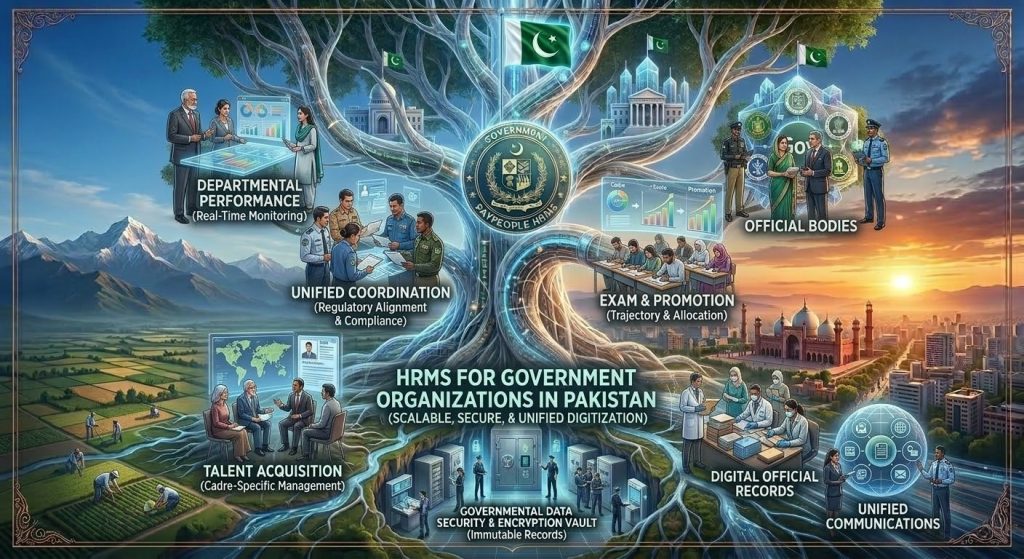
A Human Resource Management System (HRMS) is designed to manage workforce operations digitally.
For government organizations, HRMS can automate several important processes:
An HRMS ensures that employee data remains accurate and accessible across departments.
This system also helps organizations improve transparency and maintain better audit and compliance records.
Payroll processing is one of the most complex HR functions in the public sector.
Government salary structures often include multiple components, such as:
Manual payroll processing increases the risk of errors and delays.
A payroll management system for government employees in Pakistan automates salary calculations and generates digital payslips.
Benefits of payroll automation include:
Payroll systems also generate detailed reports that support audits and financial reviews.
Attendance tracking is essential for maintaining workforce accountability in government organizations.
Traditional attendance systems rely on manual registers, which can be inaccurate and time-consuming.
Modern HR software allows organizations to track attendance through:
Attendance data is automatically connected to payroll systems, ensuring accurate salary calculations.
Government employees are entitled to various types of leave, including:
Managing leave requests manually can create delays and confusion.
A leave management system allows employees to apply for leave online while HR managers review and approve requests digitally.
This improves transparency and ensures accurate leave records.
Government departments regularly recruit new employees for administrative roles, technical positions, and project-based jobs.
Recruitment software simplifies the hiring process by helping HR teams:
Digital recruitment systems also improve record-keeping and ensure a fair, structured hiring process.
Digital transformation is becoming a priority for many public sector institutions.
Governments worldwide are adopting digital technologies to improve administrative efficiency and service delivery.
In Pakistan, digital HR transformation can help government organizations:
HR software plays a critical role in this transformation by digitizing employee management processes.
Implementing HR software provides several long-term benefits for government institutions.
Automation reduces the time required for routine HR tasks.
HR departments can focus more on strategic workforce planning.
Digital HR systems reduce human errors in employee records, payroll calculations, and attendance tracking.
Accurate data improves reporting and decision-making.
HR software creates digital records for every HR process.
This helps organizations maintain transparency and improve accountability.
Public sector institutions often need HR reports for internal management and external audits.
HR software generates these reports instantly.
Many public organizations are adopting cloud-based HR systems to support their digital transformation strategies.
Cloud HR systems provide several advantages:
HR teams can access employee data and reports from multiple locations.
Cloud systems eliminate the need for expensive hardware or local servers.
Modern cloud platforms use advanced security measures to protect sensitive employee data.
When selecting HR software, government organizations should consider several important factors.
The system must protect sensitive employee data and follow government regulations.
The HR system should support large employee databases and multiple departments.
A provider with experience in Pakistani HR regulations can ensure smooth implementation.
Reliable technical support is essential for successful system adoption.
Modern HR platforms such as PayPeople help organizations automate HR operations through a centralized digital system.
PayPeople offers tools designed to simplify workforce management, including:
These tools allow organizations to manage large workforces efficiently while improving data transparency and administrative efficiency.
As digital transformation continues, HR technology will become increasingly important for government institutions.
Future HR systems are expected to include:
Public sector organizations that adopt HR technology early will gain significant operational advantages.
Public sector organizations in Pakistan face complex workforce management challenges.
Manual HR processes are no longer sufficient to handle large employee databases, complex payroll structures, and increasing compliance requirements.
HR software provides a modern solution by automating HR operations, improving transparency, and strengthening workforce management.
As government institutions continue their digital transformation journey, adopting HR software will play a critical role in improving efficiency and administrative performance.
HR software for public sector organizations is a digital system that helps government departments manage employee records, payroll, attendance, recruitment, and HR operations efficiently.
Government organizations need HRMS to automate administrative tasks, maintain accurate employee records, and improve transparency in workforce management.
Yes. Modern HR software platforms are designed to handle thousands of employees across multiple departments and locations.
Most modern HR systems include strong security features such as encryption, access controls, and secure cloud storage to protect sensitive employee data.
HR software automates HR tasks such as payroll processing, attendance tracking, and leave management, allowing organizations to operate more efficiently.